India’s quick commerce race is entering a more crowded phase.
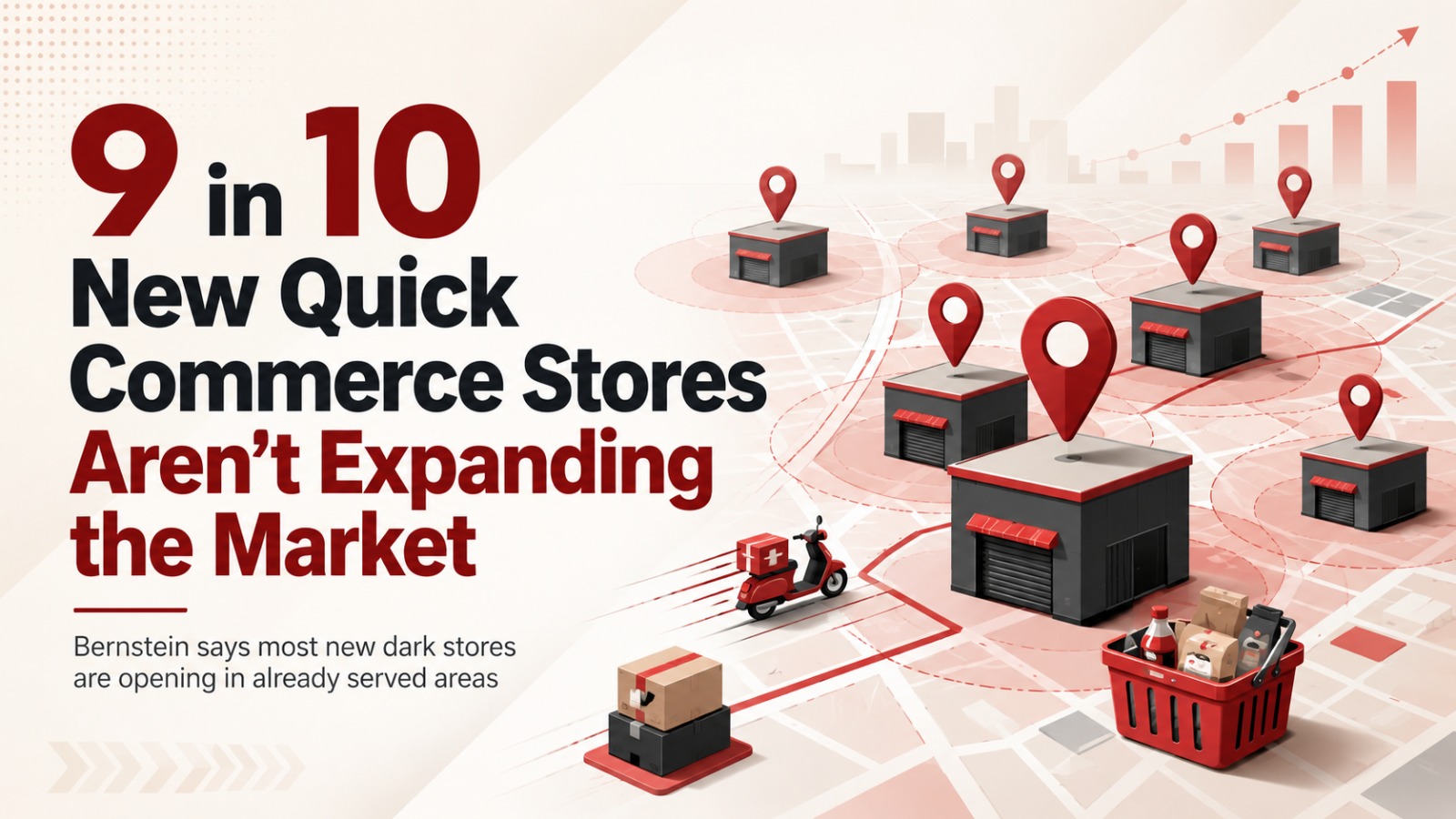
Blinkit, Swiggy Instamart, Zepto, Flipkart Minutes and Amazon Now now operate roughly 6,500 dark stores between them. About 900 of those stores were added during the April to June quarter, according to estimates by brokerage Bernstein.
Yet the industry’s geographic footprint expanded far more slowly. The number of unique serviceable pincodes rose by only about 150, reaching 2,722.
That means close to nine out of every 10 new dark stores were opened in pincodes where quick commerce services were already available.
The shift suggests that the sector’s growth is becoming less about reaching untouched markets and more about winning a larger share of demand in established ones. Companies are placing additional stores inside existing service zones to shorten delivery times, carry more products and handle higher order volumes.
More stores, but not many new markets
Dark stores are small fulfilment centres positioned close to consumers. Their location can influence delivery speed, inventory availability and the number of orders a platform can process within a neighbourhood.
For much of the sector’s early expansion, opening a dark store often meant adding a new locality or city to the network. The latest numbers indicate that this relationship is weakening.
Several platforms are now operating multiple dark stores within the same catchment areas. Blinkit, Instamart and Zepto continue to add capacity, while Flipkart Minutes and Amazon Now are scaling their own networks to compete with the established players.
Bernstein estimates that the five companies already cover nearly 68 percent of organised retail locations in India. With much of the readily accessible market now within reach, the opportunity for rapid expansion through new geography alone appears to be narrowing.
Metro markets may already have excess capacity
The pressure is most visible in large cities.
Bernstein estimates that the five leading platforms operate about 4,300 dark stores across metropolitan markets. It places the level of profitable capacity in those markets at roughly 3,600 stores.
On that assessment, metro networks already have around 700 more stores than the level that can be supported profitably.
This does not mean every additional store is unviable. Store economics can vary by neighbourhood, order density, basket size and operating efficiency. The broader numbers, however, suggest that companies may eventually have to review overlapping locations and close, relocate or consolidate weaker stores.
Bernstein expects some form of network rationalisation to become unavoidable as dark store density continues to rise.
Growth will depend more on existing customers
The industry’s next phase may also look different from the explosive expansion seen in its earlier years.
Bernstein estimates that quick commerce ended FY26 with an annualised net order value run rate of about $14 billion. It also believes the period of triple-digit growth is over.
Future gains are expected to come increasingly from customers placing orders more often, buying larger baskets and choosing from wider product ranges. Geographic expansion will remain part of the strategy, but it may no longer be the main driver.
That change raises the importance of execution. Companies will need to improve inventory planning, product availability and delivery efficiency while keeping fulfilment costs under control.
Adding stores can increase capacity, but it can also raise rent, staffing and operating expenses. In heavily served neighbourhoods, a new location may divide existing order volumes instead of creating entirely new demand.
Companies are taking different routes
The leading platforms are not following identical expansion strategies.
Bernstein said 75 percent of Blinkit’s latest store additions were outside metropolitan cities, reflecting a stronger push into Tier-II and Tier-III markets.
Zepto, in contrast, continues to concentrate on dense urban clusters, where higher order volumes can support closely spaced fulfilment centres.
Flipkart Minutes and Amazon Now have contributed a significant share of recent store openings as they work to narrow the network gap with the incumbent platforms.
These differences could shape the next stage of competition. Companies expanding into smaller cities may find more room to build new demand, while those focusing on major urban centres will have to compete more intensely for customers who already have several quick commerce options.
The market still has room, but expansion will be selective
Bernstein estimates that India’s quick commerce market could profitably support about 8,500 dark stores across nearly 3,800 pincodes by FY30. It places the serviceable addressable market at approximately $35 billion.
Compared with the present network of around 6,500 stores, that projection leaves space for further expansion. The opportunity, however, is unlikely to be distributed evenly.
The strongest locations will be those where demand, order frequency and basket sizes can justify the cost of running additional fulfilment capacity. In saturated neighbourhoods, opening more stores may no longer be enough to produce sustainable growth.
India’s quick commerce contest is therefore moving beyond the race to build the largest network. The tougher test now is whether those networks can generate enough orders, margins and customer loyalty to support the capacity already being created.
Also Read: Medial shuts down operations after building a startup network of more than 500,000 users