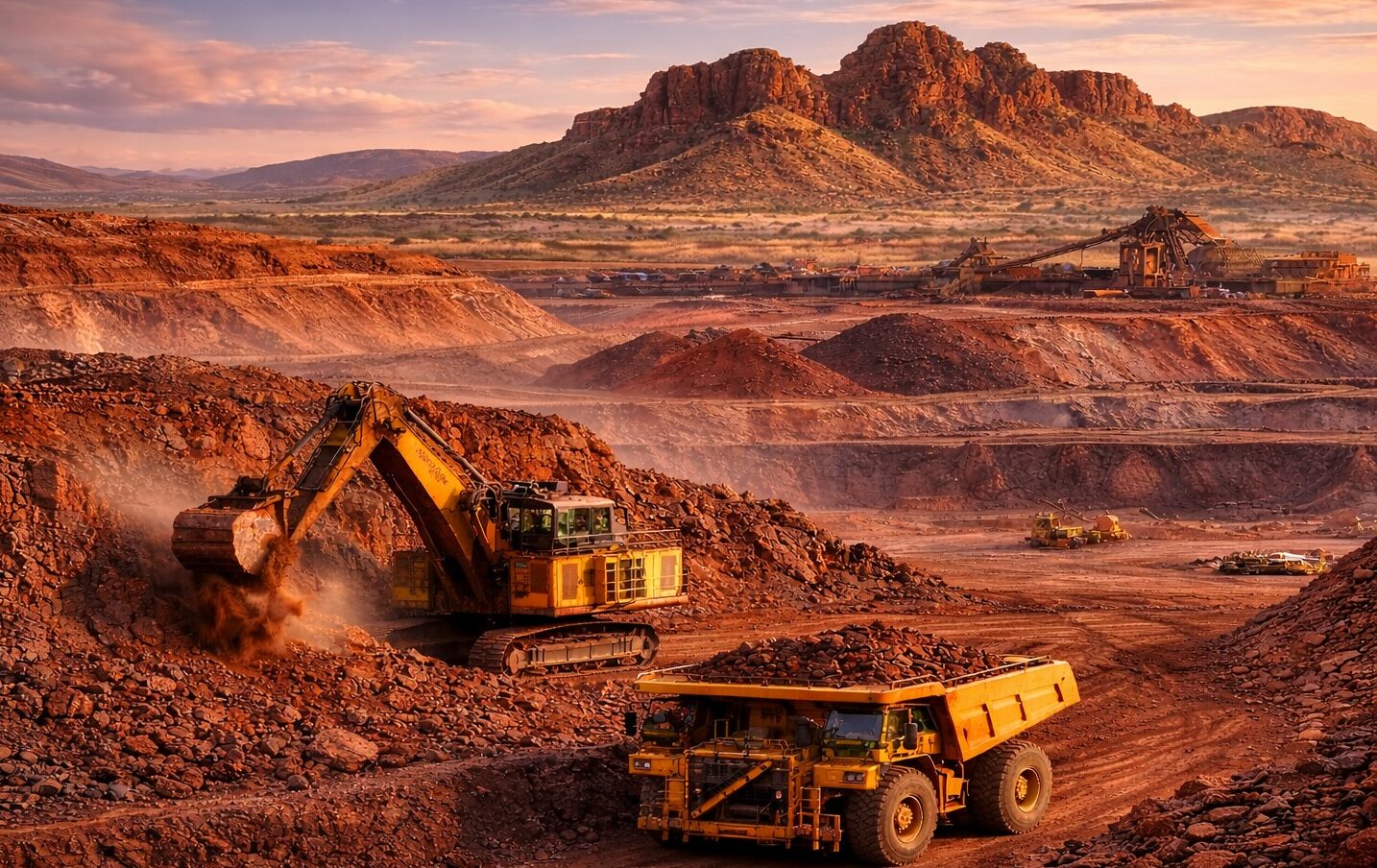
Deep beneath the rust-red landscapes of Western Australia, scientists have uncovered evidence that is changing how the world understands one of its most important natural resources. A new geological study shows that the largest known iron ore system on Earth is far younger than experts once believed, forcing a rethink of long-accepted theories about how such massive deposits form.
For decades, the iron-rich rocks of the Hamersley Basin have been central to Australia’s mining industry and global steel supply. Until now, geologists thought these ores formed more than two billion years ago, shaped mainly by early changes in Earth’s atmosphere. The latest findings tell a very different story, one driven by deep tectonic forces rather than ancient oxygen levels.
Challenging a Long-Held Geological Timeline
Iron ore is not just another mineral. It has powered industrial growth, shaped economies, and influenced global trade for more than a century. Because of its importance, the science behind how these deposits formed has been studied extensively and widely accepted.
Earlier models placed the formation of the Hamersley Basin’s high-grade iron ores between 2.2 and 2.0 billion years ago, during the Great Oxidation Event, a period when oxygen levels in Earth’s atmosphere rose sharply. This link between atmospheric change and iron enrichment became a cornerstone of geology textbooks.
The new research overturns that assumption.
Also Read: Doping Record Raises Fresh Concerns for India’s Olympic Ambitions
Dating the Iron Itself
In a study published in the Proceedings of the National Academy of Sciences, researchers used a more direct and precise method to determine the age of the iron ore. Instead of dating surrounding rocks or related minerals, the team dated hematite, the main iron-bearing mineral in the deposit.
Using in situ uranium-lead isotopic dating, they found that the iron ore formed much later, between 1.4 and 1.1 billion years ago. This age range does not overlap with earlier estimates and was confirmed across several major ore bodies in the Hamersley Basin.
The results clearly showed that previously dated phosphate minerals could not be linked to the actual crystallisation of the iron ore. This direct dating approach marked a major shift in how scientists study large mineral systems.
A Story Written by Moving Continents
The revised timeline places the formation of the iron ore long after major oxygenation events. Instead, researchers connect it to powerful tectonic processes linked to the breakup of the ancient Columbia supercontinent.
As continents slowly pulled apart, deep parts of Earth’s crust heated, deformed, and cracked. These changes allowed mineral-rich fluids to move through the crust, transforming older banded iron formations into the high-grade ores seen today. In many places, iron concentrations rose above 60 percent, creating deposits of exceptional quality.
This explanation reframes iron ore formation as a result of Earth’s internal dynamics rather than early biological or atmospheric changes. The isotopic analysis was led by geologist Liam Courtney-Davies, who carried out the work while affiliated with Curtin University and is now based at the University of Colorado Boulder.
New Directions for Mineral Exploration
By linking iron enrichment to supercontinent cycles, the findings open new possibilities for mineral exploration around the world. Curtin University has highlighted the discovery as a potential turning point, suggesting that regions with similar deep-crustal histories could host undiscovered iron ore systems.
Parts of South Africa, Canada, and Brazil share comparable geological backgrounds and may benefit from renewed exploration guided by this updated model.
A Deposit of Enormous Scale
The Hamersley iron system is estimated to contain about 55 billion metric tonnes of ore, making it the largest ever recorded. At current prices, its total value exceeds $5.7 trillion. Despite these staggering numbers, researchers stress that the scientific impact of the discovery matters more than its commercial value.
The Hamersley Basin already plays a central role in Australia’s mining strength. According to Geoscience Australia, the country accounted for more than 35 percent of global iron ore exports in 2022.
Questions That Still Remain
While the younger phase of iron formation is now firmly dated, older mineralisation events from the Palaeoproterozoic era remain difficult to assess. These earlier systems may have been altered or erased by later tectonic activity, and their contribution to iron enrichment is still unclear.
Future studies will focus on understanding how heat, fluid flow, and structural changes shaped Earth’s crust between 1.4 and 1.1 billion years ago. The advanced analytical techniques used in this research are expected to be applied to other major ore regions with uncertain histories.
By refining the geological timeline of one of the world’s most important mineral regions, this discovery offers a clearer view of how ancient continental movements continue to influence the resources modern societies depend on today.