India’s startup economy is mature enough to offer founders two distinct capital routes: angel investors and venture capitalists. Both trade equity for cash, but they differ in timing, cheque size, and the level of influence they expect.
In a more selective 2025 market, matching the type of capital to the stage of the company has become decisive. Angels tend to ignite the first spark; VCs scale proven engines. The best choice balances speed, control, and the founder’s growth horizon.
Angel investors are high-net-worth individuals who back very early ideas, often at pre-seed or seed when product–market fit is still forming. Typical cheques range from about ₹10 lakh to ₹2 crore, with syndicates occasionally stretching to ₹3-5 crore.
Because angels invest personal capital, diligence is faster and relationship-driven. Many bring hands-on mentorship and sector networks, though involvement varies by individual. For a first institutional-grade milestone, angels can be the most time-efficient fuel.
Venture capitalists pool institutional money and generally step in once there’s traction and a clear path to scale. Cheque sizes jump sharply, commonly ₹10 crore into the hundreds of crores for growth rounds, paired with structured governance and board oversight.
VC processes are intentionally rigorous, with multi-layered diligence and investment committee gates, trading speed for risk control . The upside is multi-round support, brand credibility, and access to strategic networks aligned to ambitious expansion.
Control and timelines are where philosophies diverge most. Angels seldom insist on operational control and typically keep a light touch, preserving founder autonomy. VC involvement is board-level and strategic by design, influencing major decisions and setting disciplined execution cadence.
Angel investors and venture capitalists serve different startup needs. Angels fuel early-stage ideas with agility and mentorship, while VCs drive scale with structured capital. “Funding isn’t just money, it’s alignment of vision and pace,” says Nikhil Singh, founder of BreezyScroll. In 2025’s cautious market, founders must match capital with stage, control, and long-term goals.
Exit horizons also differ in tone: angel capital is more flexible, while VC funds commonly target outcomes within roughly five to ten years to serve their LP mandates . Founders should pick partners whose governance style fits their own.
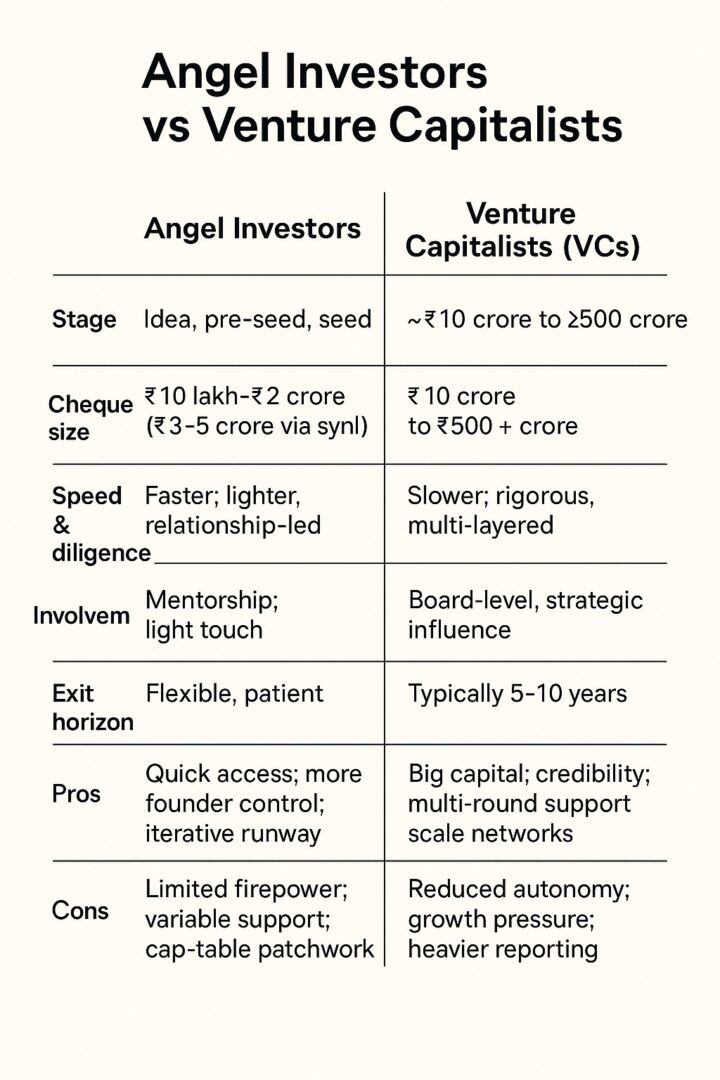
Below is a crisp side-by-side to ground the trade-offs. It distills when each route shines, and what founders give up or gain in return. Use it as a pre-term-sheet checklist before you optimize for valuation. In a cautious market, alignment on speed, decision rights, and milestone expectations matters as much as money. Choose the financing that matches the stage you’re actually in, not the stage you hope to be in next quarter.
Comparison Chart: Angel Investors vs Venture Capitalists
For early-stage founders validating problem, solution fit, angels minimize process drag and maximize learning per rupee. As metrics firm up and expansion demands heavier capex or national distribution, VC becomes the logical accelerator.
Many Indian startups sequence both: angels to reach institutional readiness, then VCs to professionalize and scale. The through-line is fit, capital that respects your stage, strengthens governance at the right time, and aligns with your ambition.
Also Read: Why Bollywood Stars Are Turning Startup Investors?