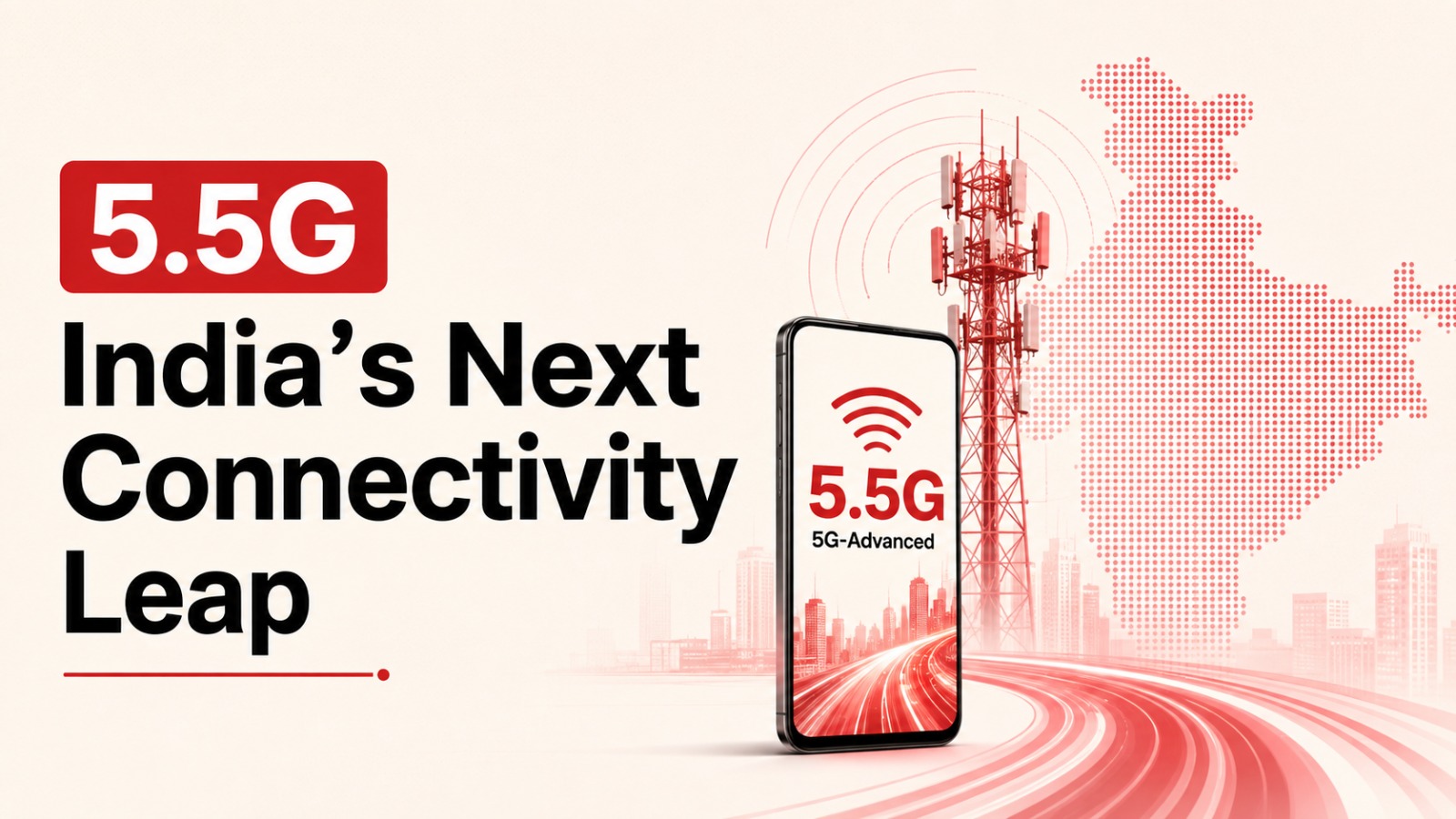
India is preparing for the next phase of mobile connectivity with the rollout of 5.5G, also known as 5G-Advanced. The technology is designed as an evolution of existing 5G networks, offering faster speeds, lower latency, and improved network efficiency while serving as an important stepping stone toward the future adoption of 6G.
Unlike the transition from 4G to 5G, 5.5G does not require an entirely new network architecture. Instead, it enhances the capabilities of current 5G infrastructure through advanced technologies such as artificial intelligence-powered network management, improved antenna systems, and more efficient spectrum utilization. These upgrades are expected to help telecom operators meet the rising demand for high-speed mobile data and support an increasing number of connected devices.
A Major Upgrade to Existing 5G Networks
5.5G builds on the foundation established by 5G, introducing significant improvements in network performance without replacing the existing infrastructure. The technology is designed to improve download and upload speeds, reduce latency, and deliver more stable connections across a wide range of use cases.
Industry experts consider 5.5G an important bridge between today’s 5G services and the next generation of wireless communication, 6G. By strengthening current networks, the technology aims to support future digital applications while making better use of existing telecom investments.
Faster Speeds and Better Network Performance
One of the most notable advantages of 5.5G is its potential to deliver much higher data speeds than conventional 5G. While current 5G networks generally offer peak download speeds of around 1Gbps, 5.5G is expected to increase peak speeds to as much as 10Gbps under suitable network conditions.
Beyond speed improvements, the technology also focuses on reducing latency and improving upload performance. Lower latency enables quicker communication between devices and networks, making digital interactions smoother and more responsive.
Another important feature is AI-driven network management. Artificial intelligence can help telecom operators optimize network resources, manage traffic efficiently, and maintain stable performance even during periods of heavy data usage. This approach is expected to improve the overall experience for consumers while supporting a larger number of connected devices simultaneously.
Also Read: FSSAI Bans 10 Liquor Products, Including Old Monk Variants, McDowell’s No. 1 and Antiquity Blue
Compatible Devices Will Be Essential
Although 5.5G will operate on upgraded 5G infrastructure, not every existing 5G smartphone will be able to access all of its enhanced capabilities.
To fully benefit from the technology, users will require smartphones equipped with advanced modem hardware, including devices powered by Qualcomm’s Snapdragon 8 Gen 3 platform or MediaTek’s Dimensity 9300 series chipsets and newer compatible platforms.
Some recently launched flagship smartphones may receive 5.5G support through software updates, depending on manufacturer compatibility. However, many older 5G devices are unlikely to support every enhancement introduced with 5.5G because of hardware limitations.
Users with compatible smartphones are generally advised to keep their network settings on “5G (Auto)” so that the device can automatically connect to upgraded networks when they become available.
Enhanced Experiences Across Digital Services
The improvements offered by 5.5G are expected to benefit a wide range of consumer and enterprise applications. Higher bandwidth and lower latency can significantly improve online gaming and cloud gaming by reducing delays and providing more consistent performance.
The technology is also expected to enhance 4K and 8K live streaming by supporting faster and more stable data transmission. In addition, applications based on augmented reality (AR) and virtual reality (VR) can benefit from quicker network responses, making immersive digital experiences more seamless.
Another key advantage of 5.5G is its ability to efficiently support a greater density of connected devices without compromising network quality. This capability will become increasingly important as connected technologies continue to expand across homes, businesses, and public infrastructure.
Indian Telecom Operators Prepare for the Next Phase
Telecom operators in India, including Airtel and Jio, are introducing 5.5G capabilities in phases as part of their long-term network evolution. The gradual deployment is intended to strengthen current mobile services while preparing networks for future technological advancements.
As 5.5G adoption expands, users with compatible devices can expect improved mobile experiences across entertainment, communication, and emerging digital applications. At the same time, the technology lays the foundation for future innovations that will eventually shape the transition toward the 6G era, making it a significant milestone in India’s evolving telecommunications landscape.
Also Read: iPhone 18 Pro Max Rumours Point to Bigger Battery, A20 Pro Chip and Major Camera Upgrade