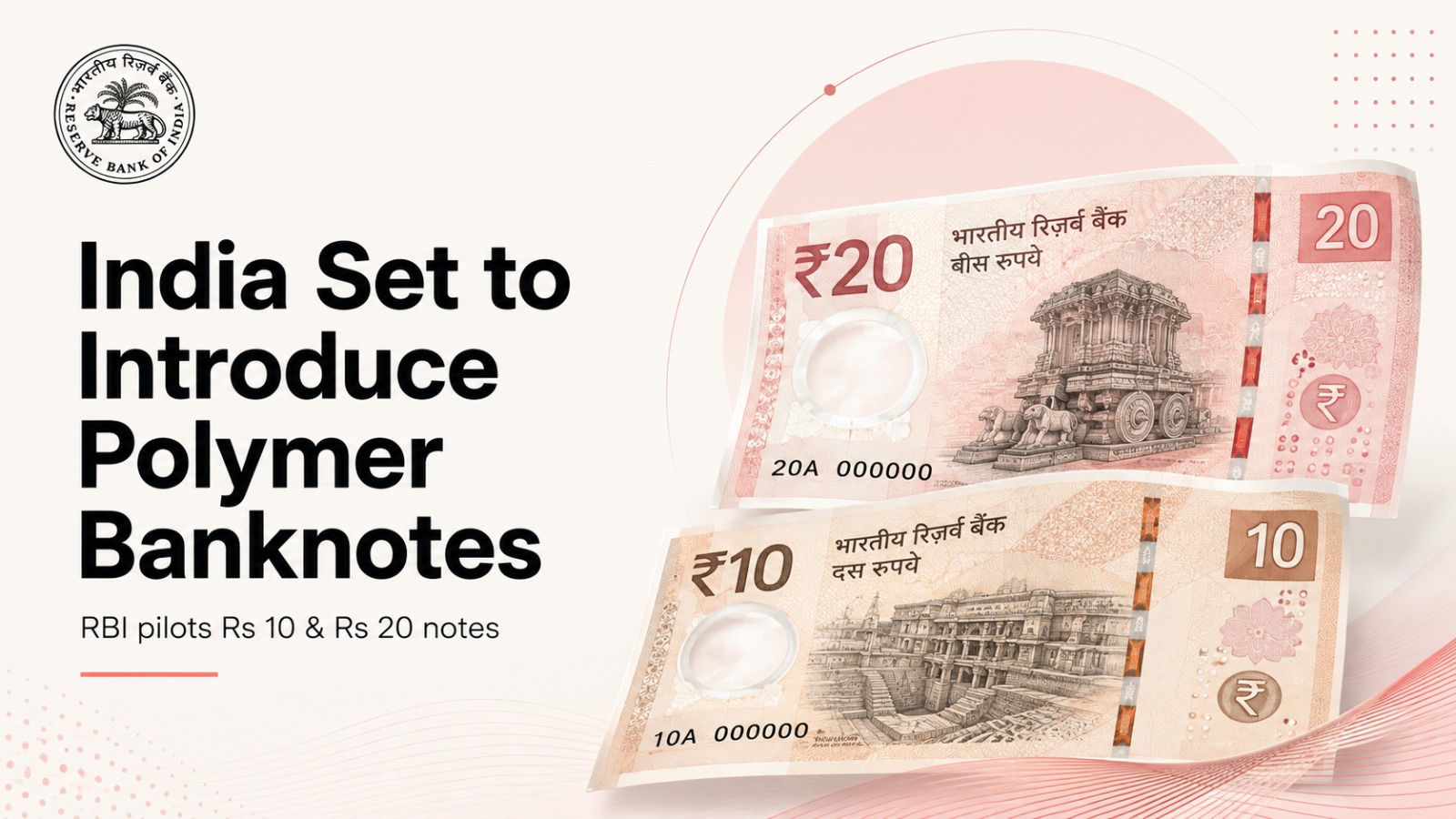
India is set to introduce its first polymer banknotes at the beginning of the next financial year, subject to the successful completion of an ongoing pilot project, Reserve Bank of India (RBI) Governor Sanjay Malhotra announced during the post-Monetary Policy Committee press conference.
The RBI is currently testing polymer banknotes under a pilot programme to evaluate their performance in Indian conditions before deciding on a wider rollout. According to the governor, the central bank is targeting the start of the next financial year for the initial circulation of these notes, provided the project progresses as planned.
The government has already authorised the RBI to print up to 2 billion polymer banknotes for field trials. The plan includes 1 billion notes each in the Rs 10 and Rs 20 denominations. At present, there is no proposal to replace paper currency entirely. Both polymer and paper banknotes will continue to circulate as legal tender.
Focus on Longer-Lasting Currency
Explaining the purpose of the initiative, Malhotra said the introduction of polymer notes is primarily aimed at improving the durability of currency, particularly lower denomination notes that change hands frequently and wear out more quickly.
He noted that polymer banknotes have been in use in several countries for more than three decades and have demonstrated a significantly longer lifespan than conventional paper notes. According to the RBI governor, polymer notes generally last two to four times longer than paper-based currency, making them better suited for denominations that experience high circulation.
He also said the move is intended to strengthen India’s currency management capacity as the country’s economic needs continue to grow.
Also Read: iPhone 18 Pro Max Rumours Point to Bigger Battery, A20 Pro Chip and Major Camera Upgrade
Pilot to Assess Performance in Indian Conditions
The RBI has emphasised that the project remains in its testing phase. The central bank will assess how polymer banknotes perform under India’s diverse climatic conditions and existing currency-handling infrastructure before taking a decision on expanding their use.
The findings from the pilot project will determine whether the initiative is scaled up in its current form or modified based on operational experience.
Global Tender Issued for Polymer Substrates
As part of the programme, the RBI’s currency-printing subsidiary, Bharatiya Reserve Bank Note Mudran Pvt. Ltd. (BRBNMPL), has issued a global tender seeking suppliers of polymer substrate sheets equipped with advanced security features.
The tender includes strict eligibility requirements. Interested suppliers must obtain government security clearance, comply with restrictions related to operations and raw materials linked to China and Pakistan, and demonstrate previous experience in supplying polymer banknote substrates to central banks.
These measures are intended to ensure the security and reliability of materials used for India’s currency production.
Rising Cost of Currency Management
The move towards polymer notes comes as India continues to deal with the challenges of replacing worn-out currency.
According to official data cited in reports, nearly Rs 50 trillion worth of soiled currency has been withdrawn from circulation over the past decade. Annual expenditure on currency security features is estimated at around Rs 5,000 crore. Reports also indicate that since FY2017, the RBI has withdrawn approximately 71 soiled notes from circulation for every 100 fresh notes issued.
The RBI is also looking at technologies that can strengthen protection against counterfeit currency while improving the overall efficiency of currency management.
Government Highlights Benefits of Polymer Notes
Earlier, Minister of State for Finance Pankaj Chaudhary informed the Lok Sabha that international studies show polymer banknotes have a significantly longer lifespan than paper banknotes. He also stated that the introduction of polymer currency in India is currently at a preliminary stage.
Polymer banknotes are widely recognised for offering several advantages over traditional paper currency. These include enhanced durability, stronger security features, lower susceptibility to counterfeiting, reduced lifetime replacement costs and a smaller environmental footprint due to less frequent replacement.
International Experience Supports the Shift
Many countries have already adopted polymer banknotes and reported positive outcomes.
Globally, polymer currency is estimated to remain in circulation for around 2.5 times longer than conventional paper notes. In the United Kingdom, a study found that the average lifespan of a £5 note increased from about 1.9 years to 4.8 years after the introduction of polymer notes. Canada also reported a substantial increase in the average lifespan of its banknotes following the transition to polymer currency.
The Bank of England has stated in its published studies and reports that the adoption of polymer banknotes has contributed to a significant reduction in counterfeiting, reinforcing their reputation as a more secure and durable alternative to paper currency.
If the RBI’s pilot project delivers the expected results, India could begin circulating its first polymer banknotes in the Rs 10 and Rs 20 denominations at the start of the next financial year, marking a significant step in the country’s currency modernisation efforts.
Also Read: What is Apple’s new leasing policy in the US, and how does Apple Upgrade work?