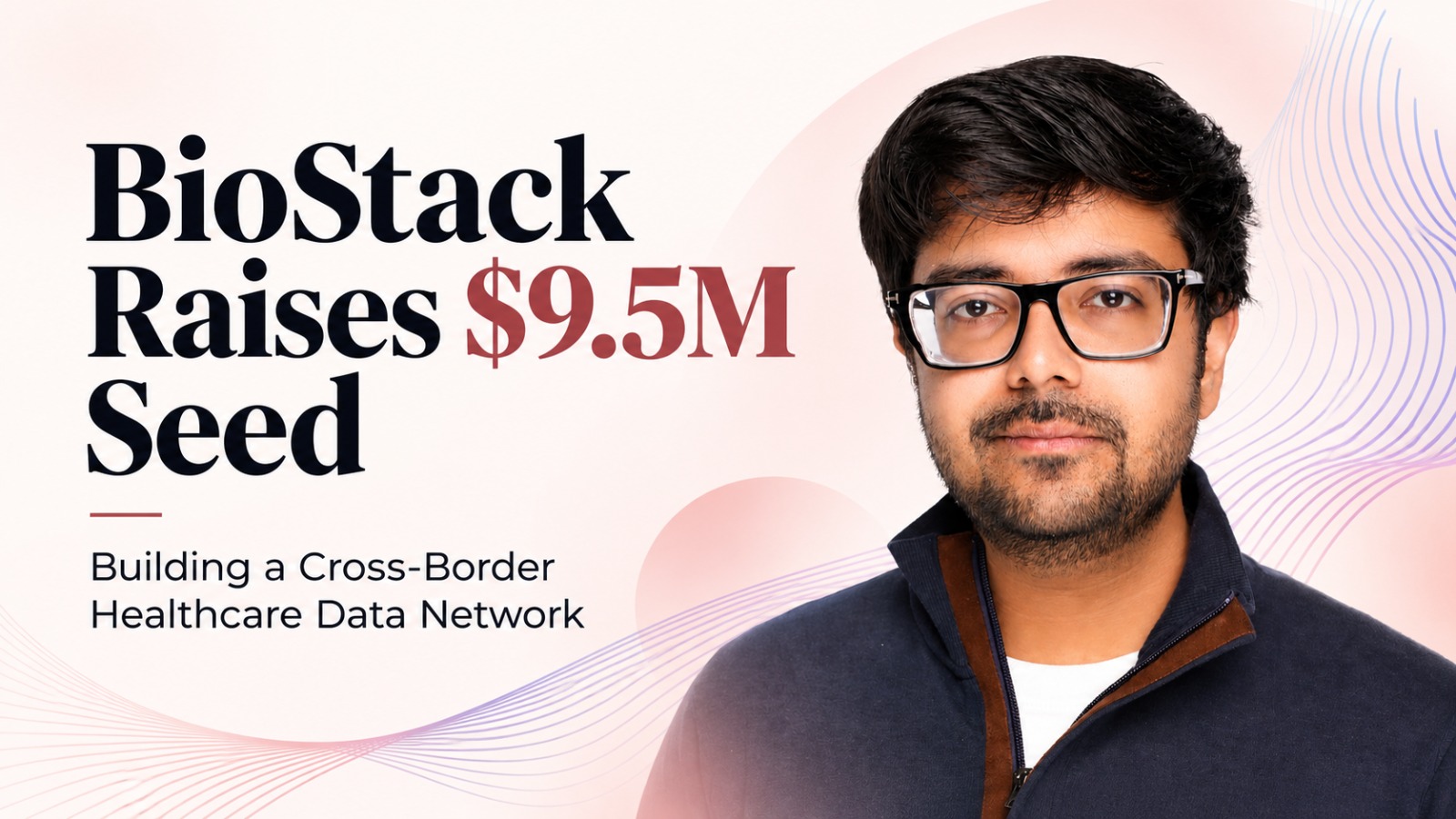
Healthcare technology startup BioStack has raised $9.5 million in a seed funding round led by Peak XV, with participation from Afore Capital, DCVC, Emerson Collective, SV Angel, Verdict Capital, Streamlined Ventures and Y Combinator.
The company plans to use the fresh capital to expand internationally, develop its technology and strengthen its engineering and research teams. Its focus is on bringing fragmented medical information together to create connected patient records that can support medical research and the development of healthcare artificial intelligence (AI) models.
BioStack Is Building a Healthcare Data Network Across Four Countries
Founded by Sanat Mishra, BioStack is developing a healthcare data infrastructure network spanning the United States, India, Brazil and Argentina. The company says the network provides access to more than 100 million de-identified patient records.
Medical information is often spread across different systems, including hospital records, laboratory reports, imaging scans, prescriptions and treatment histories. BioStack connects these separate sources to build longitudinal patient records, allowing medical information to be viewed across different stages of a patient’s healthcare journey.
These records bring together clinical notes, laboratory results, medical imaging, medication details, treatment histories and patient outcomes. The aim is to create a more connected view of patient information that can be used for research and analysis.
From Medical Records to Healthcare AI Training Data
Beyond connecting clinical information, BioStack develops proprietary datasets from de-identified medical data. These datasets are intended to support medical research, drug development and the training and evaluation of healthcare AI models.
The company’s platform is designed for several research applications, including disease modelling, biomarker discovery, patient stratification and treatment response analysis.
BioStack says it has already aggregated several hundred thousand X-rays, MRI and CT scans, alongside millions of telehealth audio transcripts and other clinical records. The collection gives the company access to different forms of medical information, extending beyond conventional text-based patient records.
For healthcare AI developers and researchers, the availability of varied clinical data can be important when building and assessing models for medical applications. BioStack’s approach centres on organising such information into datasets that can be used for specific research and development needs.
Privacy Protocols Remain Part of the Platform
BioStack’s infrastructure also incorporates workflows tailored to individual healthcare providers and their data privacy protocols.
This allows the platform to account for differences in how healthcare organisations manage their information. The company’s use of de-identified patient records is central to its data infrastructure model, although the details of its individual provider arrangements have not been disclosed in the information available.
The platform brings together data integration and dataset development, with a focus on making fragmented clinical information more useful for research and healthcare technology development.
BioStack Is Also Working on a Cancer Vaccine Programme in India
In India, BioStack is helping connect cancer patients with an investigational cancer vaccine programme. This work adds a patient-facing element to its broader focus on healthcare data infrastructure.
The company has not disclosed further details about the programme, including its scale or the number of patients involved.
With its new seed funding, BioStack plans to continue developing its technology, expand its international presence and grow its engineering and research teams. Its progress will depend on its ability to bring together clinical information across healthcare systems while supporting the research and AI applications for which its datasets are designed.
The funding round gives BioStack additional resources to pursue that strategy across its four-country network.