

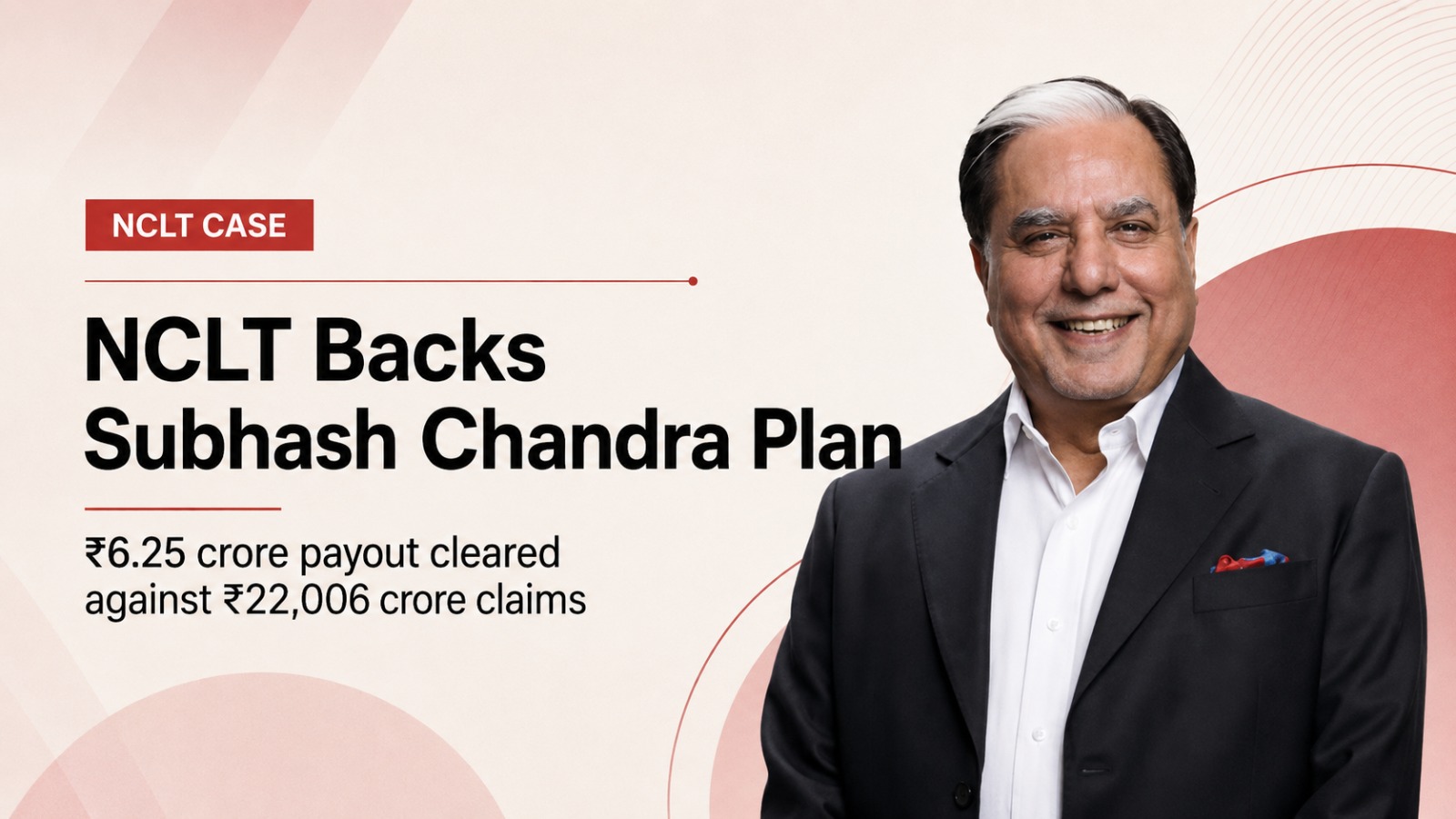
A third NCLT member has backed Subhash Chandra‘s personal insolvency repayment plan after an earlier split verdict. The proposal sets aside ₹6.25 crore for creditors against admitted claims of about ₹22,006.57 crore, but the creditor list must first be revised and the original bench still has to issue the formal order.
The headline number in Subhash Chandra’s insolvency case is difficult to ignore: creditors have admitted claims of approximately ₹22,006.57 crore, while the repayment plan provides ₹6.25 crore for distribution among them.
Another ₹25 lakh is earmarked for insolvency resolution costs, taking the total amount under the proposal to ₹6.5 crore. On the admitted claims currently on record, the recovery works out to roughly 0.03 per cent, implying a haircut of about 99.97 per cent.
But describing the case simply as an NCLT “waiver” misses an important part of what has actually happened.
This is a personal insolvency repayment plan considered under the Insolvency and Bankruptcy Code, not a straightforward order in which the tribunal has independently decided to erase more than ₹22,000 crore of debt. Creditors holding 80.81 per cent of the voting share supported the plan, and the decisive third member of the National Company Law Tribunal backed its approval after the original two-member bench delivered conflicting opinions.
There is another qualification that matters. The case is now to go back before the original division bench for the formal order giving effect to the majority view.
So what led to such an unusual outcome, why did lenders object, and why did the majority still favour the repayment plan?
The case began with a ₹170 crore loan guarantee
The insolvency proceedings trace back to a loan that was far smaller than the total claims now sitting in the case.
Subhash Chandra had given a personal guarantee for a ₹170 crore loan extended to Vivek Infracon. After the loan turned bad, Indiabulls Housing Finance Limited initiated proceedings against him under Section 95 of the Insolvency and Bankruptcy Code in 2022. Indiabulls Housing Finance is now known as Sammaan Capital. The personal insolvency plea was admitted in 2024.
This distinction is worth keeping clear. The ₹170 crore figure relates to the loan and personal guarantee that triggered the proceedings. The ₹22,006.57 crore figure represents the admitted claims that subsequently came to be recorded in the insolvency process.
The proceedings also had an earlier legal detour. Chandra had challenged the NCLT’s authority in relation to individual insolvency. The dispute went to the NCLAT and was closed after Indiabulls indicated that a settlement had been reached. That settlement did not materialise. Following the Supreme Court’s November 2023 decision upholding the relevant provisions of the IBC, the insolvency proceedings were revived in February 2024.
Why the NCLT bench was divided
The repayment plan did not receive a straightforward approval from the tribunal.
Judicial Member Ashok Kumar Bhardwaj favoured approving it. Technical Member Reena Sinha Puri took the opposite view, finding serious legal and procedural defects in the proposal.
Because the two members disagreed, the disputed points were referred to a third member. Judicial Member Nilesh Sharma was brought in to resolve the difference. On August 25, Sharma sided with the view favouring approval of the repayment plan under Section 114 of the IBC.
That created the majority position on which the case is now proceeding.
The unusual detail: claims involving 1,260 individuals must be removed
One of the most consequential findings in the third member’s ruling concerns the creditor list itself.
Sharma directed the Resolution Professional to exclude claims submitted by Anil Kumar on behalf of 960 individuals and by Sunil Jain on behalf of another 300 individuals. Those claims, according to the ruling, had been admitted without supporting documents.
That means claims connected to 1,260 individuals are to be taken out before a revised creditor list is prepared.
The ₹6.25 crore earmarked for creditors will then be redistributed among the remaining eligible creditors. As a result, the amount received by individual creditors could change even though the pool of ₹6.25 crore remains the central distribution amount under the plan.
Sharma treated the admission of those unsupported claims as a lapse by the Resolution Professional, but not one serious enough to invalidate the repayment plan as a whole.
This is why focusing only on the ₹6.5 crore versus ₹22,006.57 crore comparison does not tell the full story. The ruling also changes who is entitled to participate in the eventual distribution.
Why LIC Housing Finance opposed the plan
Several financial institutions challenged the repayment proposal, with LIC Housing Finance among the prominent objectors.
LIC Housing Finance had an admitted claim of ₹1,322.39 crore. Under the proposal, it was set to receive about ₹38.09 lakh, or approximately 0.028 per cent of its admitted dues.
The lender argued that such a small recovery could not justify approval of the plan. Objecting creditors also questioned whether the ₹6.5 crore figure was sufficiently certain, pointing out that it had been described as indicative.
Their objections went beyond the size of the payout.
They questioned the verification of claims and raised concerns over entities they alleged were associated with Chandra participating in the voting process. They also relied on net-worth certificates purportedly showing Chandra’s net worth at about ₹45,888 crore in 2017 and ₹40,562 crore in 2018. His present net worth was stated in the proceedings to be around ₹31.79 crore.
Those figures formed part of the creditors’ case against accepting such a steep reduction in recoverable dues. They should, however, be read as figures relied upon in the objections, rather than as an independent determination of Chandra’s current wealth.
Five entities were not established as Chandra’s ‘associates’
Another important dispute centred on voting rights.
The objecting creditors sought to challenge the participation of five entities:
Veena Investments Private Limited, Direct Media Distribution Ventures Private Limited, World Crest Advisors LLP, Lemonade Capital Advisors LLP and Corpcall Capital Advisors LLP.
The third member did not accept the argument that these entities had been established as Chandra’s “associates” within the meaning of Section 79(2)(g) of the IBC.
The ruling found that the statutory definition could not be stretched simply on allegations of family, business or commercial proximity. Their votes therefore could not be excluded on that basis.
That finding mattered because the repayment plan had already secured support from creditors representing 80.81 per cent of the voting share, while the creditors opposing it together represented less than 20 per cent.
Why the tiny recovery did not automatically sink the plan
The scale of the haircut was central to the lenders’ objections, but it was not the only question the tribunal had to answer.
The majority view was that the NCLT could not simply replace the commercial decision taken by the required majority of creditors with its own view of what constituted an acceptable settlement.
The tribunal relied on the valuation material before it in concluding that rejecting the proposal was unlikely to place dissenting creditors in a better position. It also considered the possibility that a failed repayment plan could lead to bankruptcy, which could further affect prospects for recovery.
In other words, the legal question was not simply whether ₹6.25 crore looked small when placed beside ₹22,006.57 crore.
The tribunal also had to consider the statutory voting process, the commercial judgment exercised by the creditor majority, the evidence supporting objections, the valuation available in the proceedings and whether rejection of the plan could realistically produce a better result.
That is the central reason the case should not be reduced to the phrase “NCLT waived ₹22,000 crore”.
What happens to creditors who voted against the plan?
The third member also concluded that an approved repayment plan would bind creditors who opposed it or abstained from voting.
That conclusion flows from Section 115 of the IBC, according to the ruling.
For dissenting lenders, that is particularly significant. Once the plan receives the formal order in accordance with the majority decision, opposing the proposal does not by itself allow a creditor to remain outside its operation.
The creditor list, however, must first reflect the direction concerning unsupported claims, with the ₹6.25 crore distribution recalculated among those who remain eligible.
Is the ₹22,006 crore debt already ‘written off’?
That description would be too loose at the present stage.
What the available record establishes is that the third NCLT member has favoured approval of a repayment plan providing ₹6.25 crore to creditors against admitted claims of approximately ₹22,006.57 crore, along with ₹25 lakh for process costs.
The ruling gives the approval side a majority after the earlier split decision.
But procedurally, the matter is still to be placed before the original division bench for the formal order in accordance with the majority opinion under Section 419(5) of the Companies Act, 2013.
Calling it a 99.97 per cent haircut under a personal insolvency repayment plan is therefore more precise than presenting it simply as a ₹22,000 crore waiver granted by the NCLT.
Where Vijay Mallya enters the story
The size of the proposed haircut also prompted a public reaction from Vijay Mallya.
In a post on X, Mallya contrasted Chandra’s case with his own and claimed that banks and the government had acknowledged recovering ₹14,100 crore from him against what he described as a judgment debt of ₹6,203 crore. He used the comparison to question whether debt resolution was being applied consistently.
Those recovery numbers are Mallya’s stated claims in his post. They are not findings made by the NCLT in Chandra’s insolvency proceeding and do not form part of the tribunal’s reasoning in approving the repayment plan.
The larger takeaway from the Subhash Chandra NCLT case
The most eye-catching figure will remain the gap between ₹22,006.57 crore in admitted claims and ₹6.25 crore proposed for creditors.
Yet the case is ultimately about more than a percentage haircut.
It is about how India’s personal insolvency framework treats a repayment proposal supported by a statutory creditor majority when other lenders believe the recovery is unacceptably low. It also shows how disputes over claim verification, creditor voting, alleged related parties and the potential outcome of bankruptcy can shape the tribunal’s decision.
For now, three facts stand out.
Creditors holding 80.81 per cent of the voting share backed the repayment plan. The third NCLT member has sided with approval after an earlier split verdict. And before the ₹6.25 crore is distributed, claims filed on behalf of 1,260 individuals without supporting documents are to be removed and the eligible creditor pool recalculated.
The next procedural step is the formal order from the original NCLT bench giving effect to that majority view.
Also Read: Subhash Chandra: The Media Mogul Who Revolutionized Indian Television
















