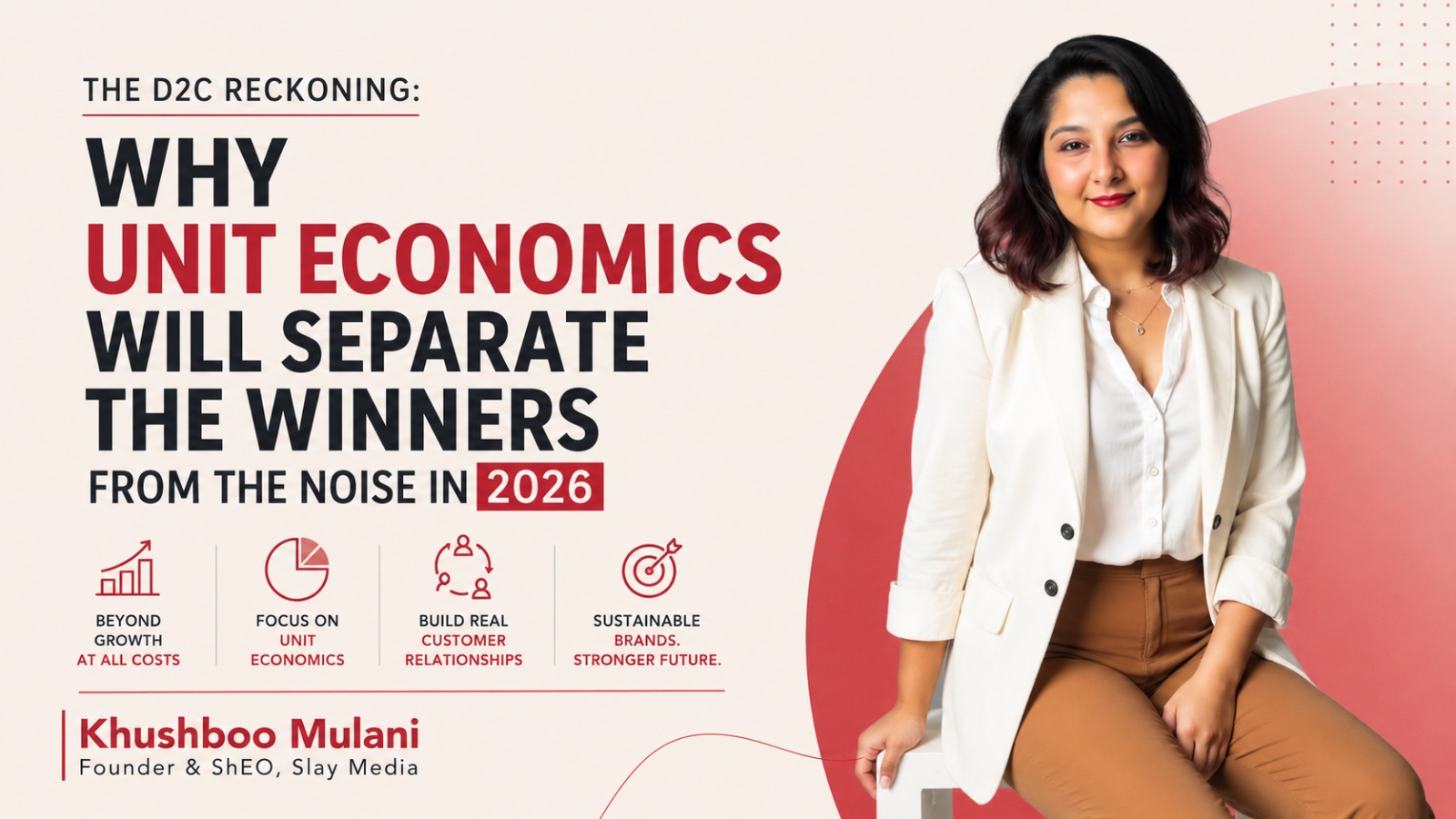
By Khushboo Mulani,Founder & ShEO, Slay Media
The Indian D2C space has had a remarkable run. The years between 2019 and 2023 saw unrestricted venture capital funding, while businesses considered customer acquisition costs to be unimportant measurement tools, and businesses adopted a “growth at all costs” approach as their primary operational principle. Brands achieved rapid growth while their investors provided funds at an even faster rate, which led to their delay in achieving profitability because they expected upcoming funding rounds to happen shortly. This period has reached its natural conclusion.
The industry received its essential reality check through the events that took place during 2025. The funding sources stopped providing financial support. Market values of companies underwent a downward adjustment. Multiple D2C brands, which had once achieved success through funding their business operations, remained operational while they adopted entirely new business models or underwent a secret acquisition. The market noise, which had concealed the truth for many years, has now become so loud that people must understand that brand scaling without proper economic performance leads to business decline. The brands that will succeed in 2026 will differ from their competitors because they have begun to grasp what sets brands apart.
What “Growth at All Costs” Actually Costs
The model had an understandable attraction because its users could see its full benefits. The Indian market, which has a large size and a low penetration rate, provided businesses with an unbreakable logic that permitted them to enter the market and gain market share while they delayed margin concerns until they achieved market domination. Digital advertising enabled automated user acquisition because it required no manual effort from users. Platforms like Instagram and Google could deliver customers in large numbers, making their businesses appear favorable as long as their revenue continued to increase.
The business model of customer acquisition cost (CAC) increased every year, resulting in the model’s margin loss of all remaining profits. Brands spent between ₹800 and ₹1,200 on customer acquisition to obtain customers who would spend an average of ₹600 on their products, while they claimed to be working on “long-term retention” without measuring actual customer return rates. The majority of people did not return.
Indian D2C businesses face difficulties because they maintain low retention performance, according to their current retention rates. Industry experts estimate that only about 20 percent of first-time D2C customers will return to make their second purchase within the next three months. The business math fails because the company operates with low contribution margins, which already exist in the range of 20 to 35 percent after accounting for logistics costs, return expenses, and platform usage charges.
The companies that demonstrated strong paper-based growth achieved their success through their ability to create convincing narratives about their business development. The companies that will succeed in 2026 will establish themselves as market leaders through effective, sustainable business development.
The Metrics That Will Actually Matter
The conversation is shifting, and fast. Investors who once found GMV(Gross Merchandise Value) and user acquisition graphs appealing have begun to ask more rigorous evaluation questions. What is the contribution margin per order? What does the payback period on CAC look like? What is the LTV(Lifetime Value): CAC ratio by cohort?
These are not new concepts. The basic principles of solid business operations serve as the foundation for these elements. The D2C ecosystem has achieved its first moment of accountability according to its principles, which have existed since the beginning.
Brands that have achieved more than 40 percent contribution margin will attract major investments and strategic partners. The brands that used their own channels to establish email and WhatsApp communication and loyalty programs experienced CAS payback periods that became shorter. Companies that achieve high customer repeat purchase rates will achieve higher valuations because their business models generate actual revenue instead of acquiring new customers.
Companies that will succeed in 2026 will win through their social media following and their partnerships with public figures. The brands that endure will be those that treat unit economics and customer relationships not as separate priorities, but as the same one.
Where the Opportunity Actually Lies
Counterintuitively, this correction is good news, especially for brands that were always building the right way.
Indian D2C market segments like nutraceuticals, personal care, pet care, and specialty foods still experience active expansion. The underlying demand is real. The businesses that supply these markets must now adopt strict discipline because the market demands change.
This creates room for a specific kind of founder, one who understands both brand and business, who is willing to grow at the pace their unit economics allow rather than the pace their funding enables, and who treats customer retention as a core product strategy rather than an afterthought.
Brands that lead their communities through audience creation before product development occupy the strongest market position. Customers who learned about a brand through organic community channels will spend much less compared to those who use paid advertisements because their community-based contacts achieve higher retention rates. The industry ignored this insight, which already existed because people thought that paid channels would remain inexpensive.
However, as paid channels have lost their affordability, the lesson about the situation becomes impossible for businesses to ignore.
What Brands Need to Do Differently?
Companies require basic operational changes that require employees to adopt new primary corporate goals.
The primary KPI of a business requires contribution margin to become its top assessment metric, which should receive priority treatment. Businesses need to assess every product launch, every channel decision, and every discount through the principle of contribution margin assessment.
Retention systems require the same immediate building work that businesses previously reserved for acquisition efforts. Email flows, WhatsApp commerce, loyalty programs, and subscription models are not nice-to-haves; they are the foundation of a defensible D2C business.
Brands must stop being deceptive about their distribution methods. The business possesses a vital structural risk that results from its excessive reliance on Meta and Google. Companies need to establish their own audience through content development or community establishment.
The performance marketing playbook requires a complete overhaul. The practice of broad-reach campaigns, which prioritize upper funnel market recognition, is becoming harder to defend because it results in reduced profitability. Advertising agencies must acquire tighter audience targeting capabilities, superior creative strategies, and an unyielding dedication to return on ad spend metrics, which they must achieve in their operations.
D2C in India does not decline because it has reached a stage of maturity. The current development process creates difficulties for brands which based their operations on past business models. The future of Indian D2C will be shaped by brands that focus on unexciting tasks through dedicated work. The year 2026 will bring success to brands that do more than just make the most noise. The year will bring rewards to businesses that display the greatest self-control.
Disclaimer: The views and opinions expressed in this article are solely those of the author and do not necessarily reflect the official position of Ascendants.
Also Read: Who Owns Your Team Now? IPL’s Latest Ownership Breakdown