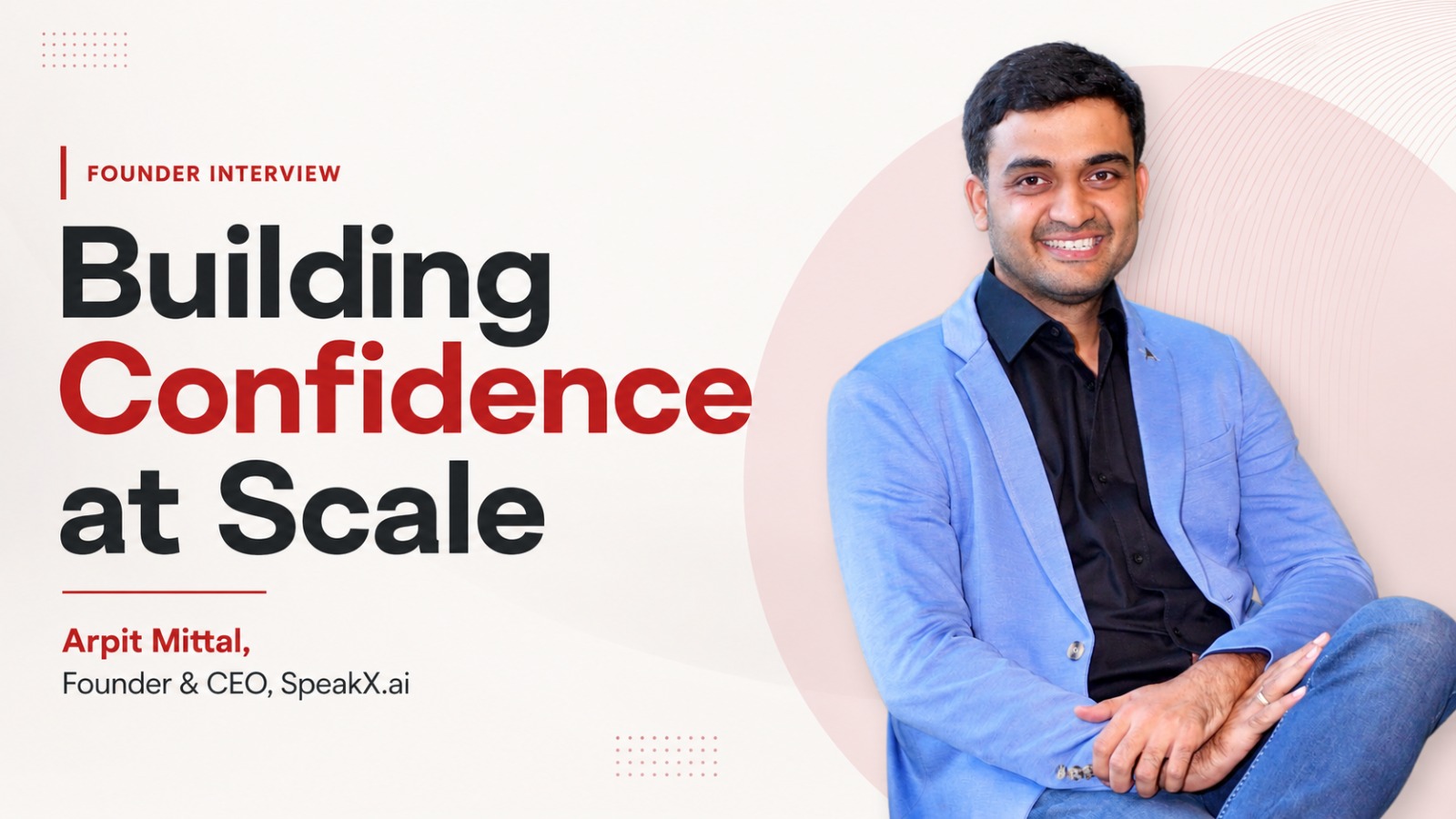
The SpeakX.ai Founder and CEO Arpit Mittal discusses building for India’s aspirational learners, why behavioural insight matters more than foundation models, scaling without chasing growth at any cost, and his ambition to make confident communication an economic enabler for millions.
Arpit Mittal Speaks: ASCENDANTS FOUNDER FEATURE
For millions of Indians, the ability to speak English confidently can influence far more than classroom performance. It can shape job interviews, workplace participation, customer interactions, professional mobility and even everyday social confidence.
That gap is what Arpit Mittal, Founder and CEO of SpeakX.ai, is attempting to address through an AI-native approach to spoken-English learning.
SpeakX.ai has built its proposition around personalised, conversation-led learning rather than conventional content delivery. Its technology is designed to adapt to a learner’s proficiency, confidence, pace and goals while providing continuous speaking practice and real-time feedback.
But for Mittal, building an AI company is not simply about having access to increasingly powerful models. The more defensible advantage, he argues, lies in understanding how people learn, what makes them hesitate, what keeps them engaged and how technology can translate those insights into meaningful outcomes.
In this conversation with Ascendants, Mittal talks about the conviction behind building SpeakX, the company’s AI-native philosophy, its approach to profitability and pricing, what it has learned from Tier II and Tier III India, and how fifteen years of entrepreneurship have changed his definition of a successful company.
“We were solving a much larger problem than language learning”
Q. SpeakX.ai is addressing English fluency not merely as an education problem, but as a barrier to employability, confidence, and social mobility. What convinced you that this was large enough to build a venture-scale company around?
What convinced us to build SpeakX was that the challenge was never limited to education. Across India, we met people who had the knowledge but lacked the confidence to use English in situations that mattered most. They could clear written examinations, but struggled in interviews, workplace discussions, customer interactions, or even everyday conversations. That hesitation often translated into missed opportunities.
When we spoke to learners across Tier II and Tier III India, the same pattern emerged repeatedly. Parents avoided speaking with teachers, professionals stayed silent during meetings, and job seekers lost confidence despite having the required skills. Spoke English was acting as a gateway to overall social mobility, higher employability and career progression
That made us realise we were solving a much larger problem than language learning. We were helping people participate more confidently in economic opportunities and social situations. When a problem affects hundreds of millions of aspirational learners and AI makes personalised practice affordable at scale, it becomes the foundation for a venture-scale business.
Building AI around conversations, not content
Q. Many EdTech companies begin with content and later add technology. SpeakX.ai appears to have been built as an AI-native platform from the outset. What product or business advantages has that given you, and what has been significantly harder than expected?
Starting SpeakX as an AI-native platform rather than content fundamentally changed how we approached learning. Traditional platforms often focus on delivering lessons, while we focused on creating conversations. Every interaction is designed to adapt to the learner’s proficiency, confidence level, pace, and goals in real time.
This AI-native approach allows us to deliver personalised feedback, unlimited speaking practice, and continuous improvement without being constrained by teacher availability. It also enables us to scale personalised learning to millions of users while maintaining affordability.
The harder part has been ensuring that the AI behaves like a supportive mentor rather than an evaluator. Technical accuracy alone is not enough. Learners need feedback that encourages them to continue speaking instead of making them self-conscious.
Designing AI that understands both language and human psychology has been one of the most rewarding and challenging aspects of building SpeakX.
“Our moat is not simply AI”
Q. In a market where generative AI capabilities are becoming increasingly accessible, what constitutes SpeakX.ai’s real moat, proprietary learner data, speech evaluation, personalization, distribution, brand, or something else?
Foundation models are becoming widely available, so for a generative AI EdTech like SpeakX, technology alone can no longer be a sustainable differentiator. Our advantage comes from combining generative AI with a deep understanding of learner behaviour.
Over time, we have learned how adult learners actually build speaking confidence, what discourages them, what motivates them to return every day, and how different learners respond to different teaching styles. Those insights shape everything from lesson design and feedback mechanisms to gamification and personalisation.
Equally important is the scale of real-world learning interactions happening on the platform. Every conversation helps us refine how we personalise the experience while keeping learners engaged. Ultimately, our moat is not simply AI. It is the combination of behavioural insight, personalized adaptive learning, and an outcome-focused product built specifically for spoken communication.
Scaling without chasing growth at any cost
Q. SpeakX.ai has reportedly reached more than 10 million users, 200,000 paying subscribers, and $7.5 million in ARR while remaining EBITDA-profitable. Which growth decisions helped the company scale efficiently, and which commonly accepted startup-growth practices did you deliberately avoid?
One of the most important decisions in scaling SpeakX was to build a profitable EdTech business, not chase growth at any cost. We remained disciplined about profitability and focused on creating genuine customer value before aggressively scaling. Rather than spending heavily to acquire users with unsustainable incentives, we invested in building a product that learners wanted to return to every day.
Strong retention, visible learner outcomes, and organic referrals became important drivers of growth. We also kept the organisation intentionally lean, allowing us to move quickly and allocate resources where they created the greatest long-term impact.
Becoming EBITDA positive before our latest fundraise meant we could raise capital to accelerate growth rather than simply finance operations, giving us significantly greater strategic flexibility.
Making the economics work at ₹299 a month
Q. At ₹299 per month, SpeakX.ai is positioned as an affordable alternative to traditional coaching. How do you think about pricing, customer acquisition cost, retention, and lifetime value while serving a highly price-sensitive market?
Affordability is central to our mission because the people who benefit the most from confident communication are often the ones least able to access expensive coaching.
Our pricing philosophy is straightforward. The product should deliver value that far exceeds its monthly cost. When learners experience tangible improvements in interviews, workplace communication, or daily conversations, retention naturally improves and customer lifetime value becomes healthier.
We therefore focus less on optimising individual metrics in isolation and more on delivering consistent learner outcomes. Strong engagement, regular practice, and visible progress reduce acquisition costs over time because satisfied learners become advocates who introduce SpeakX to friends, family members, and colleagues.
What Tier II and Tier III India taught SpeakX
Q. Tier II and Tier III users form an important part of SpeakX.ai’s customer base. What have you learned about their motivations, behavioural patterns, payment preferences, and learning anxieties that would not have been obvious from building primarily for metro users?
One of the biggest lessons has been that aspiration is remarkably consistent across geographies. Learners in smaller cities are not looking for certificates. They are looking for opportunities. Better jobs, promotions, stronger customer interactions, and greater confidence in everyday conversations with friends, family, colleagues, co-parents, remain their primary motivations.
What differs is their learning journey. Many are first-generation English speakers and are deeply concerned about being judged for making mistakes. They value privacy, flexibility, and encouragement as much as technical instruction.
We have also seen that these learners respond well to products that fit naturally into their daily routines. Short, consistent practice sessions, affordable pricing, and measurable progress create far stronger engagement than traditional classroom structures. Designing around these realities has been one of the key drivers of our growth.
“Confidence comes before perfection”
Q. Real-time feedback is valuable only when it is accurate, relevant, and motivating. How do you balance technical accuracy with learner psychology, particularly when correcting pronunciation, grammar, or fluency without discouraging the user?
At SpeakX our philosophy is that confidence comes before perfection. If learners feel constantly corrected, many simply stop speaking, and without speaking there is no improvement.
What makes this work at scale is that the AI remembers each learner across sessions. It knows what they struggled with last time, which corrections they have already worked through, what encourages them to keep going, and which pain points still need attention. So when the AI gives feedback, it is not a generic pronunciation flag, it is the one correction that matters most for that specific learner in that specific moment, in a tone the AI has learned works for them. The AI prioritises the most meaningful feedback rather than highlighting every mistake, and introduces corrections in a way that feels constructive rather than critical.
The objective is not to produce flawless English overnight. It is to help learners speak a little more confidently each day. When confidence grows, accuracy improves naturally through consistent practice.
AI versus humans? SpeakX sees it differently
Q. Traditional spoken-English coaching depends heavily on live trainers, while SpeakX.ai is building a scalable AI-led alternative. Which parts of the learning experience can AI genuinely improve, and where do you believe human involvement will continue to matter?
Traditional spoken-English coaching has always depended heavily on the quality and availability of a trainer. At SpeakX, we believe AI allows us to rethink that model completely.
Where AI can genuinely improve the learning experience is personalization, practice and availability. Every learner comes with a different level, profession, goal and hesitation. Someone preparing for a job interview needs a very different learning journey from someone who wants to speak confidently with friends or communicate better at work.
AI allows SpeakX to understand these differences and create a personalized journey for every learner. It can give learners unlimited opportunities to speak, make mistakes without being judged, receive instant feedback and practise real-life situations whenever they want. And unlike a classroom where one trainer may be teaching many students, AI can adapt continuously to each learner’s progress.
For us, one of the biggest advantages is that AI makes personalized spoken-English practice available at scale, 24×7.
But we don’t believe AI removes the need for humans. Humans continue to matter in understanding what learners truly need, designing the right learning philosophy, building empathy into the experience and deciding what “good learning” actually looks like. Our learning and product teams define the pedagogy, observe learner behaviour, understand where people struggle and continuously improve the system.
So at SpeakX, we don’t see it as AI versus humans. We see it as humans designing the intelligence and AI delivering that intelligence, personally, to millions of learners. In practice, that means the AI provides unlimited practice, immediate feedback, personalised learning paths, and consistent availability. Learners can practise whenever they want, repeat conversations as many times as needed, never feel judged, and never encounter a system that has run out of patience. It can generate an unlimited variety of realistic conversations such as a job interview, a customer call, a doctor visit, and repeat them as many times as the learner needs. That is why SpeakX is fully productised, with no human touch points in the learning loop, and why we can deliver this experience at Rs 299 a month instead of the tens of thousands of rupees traditional coaching costs.
Where the next round of capital goes
Q. As the company moves towards its next stage of funding and growth, how are you prioritising capital allocation across product development, AI infrastructure, customer acquisition, talent, and international expansion?
Our first priority remains strengthening the product. Continued investment in AI capabilities, speech technology, and personalisation directly improves learner outcomes, which is the strongest driver of sustainable growth.
We are also investing in engineering talent and infrastructure that allows us to deliver increasingly sophisticated learning experiences efficiently at scale.
Customer acquisition remains important, but we continue to emphasise disciplined growth supported by strong retention and engagement rather than aggressive spending. As we expand internationally, we will focus on markets where English proficiency creates similar economic opportunities and where our affordable, AI-driven model can deliver meaningful impact.
Fifteen years of building changed the definition of success
Q. You have previously built and exited multiple ventures. How has your definition of a good company changed over time, and what must SpeakX.ai become over the next five years for you to consider it your most meaningful entrepreneurial achievement?
Earlier in my journey, I measured a good company by standard metrics such as growth, funding, valuation and scale. Fifteen years of building has shifted that perspective materially.
Today, I evaluate every decision against four fundamentals. The problem must be worth solving. Technology should be applied where it can genuinely create an advantage, while the right people should be brought in where technology cannot. The team must have the execution depth to turn an idea into value. The people building alongside me matter just as much, because a small group of high-intent people can outperform an organisation ten times its size.
A previous chapter also taught me something I did not fully understand as a younger founder: the ability to change direction when the market demands it. SpeakX itself was born from that willingness to let go of a version of the company that was no longer serving its users.
I have also learned that capital alone cannot create a long enough runway; patience does. Holding on to that belief while staying true to who the product is built for will make SpeakX my most consequential entrepreneurial achievement. Not because it grew the fastest, but because it opened the most doors for the most people.
Over the next five years, success for SpeakX will extend beyond revenue and international expansion. It will be measured by the number of people who gain confidence, secure better opportunities and transform their lives through stronger communication. Becoming the platform that millions trust to unlock those opportunities would make SpeakX my most meaningful entrepreneurial achievement.
Editor’s Note
Arpit Mittal’s thesis around SpeakX.ai goes beyond replacing a classroom teacher with artificial intelligence. The larger bet is that AI can make personalised practice dramatically more accessible while allowing learners to make mistakes privately, improve consistently and build the confidence required to participate more fully in professional and economic opportunities.
Perhaps the clearest indication of Mittal’s founder philosophy comes from how his definition of success has evolved. Growth, funding and valuation still matter, but after fifteen years of building companies, his benchmark for SpeakX is increasingly centred on whether the product can open more doors for more people.
For SpeakX.ai, that makes the next chapter as much about outcomes as scale.
Also Read: Ragini Das Marks 14 Years of Work With One Unusual Rule