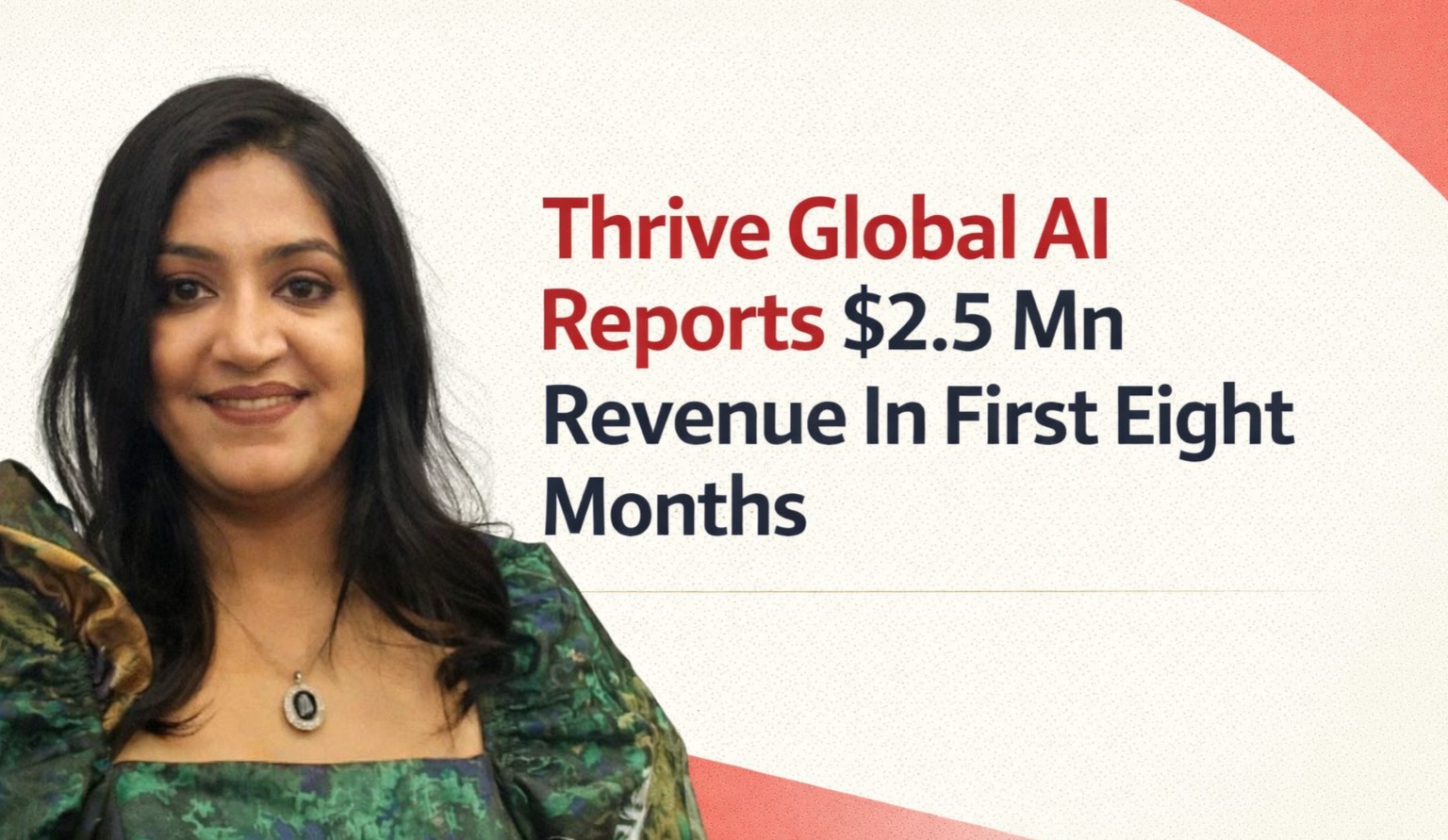
New Delhi-based startup Thrive Global AI has reported $2.5 million in revenue within its first eight months of operations, while also claiming $4.5 million in order bookings, marking an early milestone for the bootstrapped artificial intelligence platform.
The company’s update stands out not just for the revenue number, but for the way it is positioning itself in a crowded AI market. Rather than pitching itself as a generic AI solution, Thrive Global AI says it is building customised large language models for individual clients, designed around supply chain cycles, business benchmarks and operational definitions. According to the company, these models are usually deployed within two to three weeks.
Founded by Priyanka Aeron, the startup is targeting a problem many brands struggle with as they expand across geographies: fragmented data spread across different regions and functions. That fragmentation, the company says, often results in inconsistent insights, delayed reporting and slower decision-making.
To address that, Thrive Global AI has introduced what it calls a Real-Time Analytics Module, described as a patented technology that brings supply chain and marketing analytics closer to core business operations. The platform integrates data from multiple business functions and, in many cases, processes that information within a client’s own cloud infrastructure to meet compliance and security needs. It also connects with client systems and third-party platforms such as Amazon and Noon through APIs.
At the centre of the company’s pitch is the idea of a single source of truth. Thrive Global AI says its platform combines offline and online sales data to create a unified decision-making layer for businesses, effectively serving as a company-specific AI assistant. Its use cases include predicting stock-out risks, identifying higher-return investment opportunities, improving refill planning and optimising marketing spends.
The company has also said that brands using its platform have reported 200 to 300 per cent growth, which it attributes to better capital efficiency, tighter inventory control and improved timing in marketing decisions. That figure, however, has been presented by the company as part of its own account of customer outcomes.
Commenting on the company’s direction, founder Priyanka Aeron said the next phase of AI will be defined less by experimentation and more by how deeply it is embedded into business systems.
“AI’s future will not be shaped by who experiments the fastest, but by who integrates it the smartest. At Thrive Global AI, we are embedding intelligence directly into supply chains, capital strategy and marketing to deliver measurable revenue outcomes,” she said.
The revenue mix also offers a glimpse into the startup’s business model. Thrive Global AI said around 80 per cent of its revenue currently comes from platform subscriptions, access fees and brand management services.
Looking ahead, the company says its 2026 focus will be on enterprise-scale adoption, governance-led innovation and sector-specific AI products, especially for industries where regulatory and compliance requirements are strict. It also plans to invest in data governance frameworks and scalable decision-intelligence systems aimed at improving operational efficiency while reducing costly experimentation in enterprise AI adoption.
For now, the company’s reported numbers and positioning reflect a broader shift already visible in the AI sector: businesses are moving beyond the novelty of AI pilots and increasingly looking for tools that can plug directly into operations, finance and supply chain workflows. Thrive Global AI is clearly trying to place itself in that more practical, execution-led category. What will matter next is whether it can sustain that early momentum as enterprise adoption deepens and expectations around measurable outcomes become sharper.