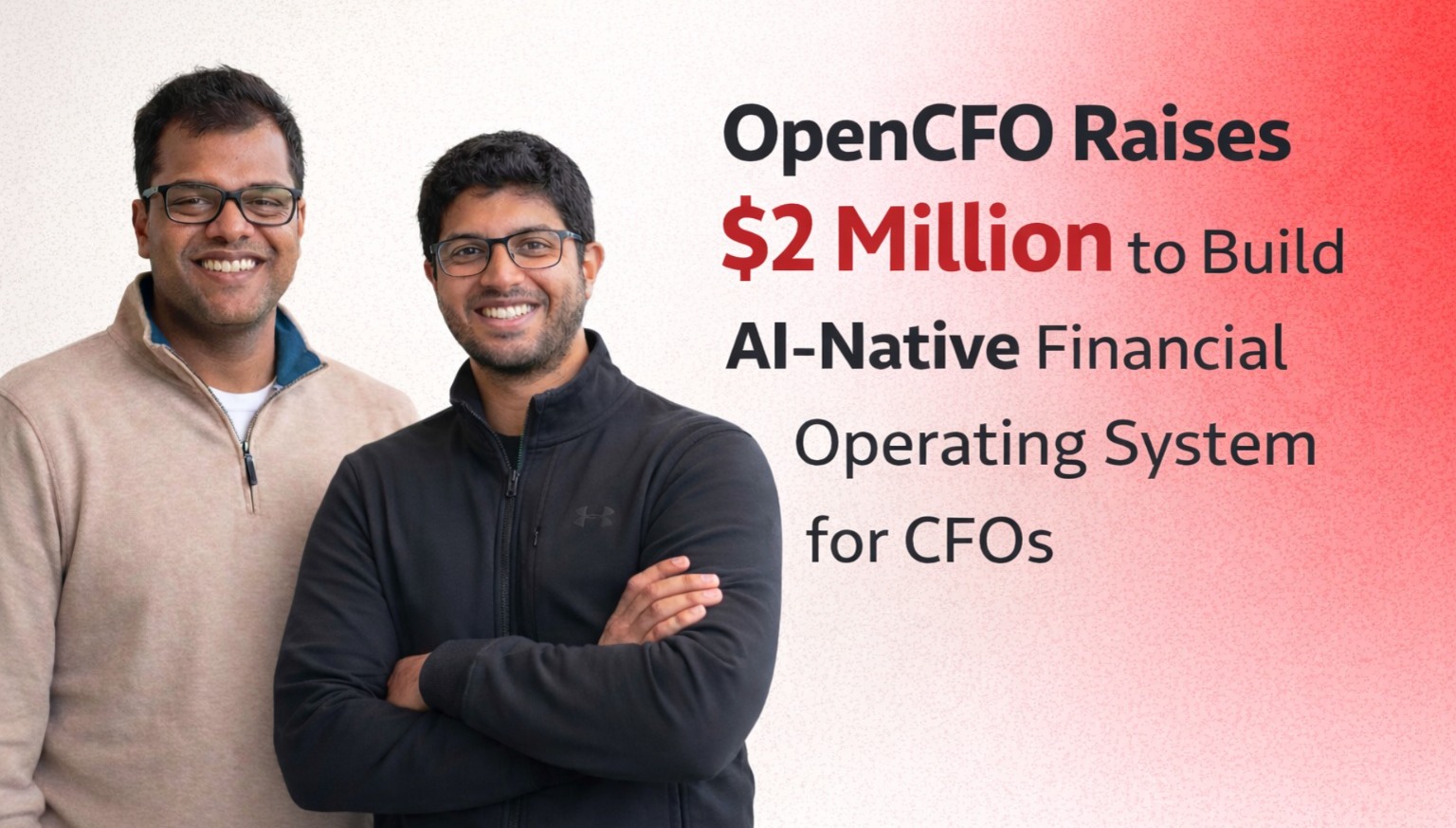
OpenCFO, a young financial operations startup working at the intersection of AI and fintech, has raised $2 million in its first institutional funding round, with Endiya Partners leading the investment and angel investors from India and the United States also participating.
The company says it is building an AI-native financial operating system designed to help mid-market businesses manage payables, receivables and treasury functions through a single platform.
At a time when enterprise AI is moving beyond chat interfaces and pilot projects into systems that can actually execute tasks inside business workflows, OpenCFO is betting that finance teams are ready for that shift.
Its pitch is simple, but timely: many growing companies are still running core financial operations across a patchwork of ERPs, bank portals, spreadsheets and narrow software tools, even as their business expands across entities, currencies and geographies.
That fragmentation is where the startup sees its opportunity.
According to the company, finance teams at mid-market businesses often face a level of operational complexity that looks increasingly global, but without the treasury infrastructure or manpower available to large enterprises. Invoice processing, reconciliation, cross-border payments and cash visibility can all become slower and harder to manage when systems do not speak to one another.
OpenCFO’s answer is to bring those moving pieces into one execution layer, where AI agents can coordinate workflows while human teams retain control through approvals, policies and audit trails.
The company says its platform is being built around three central areas of finance operations: accounts payable, accounts receivable and treasury. Rather than treating each as an isolated workflow, OpenCFO is positioning the system as a connected stack, where actions in one part of finance can automatically inform decisions in another.
That, in theory, could give finance teams sharper visibility into liquidity, payments and cash positioning across divisions and geographies.
“We are not building another dashboard or point solution,” said Prudhvi Rao Shedimbi, co-founder and CEO of OpenCFO. “CFOs are being asked to operate with greater speed and accuracy than ever, yet the underlying finance stack remains fragmented and manual. Our goal is to build the AI-native execution layer for the CFO office that connects the entire financial stack and enables finance teams to operate with confidence across borders.”
That cross-border angle appears to be central to the company’s early strategy. OpenCFO says one of the first areas where its platform is showing impact is treasury and payment optimisation for internationally operating businesses.
It claims that mid-market firms often deal with foreign exchange costs of 2% to 4%, slower settlement systems and manual reconciliation across banking partners. In early pilots, the company says its platform has shown more than 50% cost savings on cross-border transactions while also enabling near-instant settlement and reconciliation. Those figures were cited by the company in the source material and should be seen in that context.
“Mid-market CFOs are stuck stitching together fragmented tools that don’t communicate with each other,” said Sankalp Singayapally, co-founder and COO of OpenCFO. “They pay unnecessary FX fees, wait days for transfers that could settle faster, and spend hours reconciling data across systems.
By combining agentic AI with modern treasury infrastructure, we’re building a unified platform that automates financial operations while giving finance teams enhanced visibility and control.”
The funding also signals investor interest in a specific slice of enterprise fintech: tools built for mid-market companies that are growing fast enough to feel global complexity, but not large enough to justify heavyweight enterprise treasury software. Endiya Partners, which led the round, appears to be backing OpenCFO on that thesis.
“Mid-market companies with global operations have been underserved,” said Sateesh Andra, managing partner at Endiya Partners. “Consumer payment tools aren’t built for their complexity. Enterprise treasury platforms require scale they don’t have. OpenCFO is purpose-built for this segment, starting with optimized cross-border finances and expanding into the full CFO stack.”
OpenCFO said the new capital will go towards hiring, product development and market expansion. The company plans to add senior talent with enterprise treasury deployment expertise, expand its engineering presence in both India and the US, and accelerate work on automation agents for payables and receivables.
It is also targeting customer growth in cross-border corridors including the US-India route, as well as the UK, European Union and Canada. The startup expects to launch its full agentic financial operations platform by mid-2026.
Founded in December 2025, OpenCFO operates across India and the United States and says it serves US-based companies with global operations spanning India, Europe, Southeast Asia and other emerging markets. The company describes itself as a unified AI platform for mid-market CFOs, with native integrations into ERP systems and banking and financial infrastructure.
In a crowded AI market where many companies are still defining what “agentic” software really means in practical business terms, OpenCFO is trying to ground the promise in a function where inefficiency is easy to spot and expensive to ignore. Whether it can scale that promise beyond pilots will depend on execution.
But the problem it is targeting is real: finance teams are under pressure to move faster, stay compliant and manage increasingly international operations, often with tools that belong to an earlier era.
That is the gap OpenCFO now has fresh capital to chase.
Also Read: Edorica Luxury Skincare: India’s Rising Clean Beauty Brand