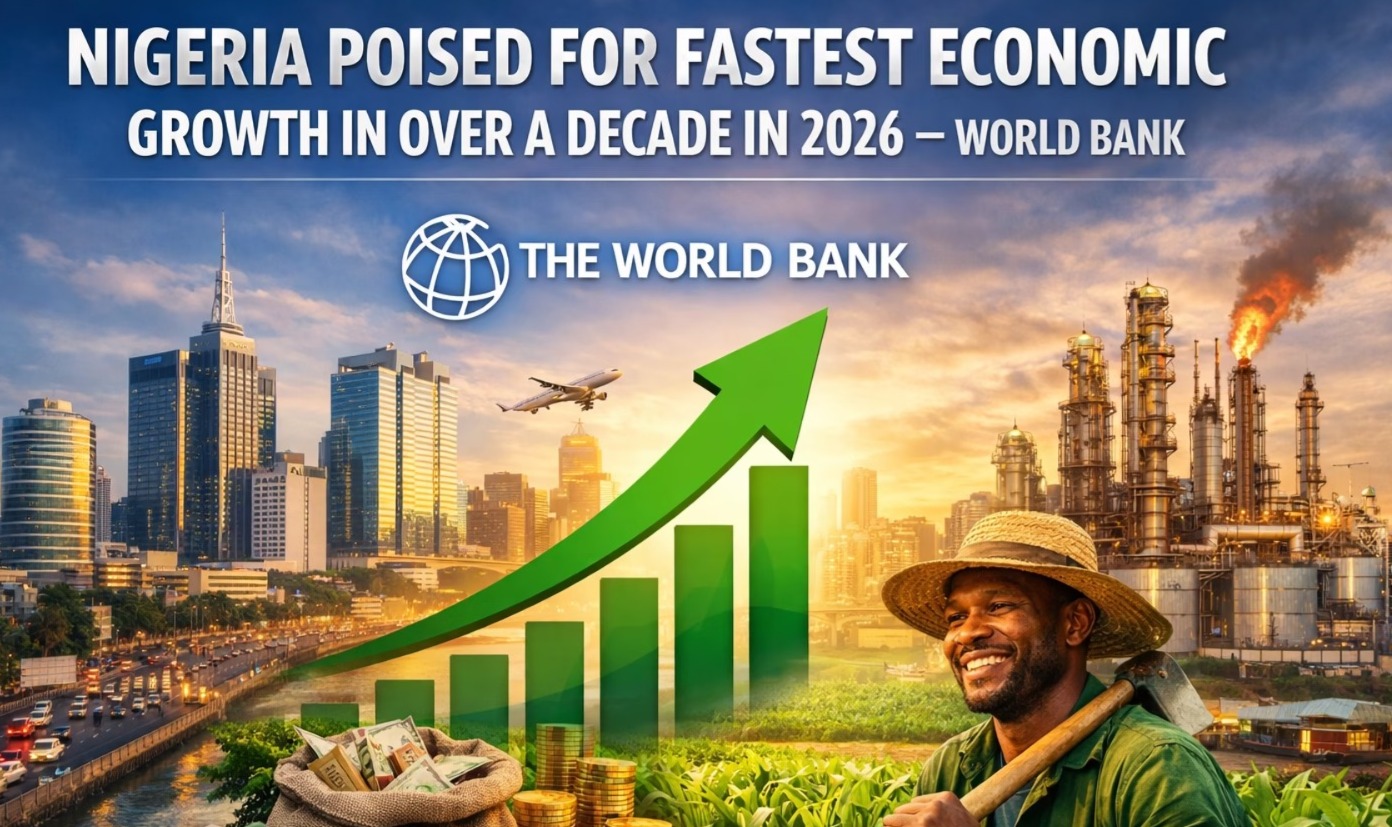
World Bank Upgrades Nigeria’s Growth Forecast to 4.4% for 2026-27 on Services
Nigeria’s economy is poised to achieve its strongest growth performance in more than ten years, according to the latest assessment by the World Bank. In its newly released Global Economic Prospects report, the World Bank upgraded Nigeria’s growth outlook, projecting an expansion of 4.4 % in both 2026 and 2027, marking a significant acceleration compared to previous estimates.
The revised forecast represents an upward adjustment of 0.7 percentage points for 2026 and 0.6 percentage points for 2027, compared with the projections issued in June, when growth was expected at 3.7% and 3.8%, respectively. The improvement signals growing confidence in Nigeria’s ongoing economic recovery and reform momentum.
Services Sector Leads the Recovery
According to the World Bank, Nigeria’s growth already strengthened to 4.2 percent in 2025, driven largely by robust expansion in the services sector. In particular, financial services and Information and Communication Technology (ICT) played a central role in lifting overall economic activity. A modest recovery in agriculture also contributed, alongside Nigeria’s emergence as a net exporter of refined petroleum products, reflecting improved domestic refining capacity.
Building on this momentum, the World Bank expects growth to firm further over the next two years. The projected 4.4% expansion in 2026 and 2027 is expected to be supported by continued strength in services, a rebound in agricultural output, and a gradual acceleration in non-oil industrial activity.
Reforms and Monetary Discipline Boost Confidence
The report highlights the role of ongoing economic reforms, particularly in the tax system, combined with prudent monetary policy, in supporting economic activity. These measures are expected to enhance investor sentiment, help reduce inflationary pressures, and create a more stable macroeconomic environment.
In addition, higher oil production is projected to help offset the impact of lower international oil prices in the near term. This, the World Bank noted, should strengthen fiscal revenues and improve Nigeria’s external balance, providing further support to growth.
Structural Challenges Remain
Despite the optimistic outlook, the World Bank cautioned that sustaining this growth trajectory will require addressing deep-rooted structural issues. Although Nigeria introduced fiscal rules in 2007 to reduce vulnerability to oil revenue volatility, weak institutional frameworks have historically limited effective enforcement, resulting in an uneven record of fiscal discipline.
Current reform efforts, the report said, are aimed at overcoming these long-standing bottlenecks to ensure that economic growth remains durable, inclusive, and resilient over the medium term.
Global Context: Resilience Amid Uncertainty
On the global front, the World Bank observed that the world economy has shown greater resilience than previously anticipated, despite ongoing trade tensions and policy uncertainty. Global growth is now projected at 2.6 percent in 2026 before edging up to 2.7 percent in 2027, both figures representing upward revisions from earlier forecasts.
Within this challenging global environment, Nigeria’s improved outlook stands out, positioning the country as one of the faster-growing economies in the coming years if reforms are effectively implemented and structural challenges addressed.
Also Read: Carl Pei Warns of Smartphone Price Hikes in 2026 as AI Drives Memory Costs Higher