

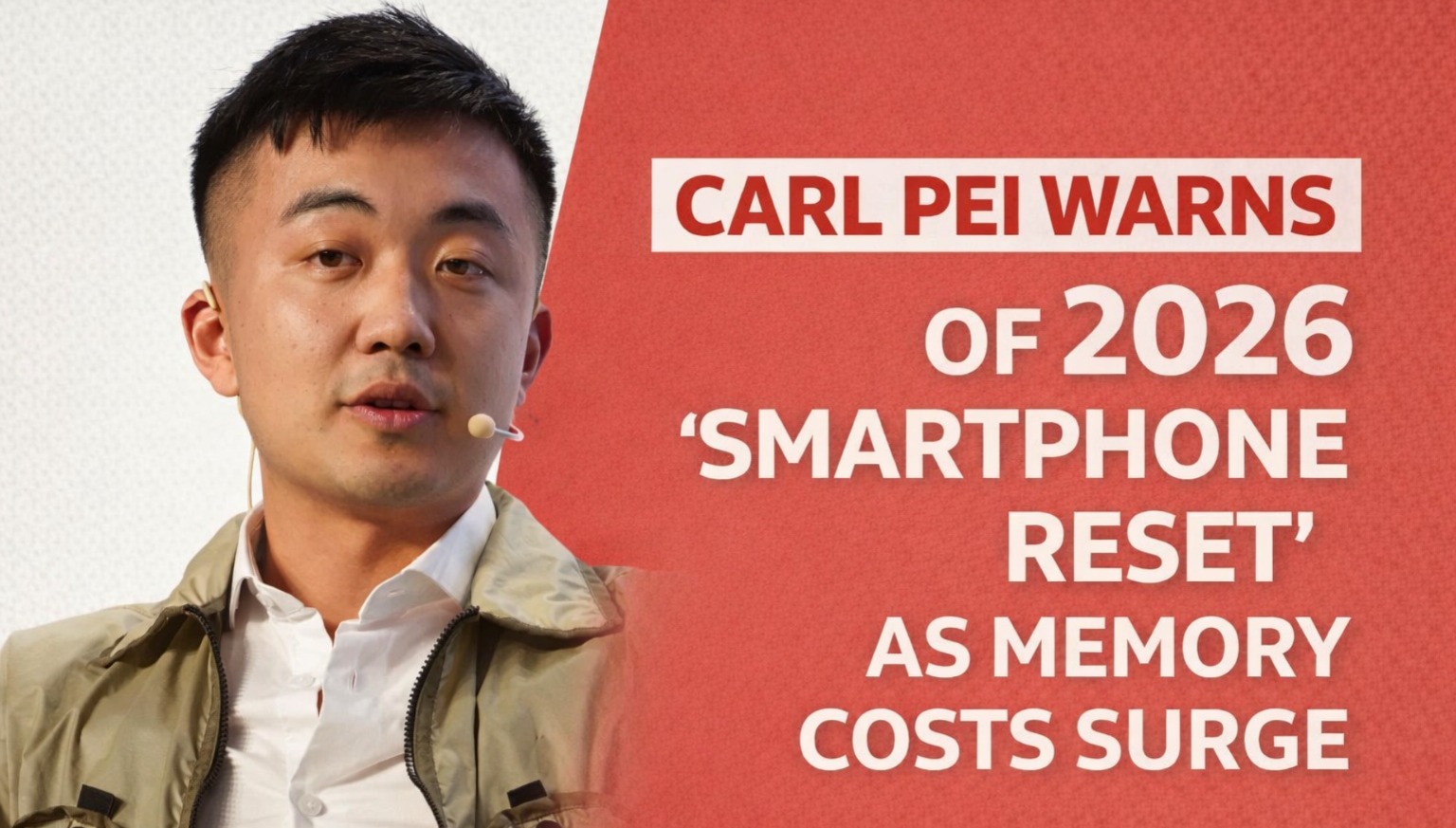
Carl Pei, the CEO of smartphone brand Nothing, has issued a stark warning about what he calls a once-in-15-years disruption for the smartphone industry, arguing that the long-standing assumption of steadily cheaper components is breaking down in 2026 because of sharply rising memory costs.
In a post shared by Pei, he says the industry’s familiar playbook, annual specification upgrades without meaningful price jumps, was sustained for years by a broad downward trend in key component prices. According to him, that model is now under direct pressure as the same memory used in phones is increasingly demanded by AI data centres, creating a competition for supply that smartphones have not faced at this scale before.
“For the first time, smartphones are competing with AI infrastructure”: Carl Pei
Pei’s central argument is that AI has shifted the demand curve. He writes that hyperscalers are locking in capacity years in advance to support the AI boom, with memory pricing rising as a consequence.
He claims the impact is already visible in market pricing and procurement pressure, adding that in some cases memory costs have increased by “up to 3x,” and could rise further as demand continues to absorb supply. He also suggests memory could become one of the most expensive components in a smartphone bill of materials by the end of the year, potentially the biggest cost driver in top-tier models.
Importantly, these figures and projections are presented as Pei’s assessment in the post.
A forced choice for brands: raise prices or cut specs
Pei frames 2026 as a structural shift rather than a temporary spike. When a component that historically got cheaper starts becoming materially more expensive, he argues, brands are left with two options:
- Raise prices by “30% or more” in some cases
- Downgrade specifications to protect margins.
He also suggests this pressure could hit budget-focused strategies hardest, writing that the “more specs for less money” model is becoming difficult to sustain and that entry and mid-tier segments could contract significantly as affordability tightens.
Nothing’s positioning: “The specs race ends”
Pei also uses the moment to place Nothing’s strategy in contrast to the traditional spec-sheet battle. He writes that Nothing, without the cost advantages enjoyed by the biggest global players, built its identity around product experience, how a phone looks, feels, and works day-to-day, rather than raw numbers.
In the same post, he notes that pricing will “inevitably” increase across Nothing’s smartphone portfolio and adds that the company plans to upgrade some products launching in Q1 to UFS 3.1 storage, an update he presents as part of the changing cost and performance equation.
From Pei’s perspective, this is the year the industry’s spec race slows down: “As the industry resets, experience becomes the only real differentiator,” he writes, calling it the kind of environment Nothing was designed for.
Significance for India
Pei’s comments will resonate sharply in India, where the smartphone market is intensely price-sensitive and where brands have historically competed by packing better hardware into aggressive price points, especially in the entry and mid-range.
If memory pricing does stay elevated, Pei’s argument implies that the pressure won’t just show up in flagship pricing. It would also influence which features survive in mass-market devices, storage tiers, multitasking performance, AI features on-device, and even the pace of annual upgrades.
For consumers, the shift he describes points to a different buying season ahead: fewer “surprising” spec bumps at the same price, and a stronger push by brands to justify value through software, design, polish, reliability, and differentiated experience.
Pei’s post reads less like a routine executive note and more like a public thesis: that the era of predictable component deflation is ending, and that the industry is entering a period where cost structures could force a reset in pricing and product strategy.
He signs off with a line that captures the positioning clearly: “The era of cheap silicon is over. The era of intentional design is just beginning.”
Also Read: Drickle Secures Rs 6 Crore in Seed Funding to Scale Coffee-First QSR Presence
















