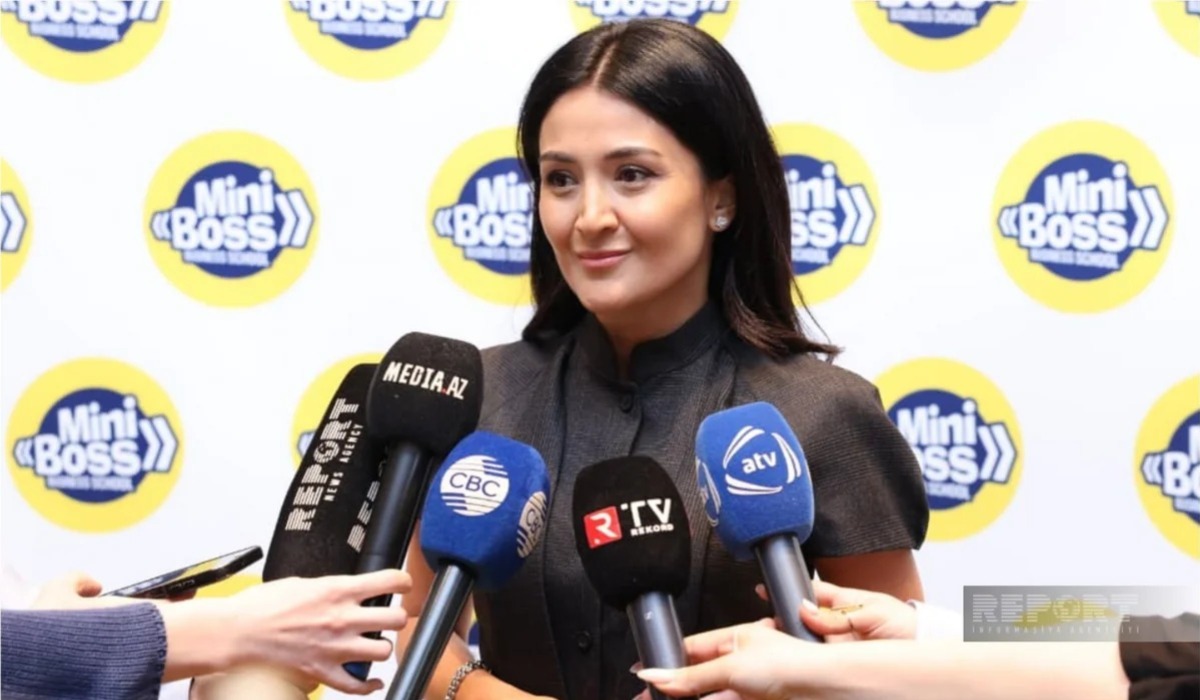
Baku’s startup conversation is increasingly making room for younger voices. At the sixth Startup Forum organized by Miniboss Business School in Azerbaijan’s capital, children and teenagers aged 6 to 17 presented a new set of business ideas, adding to a growing record that now stretches beyond 90 projects over six years.
The figure, shared by the school’s founder Narmina Hasanova, offers a snapshot of how youth-focused entrepreneurship platforms are steadily building their own ecosystem in the country.
This year’s forum brought together 20 teams, each presenting one project. But the event was framed not as a one-day showcase alone. Hasanova said the process is designed to move beyond presentations, with jury evaluation followed by sponsor-backed grants. The next step, she noted, is expected within two months, when participants return to present finished products and services developed with that support.
That detail matters. Many youth innovation events stop at applause, certificates and photographs. What stands out here is the attempt to create a bridge between an idea and an early-stage product. In practical terms, that gives students a chance to test whether their concepts can survive the harder phase of development, where execution matters more than enthusiasm.
The forum also reflects a wider shift in how entrepreneurial learning is being introduced to younger age groups. Instead of treating business education as something reserved for universities or professional incubators, the model on display in Baku pushes startup thinking into much earlier years. For children and teenagers, that can mean learning how to identify a problem, structure an idea, pitch it clearly, and then refine it with feedback.
Hasanova linked the Baku event to a larger international stage as well. She said the World Championship of Startups for children and teenagers will be held in Davos, Switzerland, in July 2026. She also highlighted the performance of Miniboss Business School’s Azerbaijan branch at past editions, saying it has finished first twice, second twice and third twice.
Those results, if seen in context, suggest that the school is not merely running internal classroom exercises.
It is positioning students for competitive exposure beyond Azerbaijan, where projects are judged against peers from other countries. For a local education platform, that kind of track record carries both symbolic and practical value. Symbolically, it signals confidence in youth-led innovation. Practically, it creates an incentive structure for students to think bigger than school-level recognition.
There is also a deeper story here about aspiration. Startup culture is often discussed in the language of venture capital, scale and disruption. But at the school level, its real power may lie somewhere simpler: it teaches children that ideas are meant to be built, not just discussed. In that sense, forums like this can become early training grounds for confidence, public speaking, problem-solving and resilience.
Of course, a presentation forum alone does not guarantee that a project will become a viable company. Most ideas do not turn into sustainable businesses, whether they come from adults or teenagers. But that is not the only measure that matters. What these platforms create is habit: the habit of thinking independently, presenting under scrutiny, accepting evaluation, and learning to turn imagination into something testable.
That is why the “more than 90 projects” milestone is worth noting. It is not simply a tally. It points to continuity. Six years of forums mean repeated exposure, recurring participation, and a system that has stayed active long enough to produce a visible body of work. In a region where startup coverage often focuses on funding rounds or government policy, youth entrepreneurship forums offer a quieter but important signal about where the next generation of founders may come from.
For now, the immediate spotlight remains on the 20 teams that took the stage in Baku this year. Their projects will be judged, some will receive grant support, and a few may return with more mature products in the coming weeks. Whether any of them becomes a major business in the future is still unknown. But the forum has already done something valuable: it has given young participants a real audience, a competitive platform and a reason to take their own ideas seriously.
And sometimes, that is where entrepreneurship begins.
Also Read: Vaibhav Suryavanshi’s Rise Is Bigger Than a Net-Worth Number