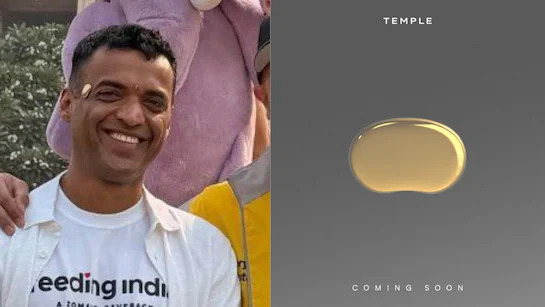
When Deepinder Goyal started Zomato, few could have imagined how big, successful, and convenience-driven the platform would become. Over time, through experiments and constant reinvention, Zomato evolved into a food-tech giant that reshaped how India eats.
Building on that success, Goyal went on to introduce Blinkit and District, both of which quickly emerged as major wins in their own right, further strengthening his track record as a founder who understands scale and consumer behavior.
Now, Goyal is venturing into an entirely new sector, and his latest venture moves far beyond food delivery and quick commerce. He is entering the complex and highly sensitive world of health technology.
He is working on a project aimed at improving our understanding of how human brains function. It is a space quite distinct from food delivery. While the idea is ambitious and still evolving, it reflects a growing conviction that technology can play a more profound role in understanding human health and longevity.
They named it Temple– A wearable that continuously and accurately monitors the brain’s blood flow.
What is Temple Device? And Why the Founders See it as Visionary
According to the company, Temple is a wearable sensor designed to monitor cerebral blood flow. What sets it apart from other health trackers is that this metric has largely remained outside the scope of consumer health technology.
Unlike smartwatches or fitness trackers that track heart rate, steps, or sleep, Temple focuses on cerebral blood flow, bringing it closer to medical and research use than everyday lifestyle gadgets.
The Vision Behind the Device
From the founders’ perspective, Temple is visionary because it attempts to explore a largely uncharted frontier. This device attempts to measure something fundamental yet underexplored.
In today’s fast-paced and high-stress environment, it is crucial to track brain health as it plays a central role in aging, cognition, and long-term well-being, but rarely tracked outside clinical settings. By monitoring brain activity over long periods, the founders believe Temple can uncover patterns that short-term medical tests often fail to detect.
The Scientific Basis of the Idea
Beyond ambition and vision, Temple is grounded in scientific reasoning. The founders believe the device can provide new insights into human biology by allowing detailed, long-term observation of brain function.
Studies have consistently linked reduced cerebral circulation to cognitive decline and neurological disorders. While some of the wider hypotheses connected to Temple are still being examined and debated, the core principle is widely accepted: sustained and healthy blood flow to the brain is essential for long-term cognitive function.
In that sense, Temple is not positioned as a device offering immediate answers. Instead, it is designed as a tool for observation, one that prioritizes data, patience, and scientific inquiry over quick conclusions. For its founders, the real value lies in asking the right questions early and allowing evidence, not assumptions, to shape what comes next.
The Controversy Linked to the Temple Device
When the Eternal founder made it public, it not only raised curiosity but also sparked a debate around its authenticity. Why? Because the idea challenged conventional thinking, offered limited public data, and stepped into a space where science demands rigorous proof rather than bold claims.
Critics have questioned whether the science behind the device has been sufficiently validated, pointing out that brain health is a complex field where assumptions require rigorous testing. Temple’s link to unconventional hypotheses has added to the skepticism, particularly among medical professionals who emphasize the importance of peer-reviewed research and clear regulatory approval.
Supporters counter that skepticism is common with early-stage innovation and that challenging established thinking is essential for scientific progress. As a result, Temple has become more than just a wearable; it now represents the ongoing debate between bold innovation and the need for scientific responsibility.
Temple & the Gravitational Theory of Aging
Temple is grounded in scientific reasoning. The founders believe the device can provide new insights into human biology by allowing detailed, long-term observation of brain function. The theory suggests that gravity, acting continuously on the human body, may gradually affect cerebral circulation, especially to critical regions of the brain, potentially contributing to aging-related decline.
By monitoring brain blood flow in everyday conditions, Temple seeks to detect subtle, long-term changes in circulation and understand how they develop over time.
But not everyone is convinced.
Dr Cyriac Abby Philips, widely known as The Liver Doc, called the idea of “gravity ageing” fake science.
In a detailed post on X, he argued that the hypothesis overlooks decades of established ageing research and described the device as an early, “questionable” longevity product aimed at “gullible audiences.”
Goyal responded firmly. “We didn’t make up the Gravity Ageing Hypothesis to sell Temple,” he wrote. “I wouldn’t risk my customers’ trust for a marketing trick.”
Key Points at the Heart of the Debate
- Unproven hypotheses linked to aging and gravity
- Limited public data available for independent review
- Medical skepticism around brain health claims
- Longevity-related claims drawing extra scrutiny
- Regulatory uncertainty around medical use
- Founder influence is shaping public perception
- Supporter pushback emphasizing exploration over certainty
Taken together, these factors have placed Temple under intense scrutiny, making it one of the most discussed health-tech experiments in recent times and highlighting the delicate balance between bold vision and scientific rigor.
In the end, Temple sits at the crossroads of curiosity, ambition, and evidence. Whether it becomes a useful research tool or remains a bold experiment, its true impact will be shaped by data, transparency, and time. For now, Temple has already succeeded in sparking an important conversation, prompting founders, scientists, and the public to consider how far innovation can push boundaries and how firmly it must be grounded in science to build lasting trust.
Read More: Why Indian Doctors Are Leaving the UK in Record Numbers