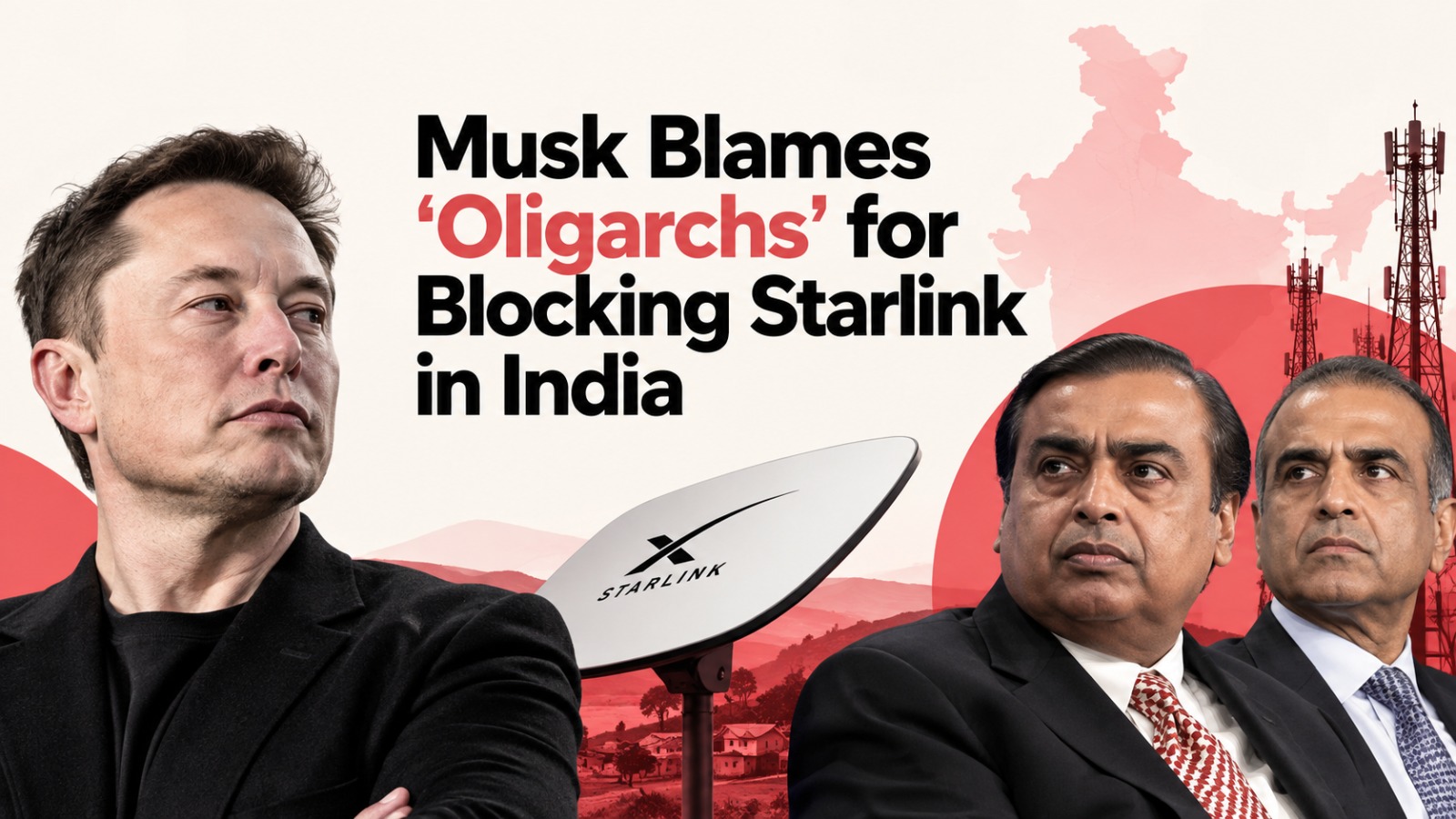
Elon Musk has taken a sharp swipe at unnamed business interests in India, saying Starlink is being blocked by “certain oligarchs” seeking to protect what he described as a “monopolistic chokehold” over the Indian people.
The comment immediately drew attention because of the structure of India’s telecom market and the prominence of two of its biggest names, Mukesh Ambani and Sunil Bharti Mittal.
Musk did not name either businessman.
But his choice of words, coupled with his suggestion that people could “guess who they are”, gives the remark the character of a pointed, indirect attack rather than a general complaint about regulation.
“Unfortunately, we are being blocked by certain oligarchs in order to maintain their monopolistic chokehold on the Indian people. You can guess who they are …” Musk wrote.
He followed that with an even stronger statement: “This is a crime against the people of India!”
The comments came in response to a post by @DogeDesigner arguing that India needs Starlink to help close persistent connectivity gaps in rural and difficult-to-reach parts of the country.
Musk does not name Ambani or Mittal, but the implication is hard to ignore
Mukesh Ambani and Sunil Bharti Mittal were not mentioned in Musk’s post.
Any suggestion that he was referring specifically to them therefore remains an interpretation of his wording, not a confirmed allegation.
Still, the remark stands out because Musk did not simply say Starlink was facing regulatory delays or commercial opposition.
He specifically referred to “oligarchs” and told readers they could “guess who they are”.
It was a sly attack by construction.
The remark comes amid Starlink’s push to enter India
The exchange came alongside a broader argument in favour of allowing Starlink to begin commercial service in India.
According to the figures cited in the original post, 11,256 listed villages in India still lacked 4G coverage as of May 2026.
India had 1.093 billion internet subscriptions in March 2026, but only 440.87 million were in rural areas.
Rural subscription density stood at 48.31 per 100 people, compared with 126.80 in urban India.
The numbers underline a sharp gap between the country’s urban and rural connectivity levels.
The post also highlighted that BharatNet had laid more than 850,000 route kilometres of fibre and made around 221,000 Gram Panchayats service-ready.
However, Points of Presence were reported operational at only 80,472 Gram Panchayats in June 2026.
Only 4.26% of India’s internet subscriptions were wired connections in March 2026.
That is the backdrop against which Starlink is making its case.
Starlink says it already has 20 gateway sites in India
Another notable detail is that Starlink has already built 20 gateway sites in India, according to Lauren Dreyer, SpaceX Vice President of Starlink Business Operations.
Speaking at India Mobile Congress, Dreyer said Starlink was ready to help India move towards universal connectivity.
She highlighted possible applications in remote classrooms, telemedicine and disaster response. “With Starlink, people can get connected within minutes, not years,” she said.
Dreyer also said Starlink could help support Prime Minister Narendra Modi’s vision of 100% connectivity across India.
The company has also said it has created India-specific security controls designed to keep Indian user data within India.
Why Starlink sees an opening?
Starlink’s argument is built around one basic advantage.
Satellite broadband can reach areas where laying fibre or building conventional mobile infrastructure is difficult.
That makes it particularly relevant to remote villages, mountain regions, islands and other areas where traditional networks may be expensive or slow to extend.
In such places, satellite broadband could potentially support online education, remote consultations, small businesses and emergency communications.
Starlink has already supported education and healthcare in remote communities internationally.
Its portable terminals have also been used in disaster-response situations around the world, where ground-based networks were unavailable or damaged.
For India, that could mean backup connectivity during floods, earthquakes or storms.
The post also highlighted Starlink’s Direct to Cell technology, which could allow ordinary 4G phones to connect beyond conventional tower coverage, subject to Indian approvals and mobile operator partnerships.
Elon Musk has turned a connectivity debate into a corporate power debate
Until now, the Starlink discussion in India could largely be framed around spectrum, clearances, infrastructure and technology.
Musk’s intervention adds another layer.
By accusing unnamed “oligarchs” of blocking Starlink to protect a “monopolistic chokehold”, he has framed the issue as a battle between a new entrant and entrenched business interests.
It also shifts attention away from Starlink’s technology alone and towards the competitive forces surrounding its possible entry into India.
Again, Musk did not name Mukesh Ambani or Sunil Bharti Mittal.
There is no basis, from his quoted words alone, to state as fact that they were the individuals he meant.
But the wording was clearly designed to invite speculation.
And in a telecom market where Ambani and Mittal are among the most prominent industry figures, it is unsurprising that their names would enter the conversation.
The biggest question is no longer only when Starlink launches
Starlink’s India story is now about more than commercial approval.
It is also becoming a public argument over who controls access, who benefits from the existing structure and whether satellite broadband should be given a larger role in closing India’s remaining connectivity gaps.
The figures cited in support of Starlink show why the company believes there is a substantial underserved market.
Thousands of villages still lacked 4G coverage as of May 2026, rural internet density remained well below urban levels and wired internet accounted for only a small fraction of total subscriptions.
At the same time, Starlink says it has already built 20 gateway sites in India and is ready to support remote connectivity once the remaining approvals and spectrum allocation are completed.
Musk’s latest remarks suggest he believes the obstacles go beyond regulation.
By talking about unnamed “oligarchs” and telling Indians they can “guess who they are”, he has ensured that the debate will now be read through the lens of corporate rivalry as much as connectivity policy.
And that may be exactly what he intended.
Also Read: Retired FBI Agent Says She Received Four Ransom Emails in Nancy Guthrie Case