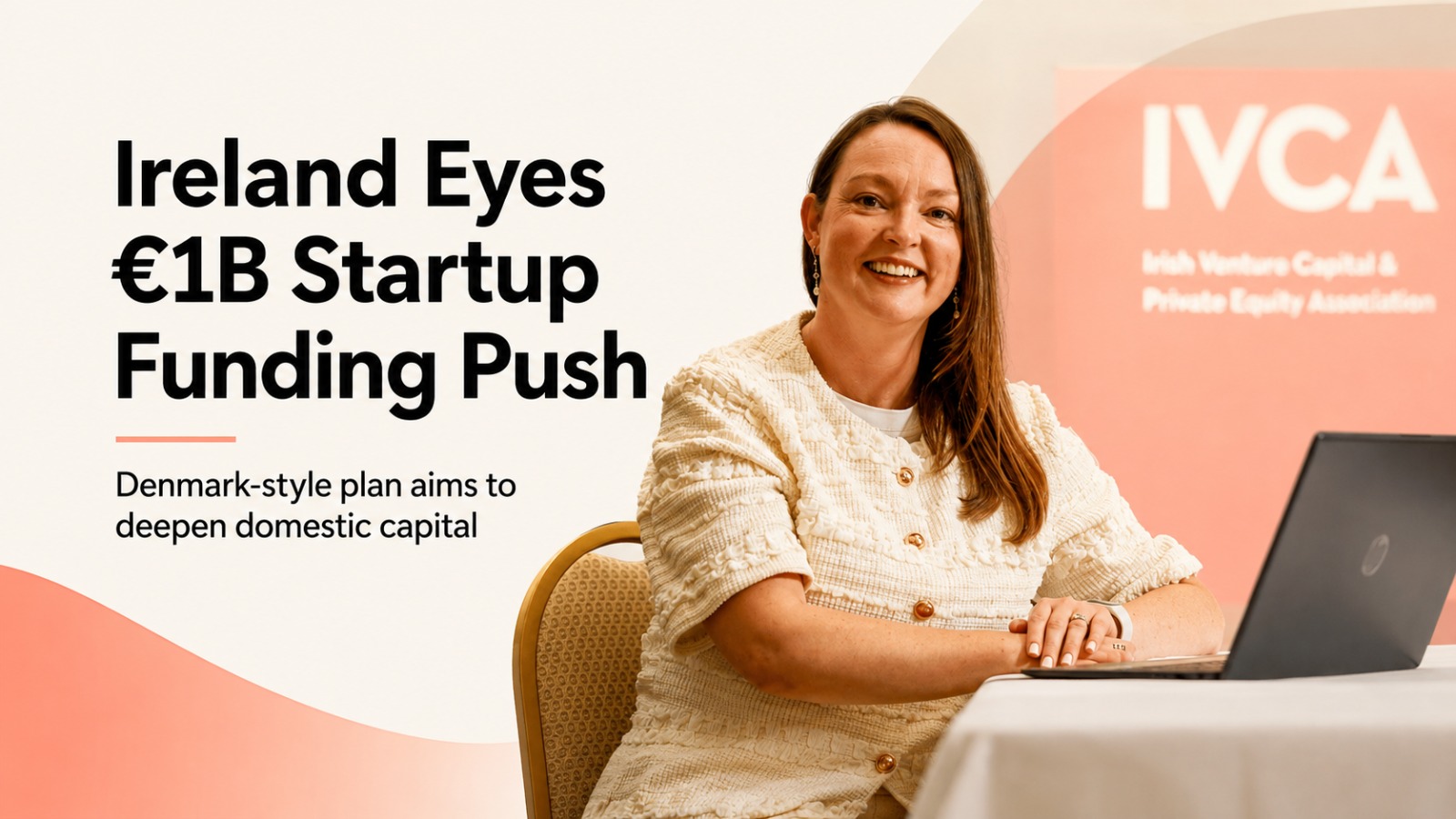
A proposal from the Irish Venture Capital and Private Equity Association would bring pension funds, insurers, banks and other institutional investors into a government-convened investment structure aimed at giving Irish startups more domestic capital as they scale.
Ireland is being urged to build a new €1 billion pool of private institutional capital for startups and scale-ups, with the country’s venture capital industry arguing that too many promising businesses still need to look abroad when their funding requirements become larger.
The proposal has been put forward by the Irish Venture Capital and Private Equity Association, or IVCA, as part of its Pre-Budget Submission 2027. Rather than calling for a large new government spending programme, the association wants the State to bring together pension funds, insurers, banks and other institutional investors through a dedicated fund-of-funds structure.
The timing of the proposal reflects a problem the IVCA believes has become increasingly difficult to ignore.
Venture capital investment in the quarter fell by almost 60% to just over €221 million, according to IVCA Director General Sarah-Jane Larkin. More strikingly, 85% of the capital raised during the period came from international investors.
For the association, those numbers do not suggest that Ireland lacks investable companies. Its concern is that the domestic funding base is not deep enough to support businesses through larger growth rounds, leaving companies more exposed to conditions in international capital markets.
The funding gap appears as companies get bigger
Ireland has mechanisms for supporting businesses at an earlier stage, but the IVCA sees a more pronounced shortage of domestic money once companies move towards late Seed, Series A, Series B and subsequent scale-up rounds.
That distinction sits at the heart of the proposal.
The association argues that Irish companies can get started at home but often need to approach international investors when they require significantly larger amounts of capital. IVCA Chairperson Richard Watson said Ireland has a strong record of helping startups get off the ground through Enterprise Ireland and the Ireland Strategic Investment Fund, but that institutional funding for the scaling stage remains a weakness.
The wider funding picture also shows how concentrated startup investment can become.
Funding announcements covered by EU-Startups in Ireland during 2026 amounted to approximately €350.4 million. Four companies, Fonoa, Neurent Medical, Equal1 and CameraMatics, accounted for as much as €256.9 million of that figure, roughly 73% of the total. Smaller Seed and pre-Seed rounds continued across areas including artificial intelligence, HR software and industrial climate technology.
The IVCA’s argument is therefore not simply about increasing the number of startup deals. It is focused on creating a domestic source of capital capable of remaining involved when funding requirements become much larger.
Ireland could borrow from Denmark’s model
The proposed solution is a government-convened fund-of-funds model inspired by Denmark’s Dansk Vækstkapital.
Under the structure outlined by the IVCA, the Irish Government would help assemble institutional investors and could potentially participate as an anchor investor through the Ireland Strategic Investment Fund or a newly established vehicle.
Pension funds, insurers, banks and other institutions would then make multi-year commitments to approved Irish venture and growth funds.
Importantly, the association is not proposing that government officials make individual investment decisions. Those decisions would remain under private sector-led governance and commercial management.
Watson pointed to the Danish model as evidence that a similar structure can operate at scale, saying Dansk Vækstkapital has channelled more than €1.5 billion into domestic companies.
That approach gives the Irish proposal a different character from a conventional public funding scheme. The State’s intended role would be to help organise and catalyse capital rather than replace private investment.
A €1 billion ambition without a large new spending programme
One of the IVCA’s main selling points is that the plan is designed to mobilise private money without creating what it describes as a material new cost to the Exchequer.
Larkin said the objective would be to use a limited portion of existing ISIF capital strategically to help convene and structure a much larger pool of private investment.
The association is also looking beyond institutional investors for possible longer-term sources of capital.
It sees Ireland’s proposed Personal Investment Account as one route that could eventually allow part of household investment savings to reach productive domestic assets through a professionally managed structure.
A separate recommendation concerns Ireland’s auto-enrolment pension system. The IVCA has proposed an opt-in mechanism for new entrants that would allow savers to direct a small proportion of their contributions towards a vehicle supporting Irish enterprise.
Both ideas remain proposals rather than established funding mechanisms.
Ireland is part of a wider European capital debate
The push to direct more long-term savings towards domestic companies is not unique to Ireland.
The IVCA points to initiatives including France’s Tibi Initiative, Denmark’s Dansk Vækstkapital, the UK’s Mansion House reforms, Germany’s Deutschlandfonds, the Dutch Venture Initiative and the European Tech Champions Initiative managed by the European Investment Fund.
The common theme is an effort to connect institutional savings with venture capital and private-market investment, particularly as European countries look for ways to help growing companies secure larger funding rounds without relying as heavily on capital from elsewhere.
For Ireland, the immediate question is whether the Government takes the IVCA’s recommendations into Budget 2027.
If it does, the proposal could alter the way growth-stage companies access capital by giving Irish venture and growth funds a deeper pool of domestic institutional money to draw from.
If it does not, the issue identified by the industry remains unchanged: Ireland may continue producing startups capable of attracting investment, while relying heavily on international investors when those businesses reach the stage where substantially more capital is required.
Also Read: Why Meta Is Paying Up to $16.68 Billion in Teen Safety Lawsuit?