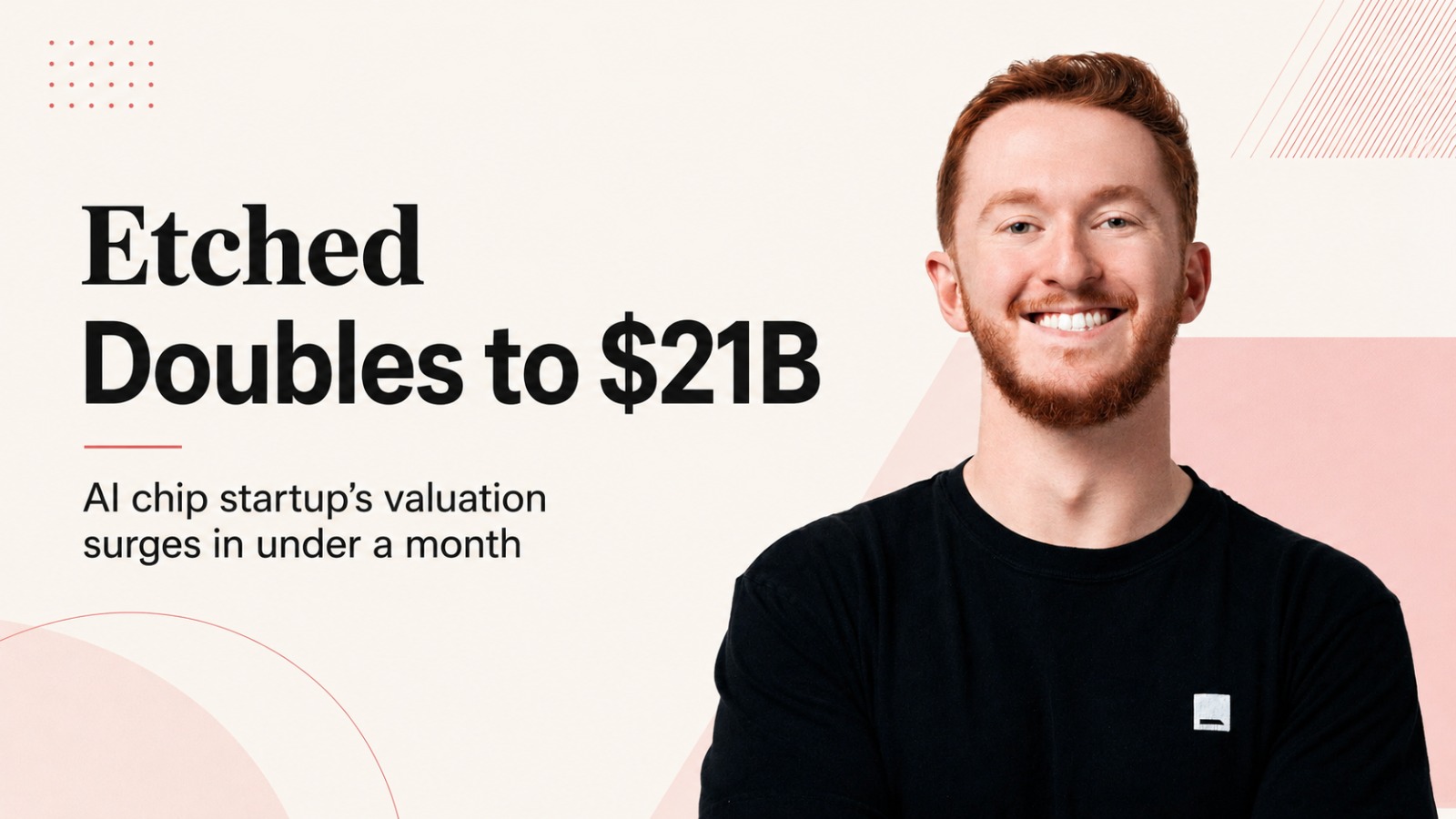
AI chip startup Etched has raised $700 million at a $21 billion valuation, extending one of the fastest valuation climbs in the current AI infrastructure market as investors back its attempt to make artificial intelligence inference faster and less expensive.
Jane Street led the latest financing after testing and buying Etched’s AI hardware. The trading firm is not only an investor, but also the startup’s first customer, giving the funding round an unusually direct connection to real-world deployment.
Etched’s valuation has moved at a remarkable pace. The company was valued at $5 billion in December, then raised a $300 million Series C at a $10.3 billion valuation in July. The latest round takes that figure to $21 billion, an increase of nearly $11 billion in roughly a month.
The San Jose, California-based company has now raised $1.9 billion in total funding and says it has secured more than $1 billion in customer contracts across public and private AI companies and cloud providers.
Jane Street is already running Etched hardware
One of the more significant details behind the latest financing is Jane Street’s role beyond the cap table.
Etched said Jane Street is its first customer and received its first rack last month, with the trading firm now deploying the technology in its workloads.
Jane Street has also publicly discussed its experience with the hardware. The firm said it had tested Etched’s chip and was pleased with the early results, adding that the startup’s inference approach offered the precision needed for demanding workloads. Jane Street also said it now has its own Etched rack running in its data center.
That customer relationship gives Etched something more concrete than investor enthusiasm alone. Its lead backer has evaluated the hardware, purchased it and begun using it.
Co-founder Robert Wachen explains Etched’s inference bet
Etched co-founder and Chief Operating Officer Robert Wachen said investor enthusiasm is tied to two components the company designed from scratch to accelerate inference, the computing process that takes place after a user submits a prompt to an AI model.
Etched sells its AI technology as complete systems that it calls “frontier inference clusters.” The company’s focus is not simply on producing an individual accelerator, but on building systems designed around the economics and performance requirements of running frontier AI models.
Wachen described inference as having two main stages: prefill and decode.
During the prefill phase, the system processes and understands the user’s prompt and its surrounding context. That stage is mathematically and computationally intensive. The decode stage is more memory intensive and is responsible for generating the output tokens that ultimately form the answer shown to the user.
That distinction is central to Etched’s hardware strategy.
Etched built separate technology around prefill and decode
For the prefill stage, Etched developed a chip that operates at low voltage. According to the company, that design allows it to pack in more transistors while avoiding some of the heat challenges associated with high-end AI chips, with the aim of processing more tokens at higher speed.
For decode, Etched created a new type of memory and interconnect system it calls cluster-scale memory. The architecture is designed to allow multiple chips to connect to a shared pool of memory with very low latency.
The company says the combination can deliver higher speeds at lower cost.
That performance-versus-cost equation is becoming increasingly important as more companies move from training AI models to serving them at scale.
Kleiner Perkins Managing Partner Mamoon Hamid said inference is becoming one of the most important infrastructure markets in artificial intelligence, with winning systems likely to be judged by how many tokens they can produce for each dollar and watt consumed.
Etched says its systems are no longer tied to one AI model
Etched is also trying to move beyond an assumption associated with its earlier technology strategy.
The startup originally intended to design chips around particular frontier models, creating the impression that individual chips would effectively be tailored to one model. That is no longer the company’s approach.
Etched now says its systems can run any frontier model, rather than being restricted to a single model architecture.
That shift matters commercially because AI models and architectures continue to evolve quickly. Hardware capable of supporting different frontier models can address a broader range of customers than technology built around one specific model.
From $5 billion to $21 billion
The scale and speed of Etched’s valuation increase stand out even in an AI funding market accustomed to large rounds.
The company moved from a $5 billion valuation in December to $10.3 billion in July and $21 billion in August.
Etched also has more than 400 employees and a working chip, while customer contracts have crossed $1 billion.
Those figures help explain why its latest round is about more than expectations for a future product. The company has hardware, contracted business and at least one major customer already putting its system into operation.
A wider group of investors is backing the company
Jane Street led the $700 million round, with Kleiner Perkins, Sequoia and Andreessen Horowitz among the participating investors. Reuters also identified Tiger Global among the backers of the financing.
Etched’s wider investor base includes Kleiner Perkins, Sequoia Capital, Andreessen Horowitz, Peter Thiel, Tiger Global, Bain Capital Ventures, Neo, Stripes, Primary, Positive Sum, Diffusion, Argo and Blackstone, according to TechCrunch.
The breadth of that backing reflects the amount of capital chasing alternatives in AI computing infrastructure, particularly systems aimed at inference.
The next AI chip battle may be about inference economics
Etched is entering a market where Nvidia remains the dominant force in AI chips, but the startup is focusing on a narrower question: how efficiently can increasingly large AI models be served once they are trained?
Reuters described Etched as part of a growing group of startups trying to challenge Nvidia’s position in the AI chip market.
For Etched, the latest $700 million round gives it substantially more capital to pursue that challenge.
But the more revealing part of the story may be what has happened alongside the valuation increase. The startup has moved from a $5 billion valuation in December to $21 billion, secured more than $1 billion in contracts, developed a working chip and seen its lead investor put an Etched rack into its own data center.
That combination of capital, customer commitments and hardware deployment is now at the center of Etched’s pitch as it tries to establish itself in the rapidly expanding market for AI inference infrastructure.
Also Read: Christopher Nolan’s The Odyssey Becomes BFI IMAX’s Biggest Film Ever