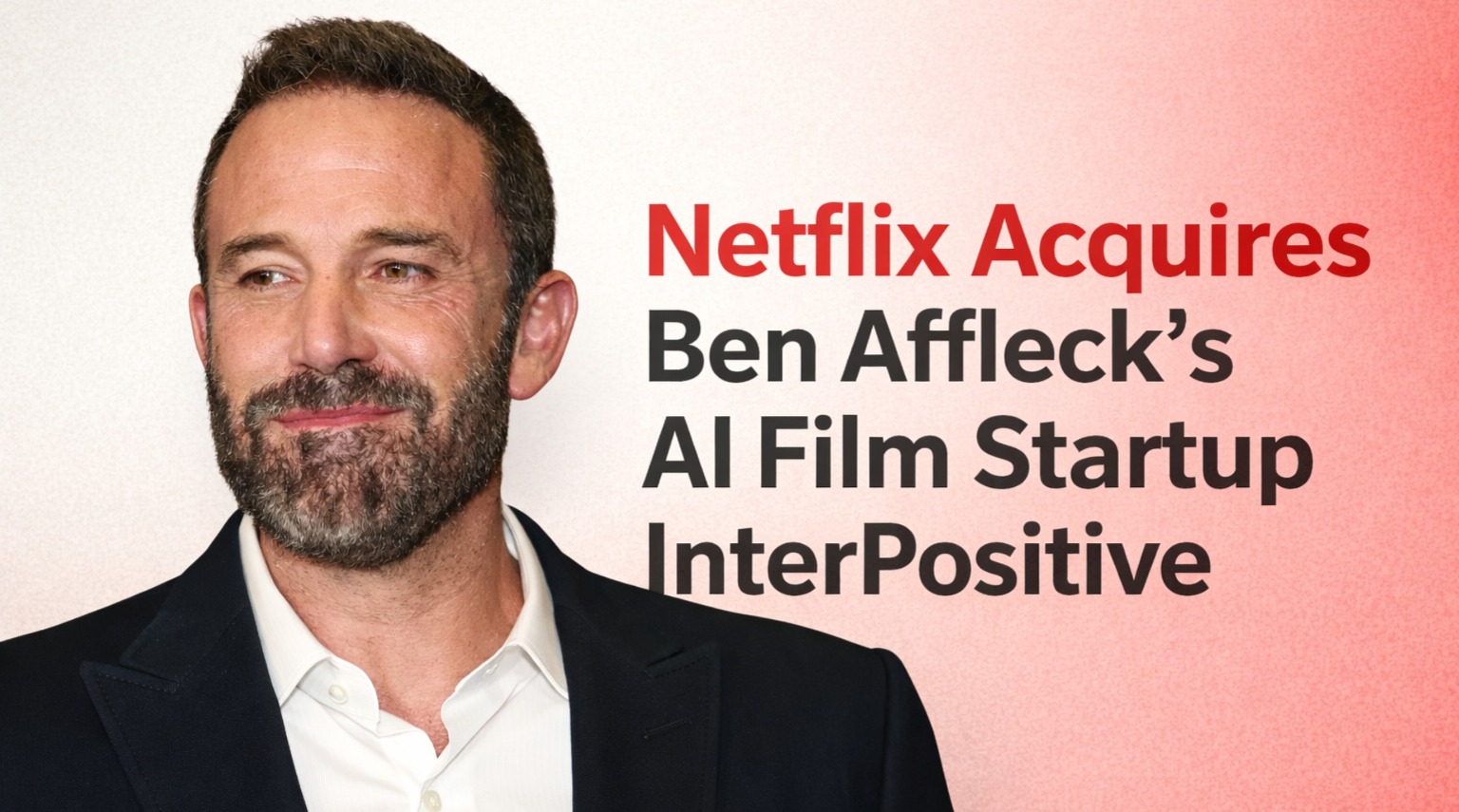
Netflix has acquired InterPositive, the film technology startup founded by actor-director Ben Affleck, in a move that could deepen the streaming giant’s push into AI-assisted production while reopening a wider debate in Hollywood over where technology should stop and creativity begin.
The deal may not carry the scale or spectacle of a studio takeover, but it signals something potentially more consequential: a growing willingness among major entertainment companies to invest in tools that reshape how films and series are made behind the scenes.
According to the information provided, InterPositive has been developing artificial intelligence tools for filmmakers, with a focus not on replacing the filmmaking process, but on assisting artists during post-production. That distinction matters, especially at a time when AI remains one of the most divisive subjects in the creative economy.
Affleck himself appears aware of that discomfort. He acknowledged the suspicion surrounding AI in filmmaking and did not try to dismiss it. Instead, he framed his involvement as a response to it.
“I understand the skepticism because I share it,” Affleck said, adding that he was concerned the technology could evolve outside the ecosystem of filmmakers and artists.
That quote sits at the centre of the story. For months, the AI conversation in film has largely been defined by anxiety, about jobs, authorship, control and the future of human creative work. What makes this acquisition notable is that it is not being pitched, at least from the details available, as a machine-first model of content creation. It is being presented as a filmmaker-first attempt to keep AI inside the production process, not above it.
InterPositive’s approach, as described in the source material, is built around traditional filmmaking. Film and television creators still have to shoot original footage. The AI layer comes later, during post-production, where the tools can help with tasks such as removing wires from stunts, reframing shots, recovering a missed shot, shaping lighting and enhancing backgrounds.
That is a crucial difference in an industry where the fiercest criticism has often been directed at generative AI systems that appear to create visual material from scratch. Affleck drew that contrast directly, describing the kind of generative AI many people fear as “making something from nothing.” By comparison, the tools linked to InterPositive appear to work on footage that has already been created by a human-led production.
Even so, the acquisition is unlikely to quiet concerns overnight.
The source material notes that many people working in creative fields have been skeptical of AI because of fears that the technology could threaten jobs. That fear is not unique to Hollywood. Across industries, AI’s rise has been accompanied by warnings that increasingly capable systems could automate large sections of work once thought to require human judgment.
In entertainment, those worries cut especially deep because film and television are collaborative industries built on specialist labour. Editors, visual effects teams, lighting artists, post-production professionals and other behind-the-camera workers have all become part of the broader AI debate. Any tool that promises efficiency also raises a difficult question: efficiency for whom, and at whose expense?
That is why Netflix’s acquisition of InterPositive will be watched closely. Not just because Ben Affleck’s name guarantees attention, but because the purchase touches a much bigger industry fault line. If a global streaming company starts integrating AI-assisted tools more deeply into production, others may follow. If the tools are seen as enhancing human work, they may gain acceptance. If they are viewed as a shortcut around skilled labour, resistance will grow just as quickly.
The report you shared also points to another layer of the debate that is increasingly hard to ignore: sustainability. AI systems are powered by data centres that consume large amounts of electricity and water. The document notes that growing data-centre demand has raised broader questions about whether rapid AI expansion can coexist with environmental goals.
That makes this story larger than a single entertainment deal. It sits at the intersection of three tensions shaping modern media: the race for technological advantage, the protection of creative labour and the environmental cost of digital scale.
For Netflix, the acquisition suggests the company is looking beyond content libraries and franchises and toward the tools that may define future production workflows. For filmmakers, the message is more complicated. The company is not just buying technology; it is buying into a version of AI that claims to remain anchored to human-made work.
Whether that promise holds will depend on how such tools are used in practice.
For now, the most revealing part of the story may be Affleck’s own framing. Rather than championing AI as an unstoppable revolution, he appears to be arguing for participation over surrender, that if the technology is going to shape filmmaking anyway, filmmakers should help shape it first.
That argument will resonate with some and alarm others. But it captures the tension of this moment in Hollywood perfectly: AI is no longer a distant possibility. It is entering the production pipeline, one acquisition at a time.
Also Read: Have You Bought Noice Without Knowing It’s Swiggy’s?