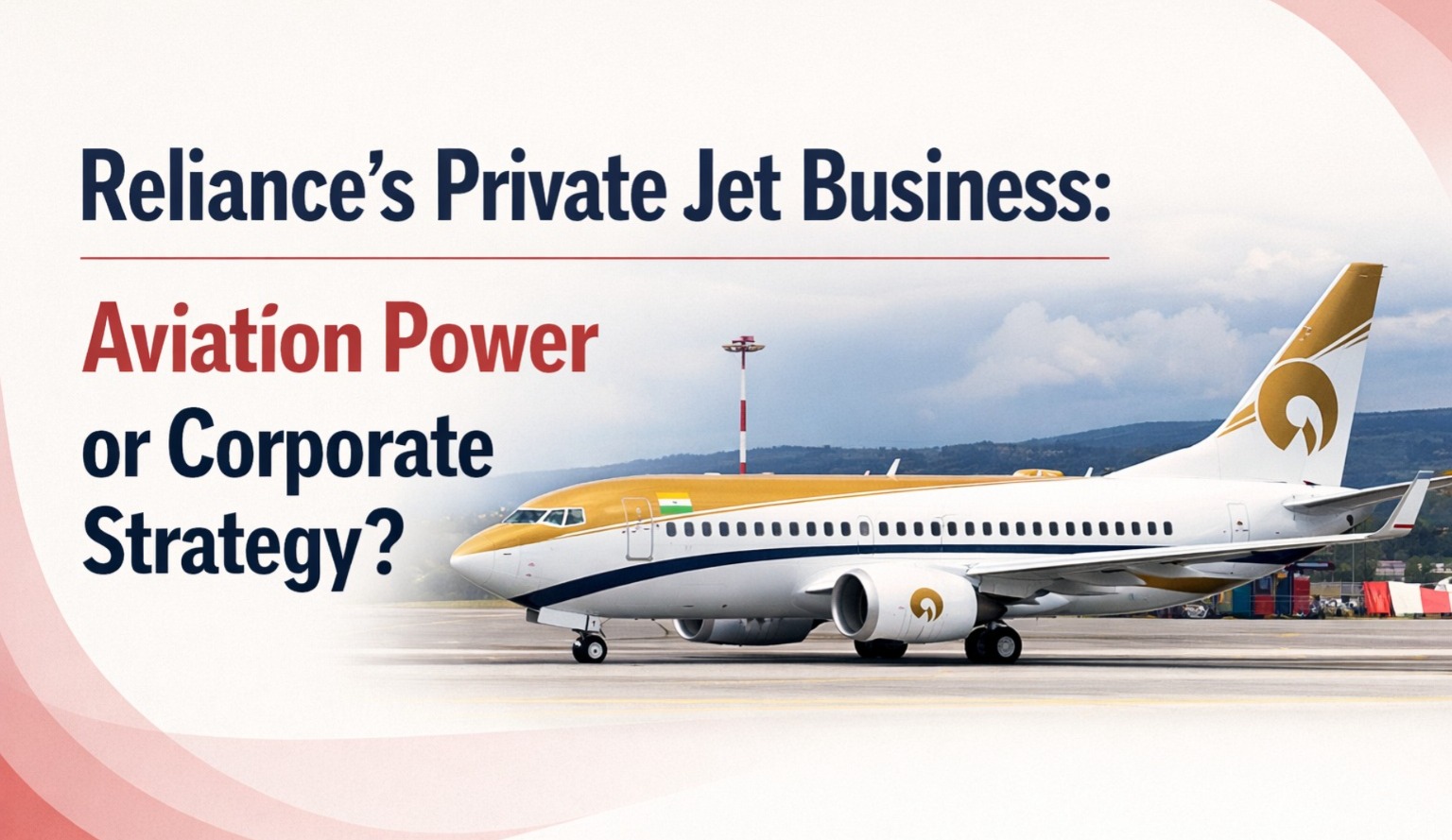
Reliance Aviation subsidiary, Reliance Commercial Dealers Ltd (RCDL), has come under fresh discussion after finance analyst Jayant Mundhra detailed how the company’s aircraft operations function less like a conventional charter business and more like a strategic mobility arm for the Ambani family and senior Reliance leadership.
The discussion, which has gained traction across business circles online, shifts focus from luxury aviation to something far more operational: how large conglomerates structure executive travel to gain speed and flexibility in global dealmaking.
The Reliance aviation arm few talk about
RCDL, a subsidiary of the Reliance group, flies planes under a Non-Scheduled Operator’s Permit (NSOP), which is a type of license that is used for commercial charter flying. According to Mundhra’s observations, this type of license enables the planes to be used for chartered transport services, as opposed to being used as private aircraft.
In other words, this enables the planes that are owned by the subsidiary to be chartered for use by the corporate group. According to Mundhra, Reliance Industries paid RCDL ₹1,100 crore for flying services in FY25.
The result is a business unit that reports large revenues while primarily serving the mobility needs of its own parent company.
A fleet built for speed, not spectacle
The discussion also throws light on the scale of the aviation assets operated by RCDL. Mundhra estimates the fleet’s combined value to be well over $500 million, comprising long-range business jets, executive aircraft and helicopters that serve both corporate and logistical requirements.
Among aircraft associated with the operation are:
• A Bombardier Global 7500, one of the longest-range business jets in operation, capable of ultra-long-haul routes.
• A Bombardier Global 6000, commonly deployed for intercontinental corporate travel.
• An Embraer ERJ-135, used for shorter executive shuttle missions.
• A Dassault Falcon 900EX, another long-range corporate jet.
• Sikorsky helicopters, typically used for regional mobility and quick point-to-point access.
• A Boeing 737-700 BBJ, a customised business jet variant suited for larger delegations.
Together, the fleet gives Reliance leadership the ability to move across geographies rapidly, often covering multiple continents in a matter of days when negotiations or project reviews demand physical presence.
Infrastructure advantages
Mundhra’s post further highlights operational infrastructure supporting the fleet, including dedicated hangar access at Mumbai airport and operations linked to Jamnagar’s civil enclave. Such arrangements, he argues, reduce turnaround delays and increase deployment efficiency compared to relying solely on commercial airline schedules.
In industries where negotiations, site visits, and partnerships stretch across continents, mobility becomes a competitive factor rather than a luxury.
When mobility becomes strategy
Corporate aviation experts have long noted that dedicated fleets allow large business groups to compress travel time, align leadership availability with opportunity windows, and maintain flexibility during high-stakes negotiations.
Mundhra frames RCDL in this context: not merely as an aviation subsidiary, but as an internal logistics engine that ensures Reliance leadership can operate globally without being constrained by commercial flight networks.
In sectors such as energy, infrastructure, technology and global partnerships, where Reliance has expanding interests, rapid mobility can significantly shorten deal cycles.
Business optics versus operational reality
The debate sparked by Mundhra’s analysis centres on optics. On paper, RCDL appears as a charter aviation company generating substantial revenue. In practice, much of that revenue may come from servicing internal group requirements.
Supporters of such structures view them as efficient corporate planning. Critics argue they blur lines between commercial operations and internal usage. Either way, the renewed attention has highlighted a little-known but significant part of Reliance’s corporate machinery.
More than luxury
What becomes apparent from this discussion is that there is a shift in perception when it comes to corporate aviation. For large conglomerates, their aircraft fleets are no longer viewed as a luxury but as a necessity, much like their data or logistics networks.
As apparent from Mundhra’s entry, it is not the luxury of the aircraft that matters but what it represents: speed, control over one’s schedule, and the ability to be wherever business takes one, often on short notice.
And in global business, speed often translates into advantage.
Also Read: Have You Bought Noice Without Knowing It’s Swiggy’s?