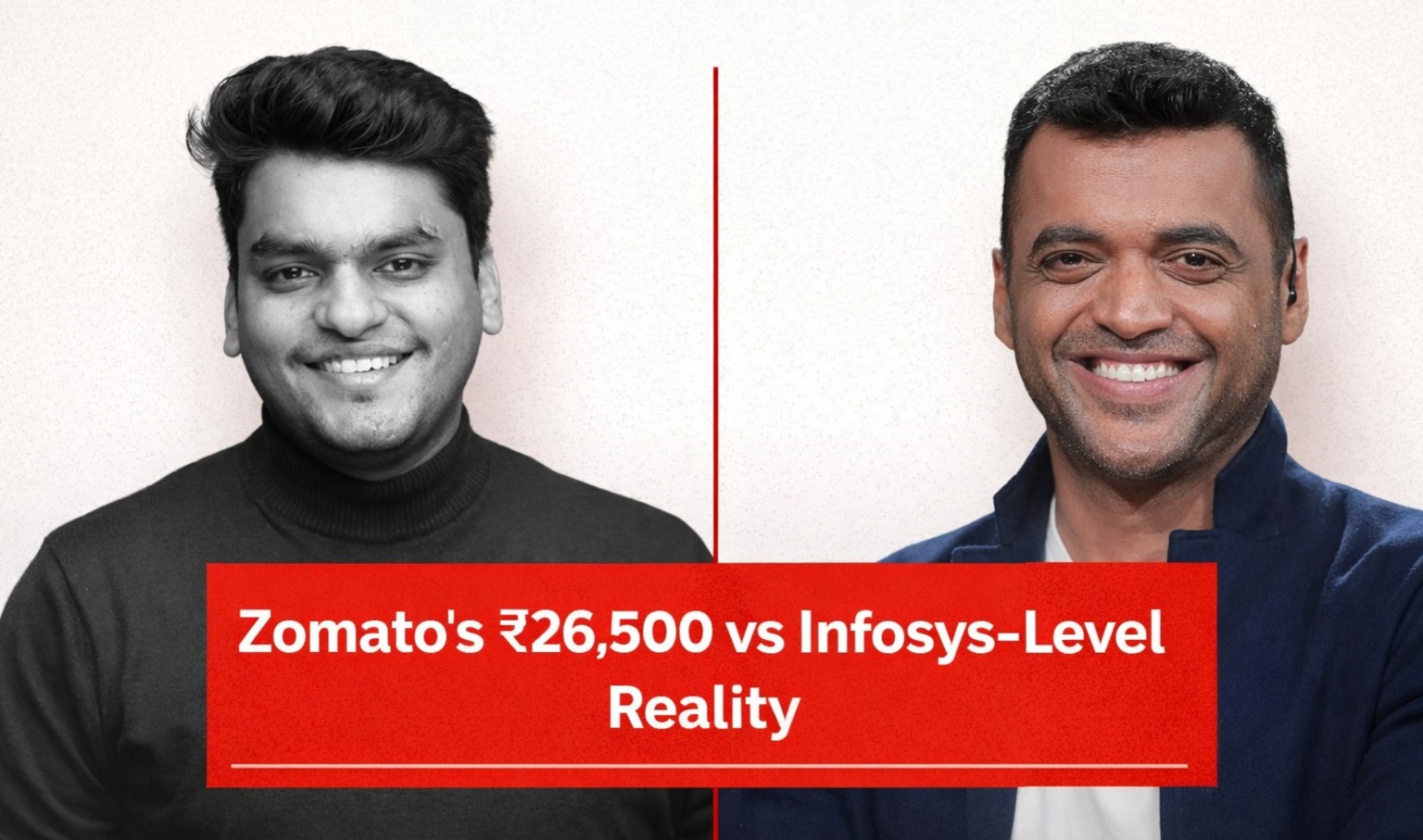
In 2025, Zomato delivery partners earned an average of ₹102 per hour, excluding tips. That was up from ₹92 in 2024, a 10.9% year-on-year increase, according to Zomato CEO Deepinder Goyal.
In a detailed post on X, Goyal argued that earnings per hour (EPH) have shown steady growth over the years. He added that if a delivery partner were to work 10 hours a day for 26 days a month, gross earnings would amount to ₹26,500, and after accounting for fuel and maintenance costs of around 20%, net earnings would be approximately ₹21,000 per month.
The post was positioned as a data-backed clarification of how delivery partner earnings are calculated. Instead, it triggered a renewed debate over how gig-economy income should be understood and whether headline earning potential reflects how platform work actually functions.
How Deepinder Goyal explains Zomato’s earnings math?
Goyal clarified that Zomato’s earnings per hour metric is calculated on total logged-in time, including periods when a partner may be waiting for an order. He explicitly rejected the idea of using “busy hour” earnings, stating that while earnings during active delivery time would be higher, it would be a misleading metric.
He also pointed out the earning facility through tips. The average tip per hour in 2025 was ₹2.6, up from ₹2.4 in 2024, according to the data provided by Zomato. The tips are shared in full with the delivery partner. There is no deduction, and the company bears the payment gateway charges. Approximately 5% orders get tips on Zomato, and 2.5% orders get tips on Blinkit.
Zomato’s central argument is clear: hourly earnings are rising, costs are transparently accounted for, and partners retain full tip income.
Where the counterargument begins
Chartered accountant Aditya Agarwal does not directly dispute Zomato’s ₹102 per hour figure. His critique focuses on what he describes as the context missing from the headline narrative.
According to Agarwal, while Zomato’s example demonstrates what is possible, it does not reflect what is typical.
The reason lies in a statistic that appeared in the same discussion: the average delivery partner worked only 38 days in the entire year 2025.
This single number, Agarwal argues, fundamentally changes how monthly earning projections should be interpreted.
Annual participation versus monthly projections
Zomato acknowledges that most delivery partners work for a few hours and only a few days in a month. Agarwal takes that statement to its logical conclusion.
Using Zomato’s stated average of 7 hours per working day, 38 working days translate to 266 hours of work in a full year.
Even at a conservative ₹70 per hour net, after fuel, maintenance, penalties, and waiting time, this results in ₹18,620 in annual earnings, or ₹1,551 per month when averaged across the year.
This is where Agarwal identifies what he calls a 95% gap between the ₹26,500 monthly earning potential presented in the post and the income implied by average annual participation.
The larger gig economy fault line
This disagreement goes beyond Zomato and into a long-running gig-economy debate in India: Should platforms be evaluated on peak earning scenarios or on the statistical experience of the average worker?
Zomato’s defence rests on transparency, it publishes hourly rates, includes waiting time, and clarifies costs. Critics argue that monthly income framing, even when labelled as “possible,” risks overstating opportunity in a system where work availability is inconsistent.
The tension is not about whether some delivery partners can earn more, they can. It is about whether monthly income projections make sense in a workforce where engagement itself is irregular.
Why the Infosys comparison struck a nerve
While Agarwal’s calculations spread on social media, comparisons began to appear between platform earnings for an average annual period and starting salaries in companies such as Infosys, where salaries are fixed.
The reason why this analogy was resonant is that it was similar not in the nature of the employment but in the fact that it highlighted the discrepancy in the nature of the compensation.
An unresolved question
Zomato’s data shows rising hourly earnings and improved transparency. Agarwal’s critique shows how those same numbers tell a very different story when viewed annually. Both can be true at the same time.
What remains unresolved and central to India’s gig economy future. is whether income discussions should focus on earning rates or on earning consistency.
Also Read: Proptech Startup Flent Raises $2.5 Million in Pre-Series A Funding Round