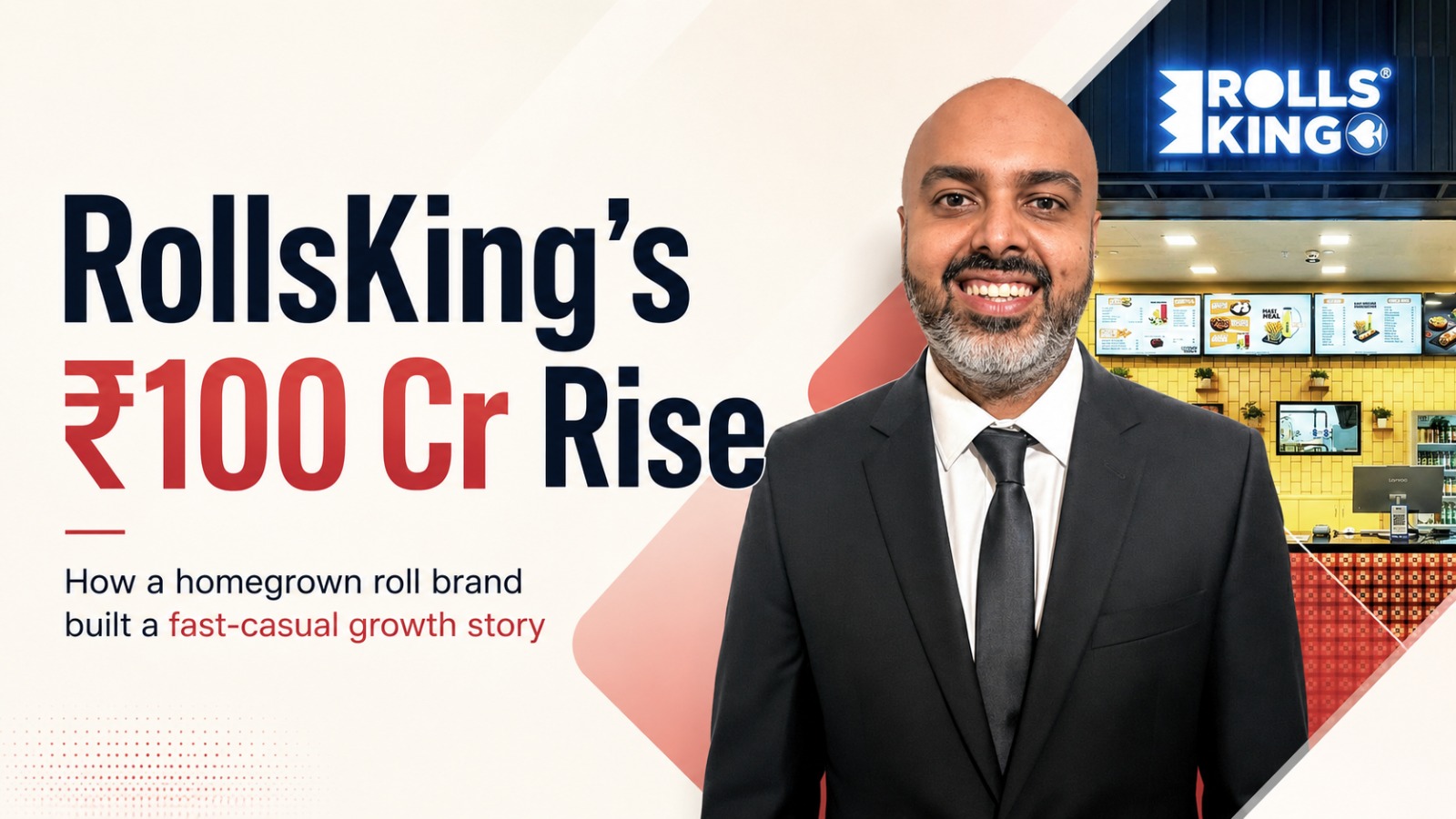
India’s quick-service restaurant market has long been shaped by burgers, pizzas and fried snacks. RollsKing is trying to build its story around something far more familiar to Indian consumers: the roll.
Founded in 2011 by Pradeep Kumar and Arjun Toor, the brand has grown into a QSR chain with more than 130 outlets across over 15 cities. Its core bet is simple. Urban India wants food that is quick, filling, easy to carry and suited to irregular eating hours. RollsKing calls this idea “One-Hand Meals”, a phrase that neatly captures the company’s focus on rolls, wraps and similar grab-and-go formats.
The brand’s rise comes at a time when consumers are moving between offices, colleges, commutes, malls, delivery apps and late-night work schedules. Formal meal times are becoming less rigid, and convenience is no longer just a selling point. For many young urban consumers, it is the starting point.
Building Around a Local Format
What makes RollsKing’s positioning interesting is that it has not tried to copy the global burger or pizza playbook. Instead, it has taken the Indian kathi roll and built a scalable fast-casual model around it.
The menu is centred on kathi rolls, shawarmas and wraps, supported by in-house breads, sauces and marinades. This allows the brand to keep the product familiar while standardising preparation across outlets. For a QSR chain, that balance matters. Food must feel fresh and local, but operations need to remain repeatable.
The company’s internal philosophy, “One-Hand Meals for Two-Speed India”, reflects the eating pattern it is trying to own. The customer could be an office-goer eating between meetings, a student grabbing a quick bite, a night-shift worker ordering late, or a commuter looking for something filling without sitting down for a full meal.
That clarity gives RollsKing a sharper identity in a crowded QSR market where many brands compete mainly through discounts, delivery visibility and menu clutter.
The Network: High-Street Stores, Malls and Cloud Kitchens
RollsKing now operates through a mix of high-street QSR outlets, mall food courts and cloud kitchens. Out of its 130-plus service points, nearly 58 are cloud kitchens, while more than 72 are dine-in or takeaway QSR formats.
The company has also chosen a model that keeps control close. Nearly 75% of its network is company-owned and company-operated, while the remaining 25% follows the FOFO model. This gives the brand room to expand while retaining control over product quality, store operations and customer experience.
Its presence is already visible across major North Indian markets such as Delhi NCR, Gurgaon, Noida, Faridabad and Jammu. The brand has also expanded into southern and western markets including Bangalore, Hyderabad, Chennai, Mumbai and Pune.
The next focus is clear: South and West India. These regions are seeing growing demand for convenience-led meals, and RollsKing is looking to deepen its presence there through both physical outlets and delivery-first infrastructure.
Revenue Growth and the Road Ahead
RollsKing’s numbers show a business moving from regional recognition to national ambition.
The company clocked ₹90 crore in operating revenue in FY25-26, marking nearly 20% year-on-year growth. It is projecting operating revenue of more than ₹110 crore for FY26, with expected growth of around 18%. The wider revenue ambition is even sharper, with the brand targeting over ₹135 crore in FY26-27.
From FY27, RollsKing is aiming for annual growth of 25% to 30%, followed by a 50% growth target for FY28. Its three-year roadmap includes scaling to 300 outlets across India.
That expansion target is not only about store count. The company is also trying to strengthen its position in what it sees as the “global street food” category, with rolls and wraps at the centre. The opportunity lies in creating a format that feels Indian in taste but can be scaled like a modern QSR product.
Why RollsKing Is Being Watched?
RollsKing’s growth story stands out because it is not built only on novelty. Rolls are already part of India’s eating culture. The brand’s challenge is to convert that familiarity into a structured, repeatable and organised QSR business.
The company serves more than 300,000 monthly orders and maintains strong consumer ratings across delivery platforms. It has also managed to operate across both dine-in and delivery channels, an important balance in a post-pandemic food market where many brands have struggled to make both formats work equally well.
Its next product pipeline includes Khameri Wraps, Crispy Shawarmas and Tandoori Tacos in FY27. At the same time, the company plans to invest deeper in cloud kitchen infrastructure in cities such as Mumbai and Bangalore.
This combination of new products, store expansion and delivery efficiency suggests that RollsKing is not just trying to sell more rolls. It is trying to build a broader fast-casual platform around portable meals.
A Familiar Food, a Modern Business Model
The Indian QSR market is full of brands trying to sound global. RollsKing’s bet is different. It is taking something Indian consumers already understand and presenting it in a faster, cleaner and more scalable format.
The road ahead will depend on consistency. As the chain expands to more cities and more outlets, maintaining taste, speed, pricing discipline and service quality will become more difficult. But the brand’s current structure, with a strong company-operated base, gives it a better chance of controlling those variables.
At its core, RollsKing’s story is about a simple consumer truth. India is eating on the move. The brand that can serve that customer quickly, affordably and consistently may find itself with a much larger opportunity than a single food category.
For RollsKing, the roll is no longer just a snack. It is the vehicle for a ₹100 crore-plus QSR ambition.
Also Read: Sydney Sweeney’s Anthropic Talks Show AI Is Entering Its Culture Era