Kusho AI Story: Software development has changed dramatically with the arrival of artificial intelligence. Writing code is getting faster, but keeping that code reliable after every new feature, integration and release remains a demanding job.
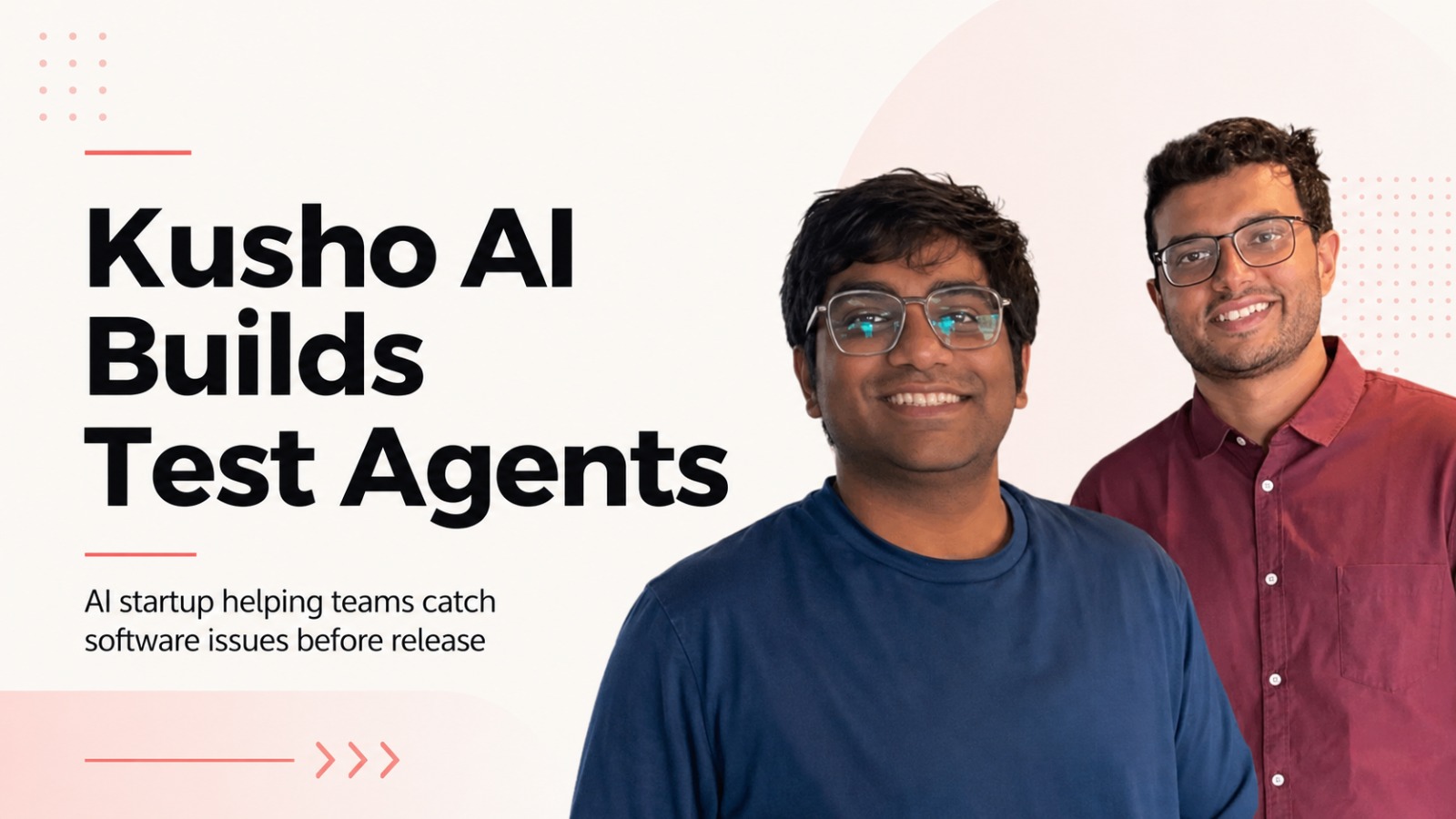
That is the problem Abhishek Saikia and Sourabh Gawande chose to work on.
Founded in 2023, Kusho AI is building AI agents that can generate, execute and continuously update software tests across APIs, web applications and mobile apps. From a seven-member team operating out of Bengaluru, the company says its platform has already generated and executed nearly 10 million tests.
For the founders, however, the story began before Kusho AI existed.
From product management and engineering to Kusho AI
Saikia, Kusho AI’s Co-founder and CEO, previously worked as a product manager at Flipkart. A BITS Pilani graduate in economics and chemical engineering, he later joined hands with his college batchmate Sourabh Gawande.
Gawande, now Co-founder and CTO at Kusho AI, had worked as a full-stack engineer at FalconX.
Their backgrounds brought together two sides of the same software problem: understanding how products behave in the real world and understanding what happens under the hood when software changes.
The company they built focuses on an issue familiar to almost every engineering organisation. Modern applications depend on APIs, workflows and third-party integrations, and every new release creates another opportunity for something that previously worked to fail.
Kusho AI is designed to automate much of the testing and maintenance work surrounding those releases.
Building an AI tester that stays with the software
The platform does more than generate a set of test cases once.
Kusho AI first develops an understanding of a company’s software environment. It then identifies important scenarios, creates the required tests, executes them and flags areas that need attention.
Its agents are designed to remain involved across the software release cycle.
Before code is merged, Kusho AI can automatically generate and run tests to identify risks. When software is ready to be released, the platform works as an additional checkpoint to assess whether the new code is ready for production.
When a release does not meet those checks, the platform can send it back with a report describing what needs to be fixed.
That role continues even after deployment.
As an application changes, Kusho AI can update its own tests to reflect those changes. The company describes this as a form of “self-healing” testing, reducing the need for engineers to repeatedly modify test cases by hand.
Every release also receives a risk score based on the underlying code changes and the tests that have been executed.
Saikia says the process can run “almost 100x more efficiently” and at a faster pace than manual testing. The comparison is the co-founder’s assessment of the platform’s performance.
Why one AI model is not enough?
One of Kusho AI’s more distinctive product decisions is not to rely on a single AI model for every testing problem.
Instead, the company operates what Saikia calls an “agentic orchestration layer”.
Different testing requirements can be routed to specialised models depending on the application being examined. Testing a banking API, for instance, is treated differently from testing an ecommerce platform.
Kusho AI combines proprietary models with foundational large language models. Saikia sees the company’s orchestration layer, along with the proprietary learning generated through product usage, as an important part of its technology advantage.
That learning loop also extends to its users. Free users can opt in to allow the platform to learn from how they use it, while Kusho AI tracks which automatically generated tests are retained or discarded and uses anonymised information to improve future recommendations.
Going after software where downtime matters
Kusho AI is not trying to position itself equally across every category of software.
Saikia describes the company’s ideal customers as organisations that “cannot afford even one minute of downtime”.
Banking and ride-hailing are among the sectors he points to, where even a short interruption in software availability can have an immediate business impact.
The startup says it now has more than 5,200 clients.
The scale of its developer reach is larger still. Kusho AI says around 35,000 developers and QA professionals use its free tier, while its platform has generated and executed nearly 10 million tests.
Developers first, enterprise conversations later
Rather than putting enterprise sales at the front of its growth strategy, Kusho AI has largely relied on developers discovering and trying the product.
The platform can be used for free without requiring payment details. That has allowed the company to spread through developer and quality assurance communities, supported by technical content rather than paid marketing.
As usage grows inside an engineering organisation, those individual users can eventually open the door to wider enterprise conversations.
The company has reported significant outcomes for some customers.
According to Kusho AI, an Indian payments platform reduced API testing time by 95%, while a private bank lowered annual QA costs by between 80% and 90%.
These figures are company-reported customer results.
Growing revenue and preparing for the next round
Kusho AI is also beginning to build a commercial business around that adoption.
Saikia says the company’s annual recurring revenue is in the “late six figures” in US dollars and is growing between 10% and 20% month on month.
The startup has so far raised $600,000 in pre-seed funding.
The round was led by Antler India, with participation from Blume Founders Fund and UpSparks Capital. Angel investors included Ultrahuman co-founders Mohit Kumar and Vatsal Singhal, as well as IDfy CEO Ashok Hariharan.
Saikia says Kusho AI plans to raise another funding round later in 2026 or early 2027.
Built in Bengaluru, looking towards the US
Kusho AI has an increasingly international shape.
The company is incorporated in the US and officially headquartered in San Francisco, but its founders are Indian and its seven-member team currently operates from Bengaluru.
The US already represents a large part of its business, accounting for 60% to 70% of its customers, according to the company. Kusho AI plans to establish a physical office in San Francisco in late 2026 or early 2027 as it expands that customer base.
Its next phase will also involve a sharper industry focus.
Over the coming year, Kusho AI plans to deepen its presence in banking and financial services, logistics and supply chain, and healthtech. The startup is targeting the 10 largest companies in each of those sectors.
The bigger ambition
Kusho AI operates in a growing AI-native software testing and reliability space alongside companies including Postman, Qodex.ai and Devzery.
But the founders’ longer-term ambition is broader than producing tests faster.
Saikia wants software maintenance to become automated enough that engineers can devote more of their attention to creating new products rather than repeatedly maintaining and checking what has already been built.
For a company founded only in 2023, the numbers already tell part of that journey: more than 5,200 clients, around 35,000 free-tier developers and QA professionals, nearly 10 million tests generated and executed, and a seven-member operating team.
The next test for Kusho AI will be turning that early adoption into a larger enterprise business while proving that AI agents can become a dependable part of how critical software is tested, released and maintained.
Also Read: Apple Begins iPhone 18 Pro Production in India for Global Exports