
Hyderabad’s deep-tech aerospace ecosystem has gained a fresh talking point with BluJ Aerospace unveiling Gen #2, a commercial-grade heavy-payload electric vertical take-off and landing aircraft designed for aerial logistics and future passenger mobility in India.
The aircraft, introduced by the city-based startup on Tuesday, is aimed at moving the company beyond demonstration flights and into a more application-focused phase. Gen #2 is currently undergoing active flight testing and has been developed for heavy-payload logistics operations.
What makes the launch significant is the stage at which India’s eVTOL space currently stands. While electric air mobility remains an emerging sector globally, BluJ Aerospace is positioning Gen #2 as a step toward indigenous aircraft development for practical use cases such as cargo transport, regional connectivity and future passenger movement.
BluJ Aerospace: Built After Four Years of In-House R&D
Gen #2 has been developed after four years of in-house research and development. It is the first aircraft built on BluJ Aerospace’s VANTIS platform architecture, which the company describes as a scalable framework for multiple VTOL aircraft variants.
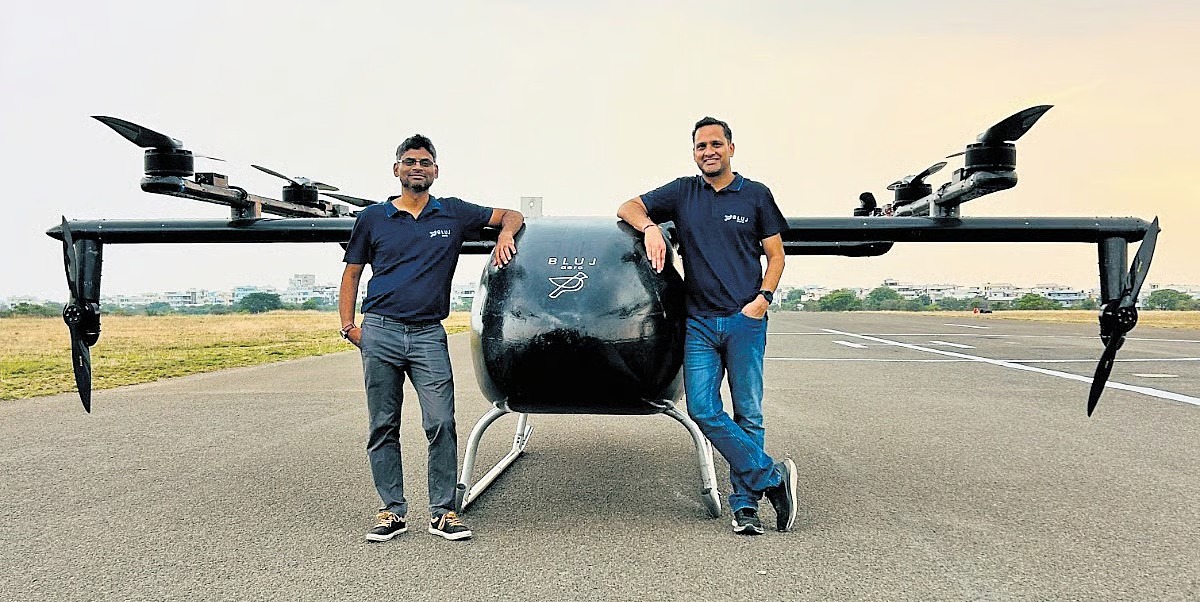
The platform has been designed to support cargo transport, regional connectivity and passenger mobility applications. In simpler terms, BluJ is not treating Gen #2 as a one-off aircraft. The company is building it as part of a broader platform approach that can be adapted for different aviation use cases over time.
A Heavy-Payload Electric Aircraft
Gen #2 is a fully battery-powered aircraft. It uses a lift-plus-cruise configuration, a design approach commonly associated with aircraft that need vertical take-off capability as well as efficient forward flight.
The aircraft is designed to carry payloads exceeding 200 kg while remaining under a 500-kg maximum take-off weight. Its initial use will focus on pilot projects, payload testing and logistics mission evaluations.
That makes the aircraft especially relevant for a future where aerial logistics may move from experimental discussions to structured operations, provided testing, certification and deployment pathways progress.
From Gen #1 to Gen #2
Founder and CEO Amar Sri Vatsavaya said Gen #2 builds on BluJ Aerospace’s earlier Gen #1 technology demonstrator. Gen #1 had achieved India’s first public flight demonstration of a 500-kg-class eVTOL aircraft.
With Gen #2, the startup appears to be moving from proof-of-capability toward a more mature aircraft meant for operational evaluation. The company’s stated long-term plans include one-tonne payload-class logistics aircraft and hydrogen-electric long-range passenger mobility variants.
India’s aviation conversation is often dominated by commercial airlines, airport expansion and aircraft manufacturing partnerships. BluJ Aerospace’s Gen #2 launch adds another layer to that story: the possibility of Indian startups building new categories of aircraft from the ground up.
For the time being, however, the aircraft is still under tests. The short-term strategy for this plane would involve pilot programs and logistics tests. Yet, the general trend is obvious. BluJ Aerospace believes that the next wave of transportation will not be confined to highways or airports only. It will feature electric vertical takeoff aircraft, which will have a capacity to transport loads and people.
In a sector where claims can often move faster than hardware, Gen #2’s importance lies in the fact that it is a physical aircraft now undergoing flight testing. The coming phase will decide how far it can move from a promising aerospace milestone to a working logistics solution.
Also Read: Ranveer Singh Brand Value, Net Worth and Investments