With Dhurandhar now being spoken of as a major box-office success, the conversation around Ranveer Singh is moving beyond cinema and into a different territory: the economics of personal branding.
For years, Singh has been one of Hindi cinema’s most visible stars, known for his screen presence, high-energy public persona and strong recall across audiences. But the larger story taking shape around him is not just about acting careers or blockbuster openings. It is about how modern celebrity works as an ecosystem, where films, endorsements, investments, businesses and lifestyle all feed into one another.
That is what makes the current Ranveer Singh narrative particularly interesting.
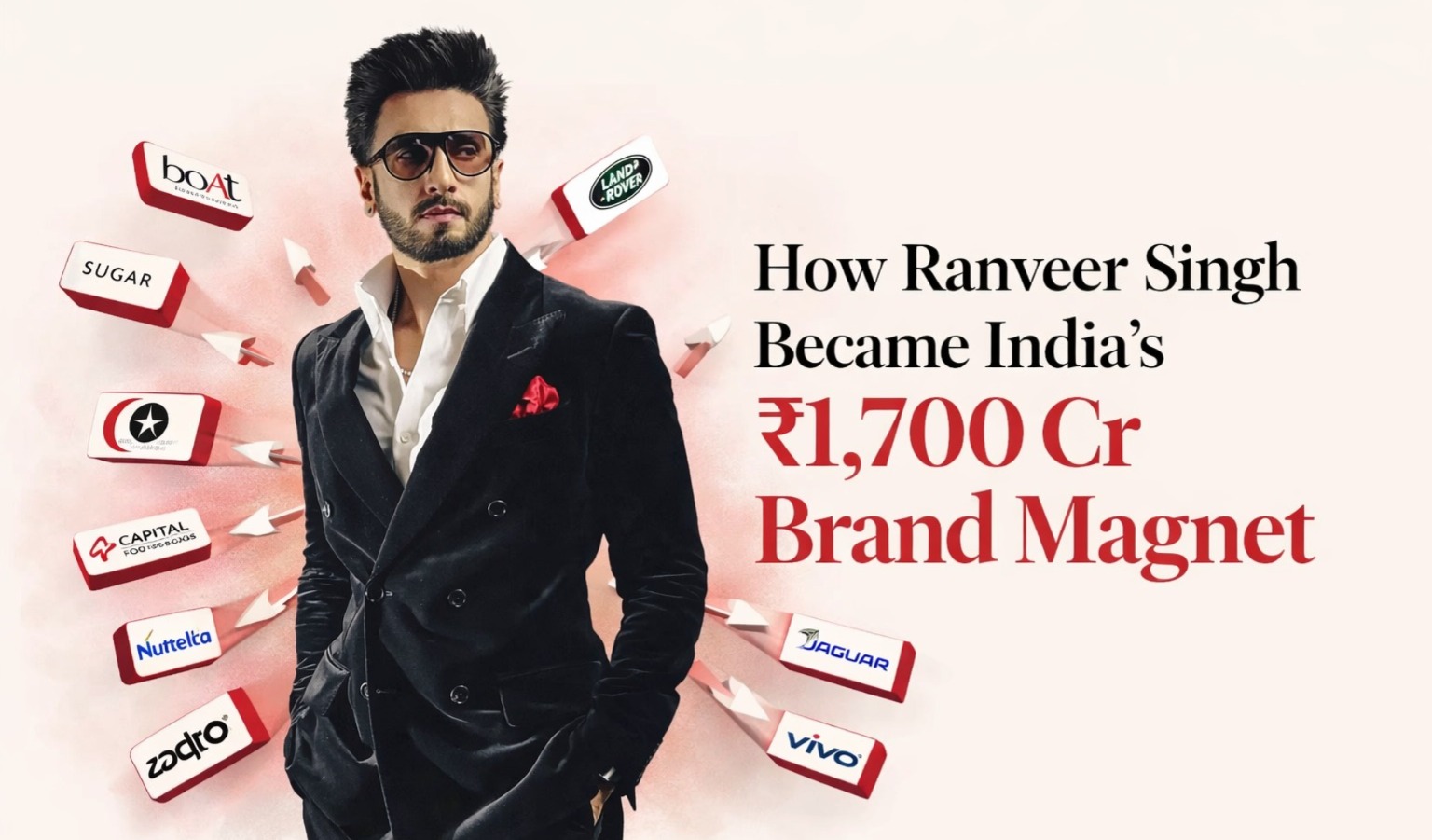
At one level, the financial numbers often associated with him point to a striking contrast: As per Himanshu Singhal of the Wharton School, a reported net worth of ₹400 crore and a brand value of ₹1,700 crore. Whether one looks at those figures as estimates or market signals, the larger point is difficult to miss. In the celebrity economy, perception can create a value that far exceeds direct earnings.
That gap matters.
It suggests that the real commercial strength of a star today lies not only in what they are paid, but in what their name can unlock. Visibility creates recall. Recall creates trust, aspiration or familiarity. And those qualities, once built at scale, travel well across sectors.
Cinema remains the foundation of that equation.
From Band Baaja Baaraat to Gully Boy, Padmaavat and Simmba, Singh’s filmography has helped him build broad recognition across very different audience segments. The significance of that journey is not just artistic or commercial. In brand terms, consistency over time matters because it keeps a public figure culturally present. And cultural presence, sustained over years, strengthens pricing power.
That is where the endorsement machine becomes important.
The list associated with Singh’s brand partnerships stretches across categories, banking, food, smartphones, travel, grooming, audio, beverages, fashion and automobiles. Among the names linked with him are Cult Fit, Capital Foods’ Ching’s Desi Chinese, Xiaomi, Kotak Mahindra Bank, Hummer, Nutella, Zomato, Tic Tac, SuperYou, Vivo, MakeMyTrip, PepsiCo, Marico’s Set Wet, JBL and Fastrack.
Read together, these are not just endorsement deals. They represent reach across consumer touchpoints.
That distinction is crucial.
In older celebrity models, endorsements were often seen as add-on income. In the newer model, they are part of a wider distribution network of influence. A star does not merely appear in campaigns; he carries audience attention from one category to another. The celebrity becomes a bridge between sectors, and the value lies in that portability.
Then comes the sharper layer: ownership.
Singh’s reported startup bets in names such as boAt Lifestyle and SUGAR Cosmetics point to a shift that is now increasingly visible among top celebrities. The logic is simple. Fees generate income. Equity creates upside.
That is a different way of thinking about fame.
Instead of treating visibility only as something to monetise in the present, it is used as leverage for future value. The move from endorsement to investment marks a more strategic relationship with capital. It is not just about lending a face to a brand; it is about being attached to its growth journey.
The same pattern appears in the business-building side of the story.
Associations with Bold Care and Allied Blenders & Distillers Ltd. deepen the image of a celebrity moving from ambassador to entrepreneur. That shift, even symbolically, changes the public reading of a star. It replaces the old template of actor-as-promoter with a newer one: actor-as-enterprise.
And in the age of digital visibility, that matters as much as any Friday release.
Social media has amplified this entire structure. With a following base that includes more than 47 million on Instagram, 15 million on Facebook and 14 million on X, Singh’s attention footprint is itself a commercial asset. The size of that audience means every move, film announcement, campaign, business association, public appearance, even lifestyle display — can travel instantly and at scale.
That scale turns celebrity into infrastructure.
A star with that kind of reach is no longer operating only within entertainment. He becomes a platform that can enter multiple businesses, carry consumer attention across markets and reinforce value through repetition. In such a system, films remain important, but they are only one layer of the total brand economy.
Even lifestyle, in this framework, stops being purely personal.
A reported luxury car portfolio featuring Mercedes-Benz, Lamborghini, Aston Martin, Jaguar Land Rover and Range Rover, estimated in your brief at around ₹31 crore, can be read not simply as consumption, but as image architecture. In the world of personal branding, visible lifestyle choices often work as signals. They project taste, status, confidence and market position. Whether intentional or not, they become part of the brand language.
That is why the Ranveer Singh story, as it stands today, has relevance beyond Bollywood.
For investors, it offers a clear reminder that top-tier celebrity is no longer just cultural capital. It is commercial leverage. For entrepreneurs, it shows why building a recognisable and trusted identity can sometimes open more doors than a single product ever can. And for the broader market, it reflects a shift already underway: India’s biggest stars are increasingly functioning not just as performers, but as multi-layered business platforms.
The enduring lesson here is not limited to Singh alone.
In today’s economy, income can be earned through work. But brand equity compounds through repetition, association, ownership and scale. The individuals who understand that distinction early are often the ones who move fastest from fame to enterprise.
That is what makes this moment around Ranveer Singh worth watching.
Not simply because he is acting.
But because the brand built around him appears to be entering businesses, categories and conversations far beyond the screen.
Also Read: Priyanka Chopra Jonas Becomes Bentley’s Global Brand Ambassador