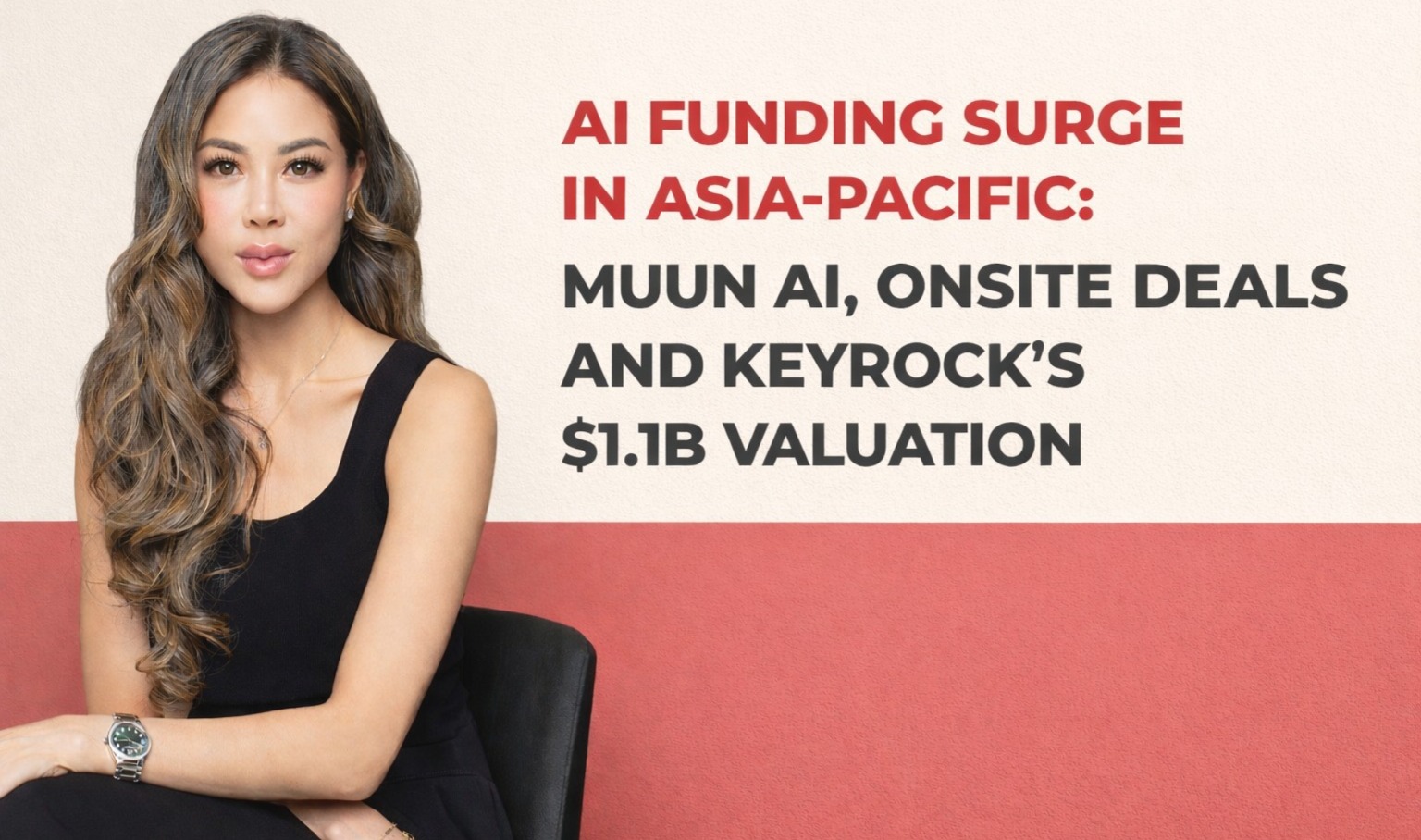
Investor appetite across Asia-Pacific appears to be sharpening around one clear theme: AI funding for technology that solves immediate business problems.
The latest funding activity in the region shows money moving toward startups working on industrial intelligence, construction workflow tools, contactless health monitoring, and digital-asset infrastructure.
While the companies operate in different sectors, the pattern is strikingly similar. Investors are backing businesses that promise practical deployment, measurable efficiency gains, and clearer revenue logic rather than broad claims around future disruption.
Among the most prominent deals is Keyrock’s Series C round, led by SC Ventures, which values the crypto market maker at about $1.1 billion. That milestone stands out not just for its size, but for what it suggests about institutional confidence in digital-asset market infrastructure.
A bank-backed lead investor entering at this level indicates that parts of traditional finance are becoming more comfortable with businesses focused on liquidity, market-making, and infrastructure rather than speculative crypto narratives alone.
Alongside that headline valuation, smaller but strategically important AI-focused deals also closed across the region.
Muun AI raised $700,000 from Wavemaker Impact to scale an industrial intelligence platform that turns machine telemetry into real-time operational insights. The company is positioned around a telemetry-first model that can deliver predictive analytics and anomaly detection without adding sensors or depending on large labelled datasets.
In an industrial setting, that matters. Manufacturers often want better visibility into inefficiencies, but they do not always want to overhaul hardware systems to get it. By lowering that barrier, Muun AI, led by Kathryn Knight is placing itself in a category of AI startups trying to make adoption easier, cheaper, and faster. The company said one pilot identified thousands of recoverable hours of inefficiency at a manufacturing site.
OnSite, meanwhile, secured SGD 1.7 million, or about $1.3 million, in a seed round co-led by Tin Men Capital and Alter Global. Its focus is construction, a sector where project communication often remains fragmented across calls, chats, documents, and field updates. The startup is building an AI-first construction communication and documentation platform, with the source pointing to multilingual support and structured, searchable project knowledge as part of its approach.
Injewelme raised $1.2 million in funding led by Catalytic Capital for Climate and Health, a Temasek Trust vehicle, to commercialise contactless vitals monitoring through remote photoplethysmography. The technology uses video-based methods to extract physiological signals and, according to the source, aims to measure more than 20 vital signs. It is an ambitious area, combining computer vision and signal processing with the demands of clinical reliability.
What links these deals is not just the sectors involved, but the kind of value they are trying to create. Muun AI is selling operational efficiency. OnSite is selling clarity and workflow discipline. Injewelme is selling a less intrusive way to monitor health metrics. Keyrock is selling infrastructure for a maturing digital-asset market. In each case, the pitch is grounded in a specific use case rather than a generic promise around artificial intelligence or digital transformation.
For much of the past few years, startup funding conversations in AI were often dominated by scale, speed, and the size of the opportunity. What this latest cluster of deals suggests is that investors are now paying closer attention to where AI can be deployed in environments that already have paying customers, known pain points, and visible operational friction. In manufacturing, even modest efficiency gains can translate into meaningful savings. In construction, better documentation can reduce disputes and project delays. In health technology, a contactless monitoring system can open up new forms of access and convenience.
And in crypto, more robust liquidity infrastructure can support institutional participation.
The Keyrock round adds another dimension to this moment. Its $1.1 billion valuation signals that infrastructure players in digital assets are still attracting serious capital, especially when they sit closer to the plumbing of the market than to consumer-facing speculation. SC Ventures’ leadership in the round also gives the deal a broader strategic significance.
It suggests that established financial institutions are not simply observing the digital-asset space from the sidelines. Some are choosing to invest in the rails that may shape how institutional participation evolves.
There are, however, different benchmarks ahead for each company.
For Muun AI and OnSite, the real test will be whether pilots convert into durable commercial contracts and whether their systems can integrate smoothly with existing industrial or construction software environments.
For Injewelme, progress will likely be judged through validation, regulatory milestones, and the credibility of its health-monitoring claims in real deployment settings. For Keyrock, attention will likely focus on how it expands its institutional services and how its compliance and governance structures evolve under the spotlight that comes with a bank-led funding round and unicorn-level valuation.
What emerges from these deals is a picture of a regional startup market that is still willing to fund risk, but is doing so with a stronger preference for specificity. The winners, at least for now, are not necessarily the loudest companies in the room. They are the ones offering tools that can be installed, measured, and defended in a boardroom.
That may be the most telling signal of all. In Asia-Pacific’s latest funding cycle, the market seems less interested in spectacle and more interested in software, systems, and infrastructure that can prove their worth in the real economy.
Also Read: Perplexity Announces $1 Million Challenge to Build a Billion-Dollar AI Startup