

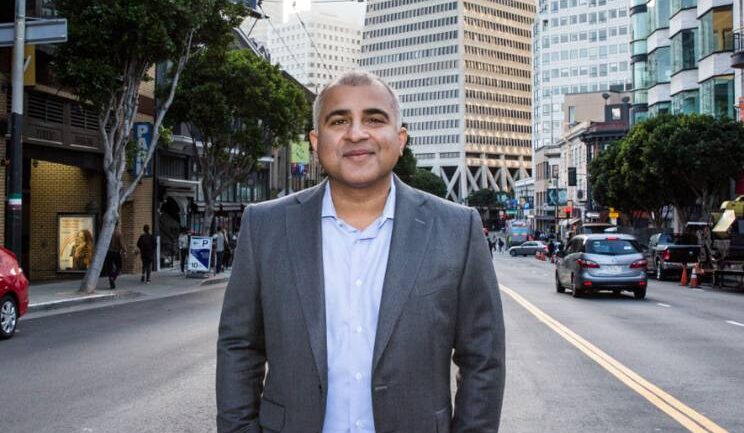
Jeff Bezos has chosen a scientist (Vikram Bajaj), not a career tech CEO, to sit beside him at the top of his most ambitious artificial intelligence venture yet.
Vikram “Vik” Bajaj, a physicist and chemist with deep roots in biotechnology and data science, has been named co-founder and co-chief executive officer of Project Prometheus, a new AI company backed with an eye-catching $6.2 billion in initial capital. Bezos will share the CEO role with Bajaj, according to details cited in US media reports and Bajaj’s updated professional profile.
The startup is positioning itself away from consumer chatbots and towards the “physical economy”, sectors such as manufacturing, aerospace, automotive engineering and complex industrial products, where AI systems must interact with real-world constraints rather than just language on a screen.
Vikram Bajaj: A low-profile scientist at the centre
Bajaj has, until now, largely stayed in the background compared to the celebrity founders who dominate the AI conversation. Inside science and health-tech circles, however, his name is familiar.
Trained in the physical sciences, he completed a combined Bachelor of Arts and Master of Science in biochemistry at the University of Pennsylvania before earning a PhD in physical chemistry from the Massachusetts Institute of Technology (MIT). His research and technical work have spanned advanced chemistry, physics and biomedical applications.
Over the last decade, he has been closely involved in some of the most aggressive attempts to merge biology, data and computation into commercial businesses. That background now feeds directly into Project Prometheus, which wants to build AI systems capable of learning from, and ultimately helping design and operate, complex physical systems.
From Google’s ‘Moonshot Factory’ to cancer detection
Before turning investor-entrepreneur, Bajaj spent years inside Alphabet’s ecosystem of experimental projects.
He co-founded Verily, earlier known as Google Life Sciences, and served as its Chief Scientific Officer from 2013 to 2016. During that time, he worked out of Google X, the internal research lab often described as the company’s “Moonshot Factory” and collaborated closely with Google co-founder Sergey Brin on high-risk, high-reward science projects.
He later moved into one of the most closely watched areas in health technology: early cancer detection. As Chief Scientific Officer at GRAIL, he was involved in efforts to use data-driven tools to detect cancer earlier than conventional screening methods typically allow.
This combination, long-horizon research at Google X and applied medical technology at GRAIL, has given Bajaj an unusual vantage point across both experimental and translational science.
Building companies at the intersection of biology, data and capital
Over the last several years, Bajaj has shifted into roles where he straddles science, entrepreneurship and investment.
He is a Managing Director at Foresite Capital, a firm that backs companies working in technology, data science, precision health and biotechnology. He also co-founded Foresite Labs in October 2018 and leads it as CEO, helping build startups that sit squarely at the junction of biology and data.
In January 2023, he co-founded Xaira Therapeutics, where he serves as director and interim president.
The company focuses on using advanced tools to tackle problems in therapeutics, again reflecting the same pattern: sophisticated science, heavy use of data and long development cycles.
Alongside his industry roles, Bajaj has kept one foot in academia. He has been an adjunct associate professor at Stanford University’s School of Medicine since 2014 and previously served on the advisory board of the University of California, Berkeley’s College of Chemistry between 2015 and 2021. His scientific work has been recognised with honours including the Anatole Abragam Prize (2012), R&D 100 Awards (2011 and 2013) and a US Department of Energy LBL Innovation Grant in 2013.
What Project Prometheus wants to build
Project Prometheus is emerging as one of the world’s best-funded early-stage AI companies. With $6.2 billion in launch funding and nearly 100 employees recruited from organisations such as OpenAI, DeepMind and Meta, the startup has drawn global attention despite revealing only a limited amount publicly about its roadmap.
The company is not positioning itself as another chatbot developer. Instead, it aims to create AI models that can learn in more complex ways than traditional language-based systems and can be applied to real-world physical systems: the sort found in industrial plants, aircraft, automobiles and advanced manufacturing lines.
Its remit spans computing, aerospace, automotive engineering and industrial manufacturing, all areas where AI has the potential to make design, production and maintenance more efficient, but where the underlying systems are far harder to model than text or images. The company has not yet announced where it will be headquartered.
The choice of focus closely matches Bezos’s long-standing interest in space, engineering and advanced manufacturing. Project Prometheus’s vision of AI for complex physical systems fits naturally alongside his other bets in aerospace and infrastructure.
Bezos’s decision to share the CEO role with a scientist who has moved fluidly between labs, startups and investment funds underlines how different this AI bet is from many of its peers.
Bajaj’s track record cuts across three domains that are increasingly converging:
- Frontline science, from magnetic resonance and physical chemistry to oncology;
- Data-intensive health and life sciences platforms, through Verily, GRAIL and Foresite Labs; and
- Capital allocation in deep-tech, via Foresite Capital’s investment lens.
In Project Prometheus, those strands now meet an industrial brief: using AI to understand and optimise systems that build, move or power things in the real world.
Many details about Project Prometheus remain undisclosed, including its first commercial products and exact operating structure. For now, what is visible is its scale of funding, the calibre of its early technical hires and the unusually science-heavy profile of its co-CEO.
As the AI race broadens from chatbots and image generators to more specialised systems for industry, Bajaj’s appointment signals how central deep scientific expertise is becoming in the next wave of AI companies, especially those that hope to redesign the physical world, not just describe it in words.
Also Read: iPhone Air’s Star Designer Abidur Chowdhury Quits Apple For AI Startup
















