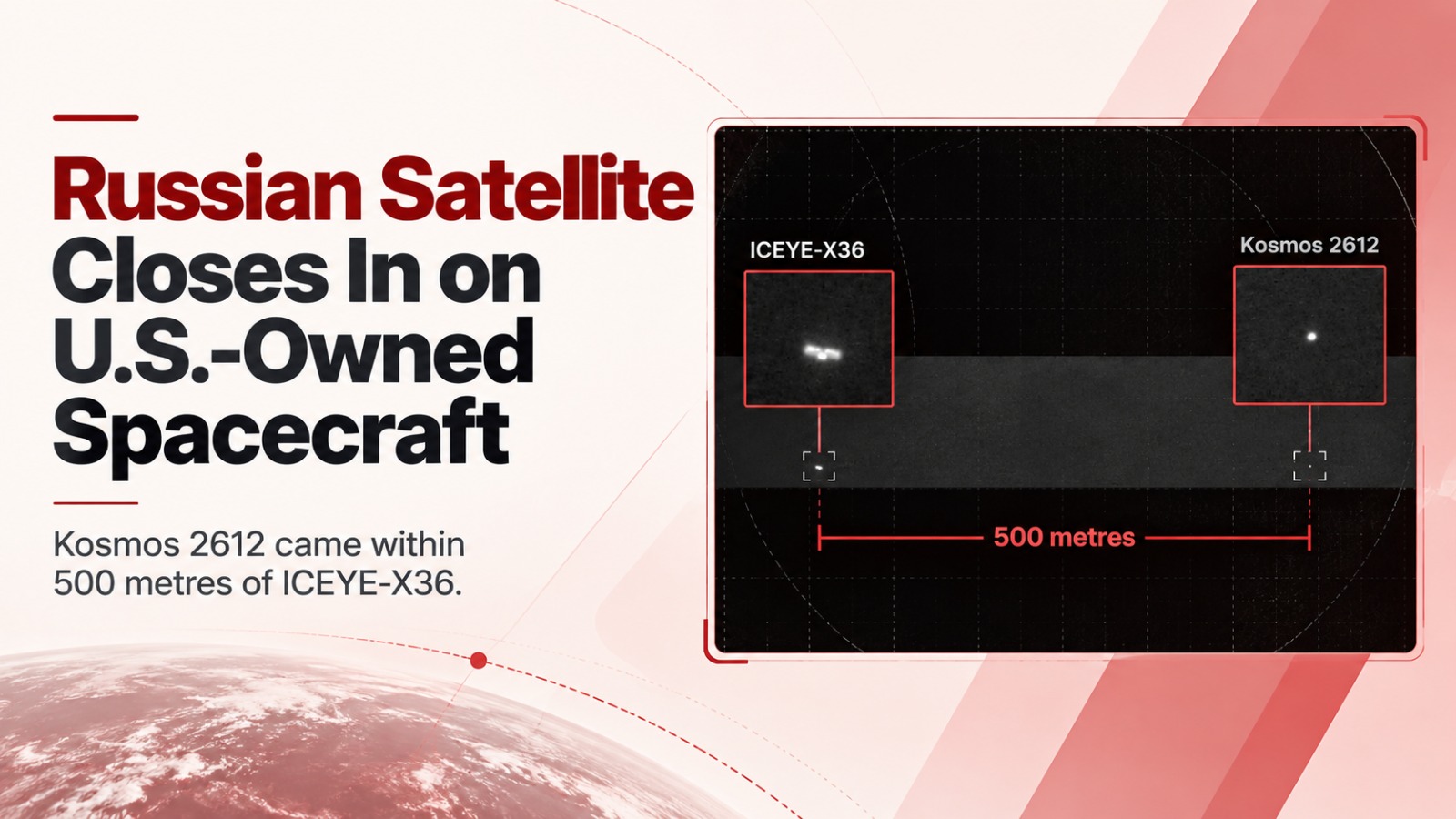
New images reveal how closely Russia’s Kosmos 2612 approached the commercial Earth-observation satellite ICEYE-X36. The manoeuvre has raised questions about Moscow’s intentions and the growing vulnerability of satellites in space.
A Russian satellite has been photographed operating just over a kilometre from a commercial Earth-observation spacecraft, bringing fresh attention to an unusual encounter in orbit that has concerned space-monitoring experts.
The image, captured by spatial intelligence company Vantor on October 17 and published by Axios on October 22, shows Russia’s Kosmos 2612 near ICEYE-X36, a satellite operated by multinational space technology company ICEYE. Vantor estimated the distance between the spacecraft at approximately 1.02 kilometres.
This time lapse, captured by Swiss space monitoring company S2a Systems,
The photograph offers a rare visual perspective on an encounter that began days earlier. According to orbital-tracking company LeoLabs, Kosmos 2612 carried out a series of manoeuvres that brought it unusually close to ICEYE-X36, with some tracking estimates suggesting the separation may have narrowed to roughly 500 metres.
How Did the Russian Satellite Get So Close?
The incident developed rapidly between October 15 and 16, when Kosmos 2612 reduced its distance from ICEYE-X36 from approximately 350 kilometres to less than five kilometres, according to LeoLabs.
Rather than immediately moving away, the Russian spacecraft appeared to maintain a nearby position through the following weekend, making minor orbital adjustments to remain close to its target.
LeoLabs identified the activity as consistent with rendezvous and proximity operations, a term used for manoeuvres that bring spacecraft near one another in orbit.
Such operations are not inherently suspicious. Spacecraft routinely approach each other during planned missions, including docking activities. What makes this encounter unusual is that it involved a Russian-controlled satellite approaching another operator’s spacecraft without permission.
Astrophysicist and space analyst Jonathan McDowell suggested that the manoeuvre could represent an unprecedented example of an uninvited close approach between spacecraft.
The exact minimum distance remains uncertain. LeoLabs cautioned that repeated manoeuvres and difficult tracking conditions affected its separation estimates.
By October 19, the Russian spacecraft had begun moving away from ICEYE-X36.
Why Was ICEYE-X36 a Satellite of Interest?
ICEYE-X36 is part of ICEYE’s Earth-observation operations, which use synthetic aperture radar (SAR) technology to capture detailed images of the planet.
Unlike conventional optical imaging, SAR can produce high-resolution imagery during both day and night, including when weather conditions obstruct ordinary satellite photography.
That capability has significant value for defence and security operations.
ICEYE has previously disclosed that its satellite constellation supports the Ukrainian Armed Forces by providing timely information about conditions on the ground.
However, there is an important distinction: there is no confirmation that ICEYE-X36 itself was being used for Ukrainian military operations.
The satellite’s connection to a company that provides defence-related services makes the encounter noteworthy, but it does not establish why Russia approached this particular spacecraft.
Was This an Isolated Incident?
Evidence suggests that the October encounter followed months of unusual orbital activity involving ICEYE satellites.
A June report by the Royal United Services Institute (RUSI), a UK-based defence and security research organisation, identified movements involving four Russian-controlled satellites that had adjusted their orbits to align with ICEYE-X36 beginning in May.
Those earlier observations provide context for the latest approach, although they do not conclusively establish a coordinated attempt to interfere with the satellite.
The October incident stands out because of the exceptionally short separation reported by tracking services and the newly released imagery showing the spacecraft in close proximity.
Vantor CEO Dan Smoot told Axios that the photograph illustrated the increasingly contested nature of space.
He also warned that repeated close manoeuvres between spacecraft raise serious questions about technical capabilities and intentions.
Could Russia Have Been Testing Anti-Satellite Capabilities?
The proximity of the two spacecraft has prompted questions about whether Kosmos 2612 was demonstrating capabilities that could potentially be used against satellites.
LeoLabs outlined several possible purposes for such operations, including inspecting another spacecraft, observing its behaviour, maintaining a nearby position or potentially interfering with its activities.
These possibilities matter because the ability to approach another satellite precisely could also support intelligence gathering, coercive signalling or future counterspace operations.
RUSI previously identified intimidation and electronic interference as potential objectives of close orbital approaches. One concern involves jamming, in which radio interference disrupts satellite communications.
However, no evidence presented in the reporting establishes that Kosmos 2612 jammed, damaged or physically attacked ICEYE-X36.
LeoLabs specifically cautioned that the manoeuvres did not establish hostile intent.
What Does the Incident Mean for Satellite Security?
The episode highlights a security problem that extends beyond the two spacecraft.
Commercial satellites are increasingly involved in activities with military and strategic importance. Their imaging and monitoring capabilities can support governments and armed forces, even when the spacecraft themselves are operated by private companies.
That creates difficult questions about how such assets can be protected when another country’s satellite moves close to them.
Unlike a planned docking operation, an unexpected approach gives the targeted spacecraft operator little certainty about what the approaching vehicle intends to do.
RUSI has also highlighted the limited options currently available for protecting satellites in such circumstances.
The challenge is not simply detecting a nearby spacecraft. It is determining whether its movements represent routine observation, deliberate intimidation or preparation for interference, often without clear evidence of intent.
For commercial operators, maintaining service continuity while monitoring potentially threatening orbital activity is becoming an increasingly important concern.
What Happens Next?
The Russian satellite had started moving away by October 19, according to LeoLabs, but the significance of the encounter remains unresolved.
CNN reported that it had contacted Russia’s Ministry of Defence, Aerospace Forces and space agency Roscosmos for comment. The available reporting does not establish an official Russian explanation for the manoeuvres.
The newly published Vantor image adds visual evidence to the orbital tracking data, confirming the close proximity observed on October 17. It does not, however, reveal the purpose of the approach.
Kosmos 2612 demonstrated that it could move close to a commercially operated satellite and remain nearby through a series of orbital adjustments. The unanswered question is whether the manoeuvre was intended simply to observe ICEYE-X36 or to demonstrate a capability that could be used more aggressively in the future.
For now, the incident illustrates a developing challenge in space security: a spacecraft does not need to make physical contact with another satellite to raise serious concerns about its intentions.
Also Read: Meta Q3 Earnings 2026: $64 Billion Revenue, 2-for-1 Stock Split With No Voting Rights