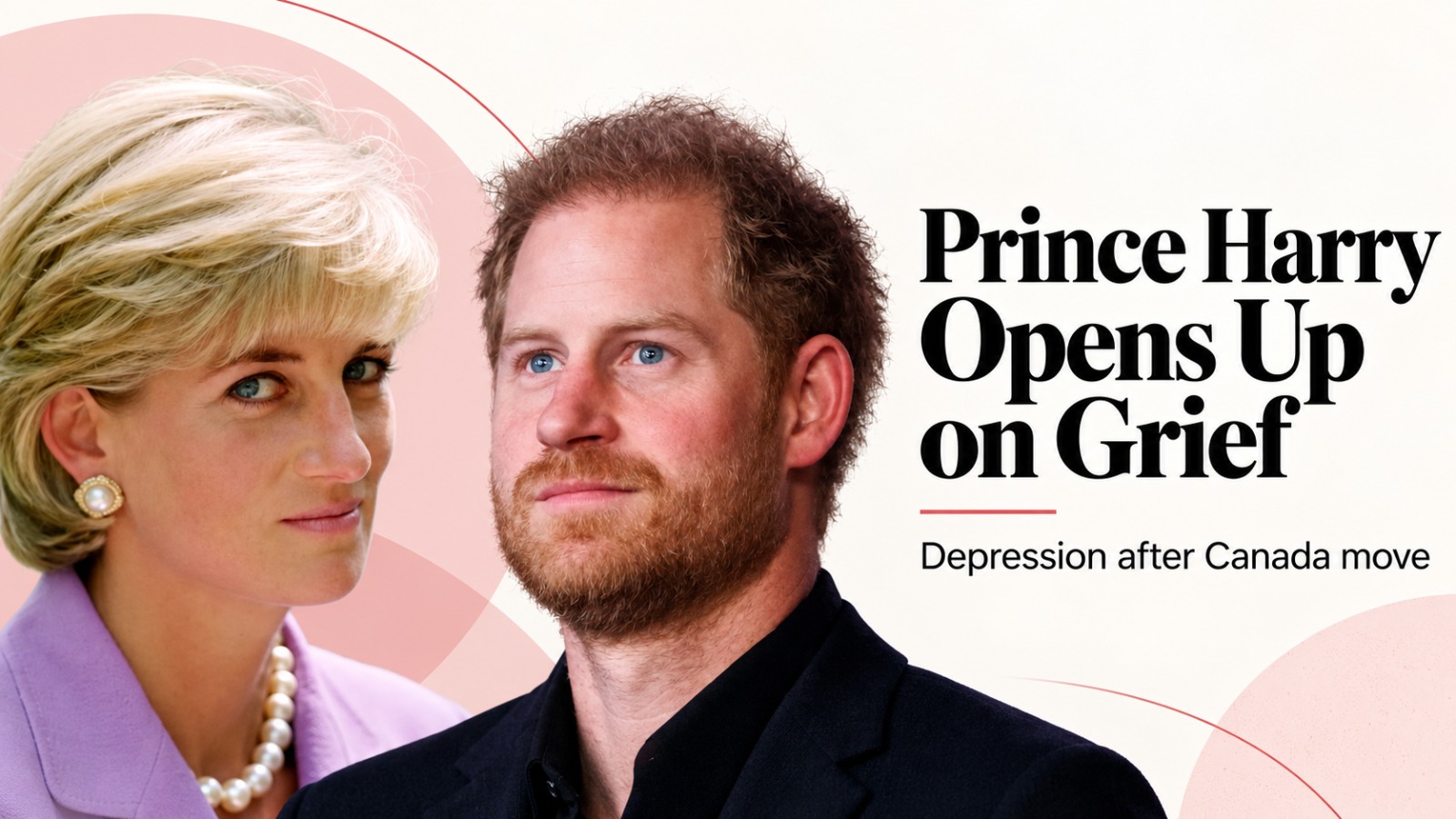
Prince Harry has spoken about experiencing a two-week period of depression after relocating to Canada with Meghan Markle, describing how the sudden reduction in stress left him struggling to function.
The Duke of Sussex also revisited the death of his mother, Princess Diana, revealing that he barely cried for almost two decades after losing her at the age of 12.
The 42-year-old royal discussed his experiences in a MasterClass session titled Redefining Grief: Building Resilience Through Loss, featuring neuroscientist Dr Mary-Frances O’Connor.
Prince Harry Describes Depression Following Move to Canada
Harry recalled experiencing an unexpected emotional and physical reaction after moving to Vancouver Island with Meghan and their young son, Archie, in late 2019.
The move afforded Harry some temporary relief from the stress of performing his duties as a member of the royal family and media scrutiny. However, according to Harry, moving away from that scene proved challenging for him.
“Being in Canada, away from the stressful environment where presumably my body was just pumped full of adrenaline, within two or three days, I experienced this adrenaline crash, something that I’d never experienced before,” he said during the session, as reported by Clarín.
Harry described becoming unusually dependent on the sense of urgency he had experienced during years of sustained pressure.
“It was as if I needed stress in order to get the adrenaline to make my brain function because I became useless around the house,” he recalled.
He added that he had “slipped into depression for about two weeks” and felt unable to function without the adrenaline he associated with his previous lifestyle.
The account offers a personal perspective on the challenges Harry experienced during a significant family transition.
Harry and Meghan subsequently formalised their departure from senior working royal roles in 2020, following their announcement in January of that year.
Princess Diana’s Death Left Harry Struggling to Express Grief
Harry also revisited the loss of Princess Diana, who died following a car crash in Paris on August 31, 1997.
He was 12 at the time, and the experience became a defining part of his childhood.
During the MasterClass discussion, Harry said he had struggled to express his emotions following his mother’s death.
“I didn’t cry when I was told my mum died, only at her burial, and then not again for nearly two decades,” he said.
Reflecting on how he interpreted that emotional restraint as a child, Harry described a fundamental change in his understanding of grief.
“I was convinced that was strength, but it wasn’t. It was a 12-year-old boy with no permission to fall apart and no roadmap for how to heal.”
His comments illustrate the difference between appearing emotionally composed and processing a major personal loss.
Harry remembered meeting people from the general public outside Kensington Palace during the mourning period. He believed that he felt guilty since most of the people were crying but he could not express those feelings himself.
The memories also reveal how difficult he found it to accept that his mother would not return.
He described once believing Diana had deliberately disappeared to escape the pressures surrounding her life and might eventually return to take him and his brother, Prince William, away.
Harry presented this childhood belief as part of his difficulty coming to terms with her death.
Military Service and the Panic Attacks That Followed
Harry’s reflections extended to his military career, which he described as a way of finding distance from painful personal memories.
He joined the British Army in 2005 and subsequently served two tours in Afghanistan.
Military life offered structure, responsibility and a sense of purpose, but Harry said the emotional difficulties he had avoided resurfaced after his second deployment ended in 2013.
He recalled experiencing panic attacks during ordinary activities, including while travelling to work.
“The tightening of the collar [of a dress shirt] literally felt like I was suffocating, and I would be experiencing panic attacks just in the car on the way to work,” he said.
The experiences became part of his broader account of how grief and anxiety affected him long after his mother’s death.
How Harry’s Experience Connects Grief, Stress and Mental Health
The MasterClass discussion with Dr O’Connor brought together Harry’s experiences of childhood bereavement, sustained stress and emotional recovery.
Harry associated his difficulties in Canada with a sudden change from an environment in which he had become accustomed to functioning under intense pressure.
The conversation also addressed how prolonged stress can affect physical and psychological well-being.
However, an individual’s experience of exhaustion, reduced concentration or depressed mood cannot, by itself, establish a particular hormonal imbalance.
Chronic stress can influence the body’s stress-response systems, but claims about depleted cortisol levels require appropriate medical evidence and cannot be inferred from symptoms alone.
Harry’s remarks are therefore best understood as a first-person account of his mental health rather than a general medical explanation of depression.
His experiences also highlight an important distinction in discussions about bereavement: grief does not follow a fixed emotional pattern, and the absence of visible tears does not necessarily indicate that someone has processed a loss.
Prince Harry Says Family and Charitable Work Helped Him Find Balance
Looking back on his experiences, Harry said his understanding of grief changed when he began to separate his mother’s memory from feelings of guilt about experiencing happiness.
For years, he associated moving forward emotionally with being disloyal to Diana.
“I’d spent so long emotionally numb, to a large extent, because I felt disloyal and guilty for the possibility of being happy and joyful without her,” he explained.
He said a turning point came when he recognised that his mother would have wanted him to lead a fulfilling life.
“But the reality is, what I discovered was actually that she just wanted me to be happy. And that was a huge mental shift for me. It freed me.”
Harry also described making family time a priority. He said he follows a personal rule of avoiding separations from his wife and children lasting longer than 10 days.
His charitable activities remain another important part of his life, reflecting causes associated with his mother’s humanitarian legacy.
The Duke of Sussex has previously spoken about his mental well-being in interviews and initiatives that explore the lasting impacts of bereavement and psychological stress.
His latest reflections place particular emphasis on the relationship between two experiences separated by more than two decades: losing his mother as a child and confronting an unexpected emotional downturn after leaving the royal environment.
Also Read: 7-Eleven Ends India Run as Last 31 Stores in Mumbai and Pune Close