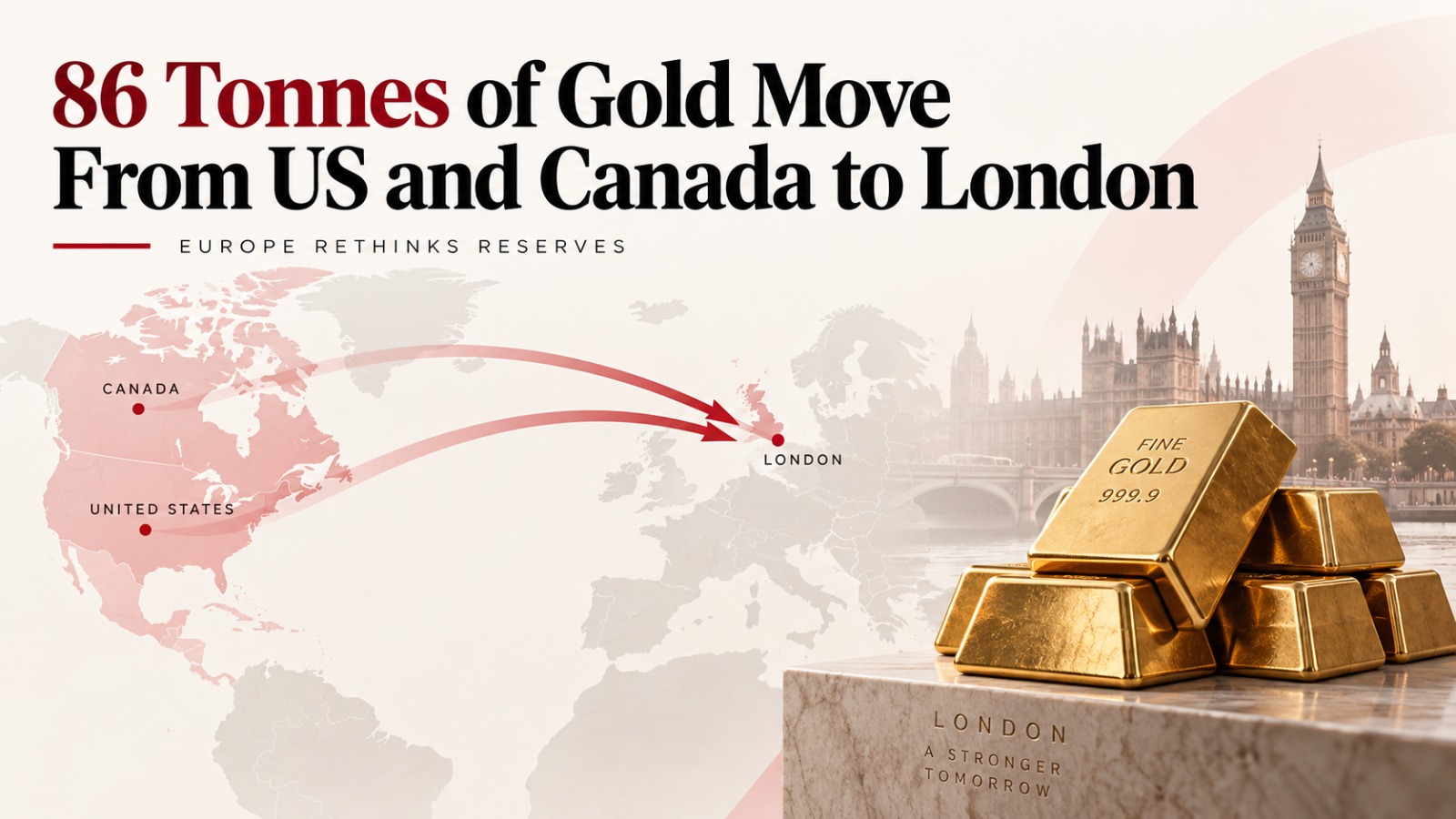
The Netherlands has moved around 86 tonnes of gold from the United States and Canada to London as it strengthens the accessibility and crisis readiness of its reserves amid growing geopolitical uncertainty.
De Nederlandsche Bank (DNB), the Dutch central bank, said the transfer took place between March and August 2026. The gold was moved from storage locations in New York and Ottawa to London, where it is held at the Bank of England. DNB said the move would make its gold easier to trade and deploy if a serious crisis occurs.
A major shift in where Dutch gold is stored
Before the transfer, the Netherlands held almost 313 tonnes of gold across New York and Ottawa. Around 86 tonnes of that holding was shifted to London. DNB said the decision was part of a broader effort to improve the tradability of its reserves while maintaining a more balanced geographical distribution between North America, the United Kingdom and the Netherlands.
The move does not mean that all of the 86 tonnes was physically transported across the Atlantic. Around 59 tonnes was sold in New York and an equivalent amount was purchased in London. This allowed the Netherlands to change the location of the holding without moving those bars.
More than 27 tonnes, however, was physically transported from the United States and Canada to a secure DNB facility in Zeist before an equivalent quantity was moved from Zeist to London. This approach reduced the amount of gold that needed to be transported directly over long distances.
DNB Governor Olaf Sleijpen said the central bank does not expect to need the gold in a crisis, but considers stronger preparedness important.
Why London has become the preferred destination
London plays a central role in the global physical gold market, making it an important location for central banks that need to trade bullion quickly.
The Bank of England is one of the world’s leading gold custodians. Its vaults hold around 400,000 gold bars worth more than £200 billion for the UK government, commercial banks and other central banks. The institution says storing gold in its vaults provides central banks with access to the liquidity of the London gold market.
The Dutch decision therefore reflects a practical consideration as much as a geopolitical one. Gold held in a major trading centre can be exchanged more easily when a central bank needs access to liquidity.
DNB’s latest move also highlights how central banks are paying greater attention to where their reserves are held, rather than focusing only on how much gold they own.
France and Germany have taken different approaches
The Netherlands is not the only European country to have changed the location of its gold.
France recently dealt with 129 tonnes of gold held in New York that did not meet the London Bullion Market Association’s 99.99% purity standard. Instead of physically moving the bars, the Banque de France sold them and purchased gold meeting the required standard in Europe. The central bank said France’s overall gold reserves remained unchanged at 2,437 tonnes.
Germany also carried out a major repatriation programme. In 2016 alone, the Bundesbank transferred more than 216 tonnes of gold to Frankfurt, including 111 tonnes from New York and 105 tonnes from Paris. By 2017, Germany had completed the wider programme, moving around 300 tonnes from New York and 374 tonnes from Paris to Frankfurt.
These moves show that European central banks have long considered the location of their bullion an important part of reserve management.
Central banks are accumulating more gold
The Netherlands’ decision comes during a period of strong central bank demand for gold.
According to the World Gold Council’s 2026 Central Bank Gold Reserves Survey, central banks accumulated an average of about 1,000 tonnes of gold annually over the previous four years. That compares with an average of about 500 tonnes a year during the preceding decade. The organisation linked the faster pace of accumulation to geopolitical and economic uncertainty.
Gold’s role in official reserves has also become more significant because central banks value the metal for its safety, liquidity and return characteristics. The World Gold Council’s latest reserve data shows that central banks and other official institutions remain major holders of the world’s above-ground gold supply.
For the Netherlands, the latest relocation is therefore less about removing gold from one country and more about making its reserves easier to access. The decision also demonstrates how central banks are increasingly considering storage locations, market access and crisis preparedness alongside the size of their gold holdings.
The movement of 86 tonnes does not by itself indicate that Europe is preparing for war. Instead, it points to a broader reassessment of how countries protect, distribute and manage strategic reserve assets during a period of heightened geopolitical and economic uncertainty.