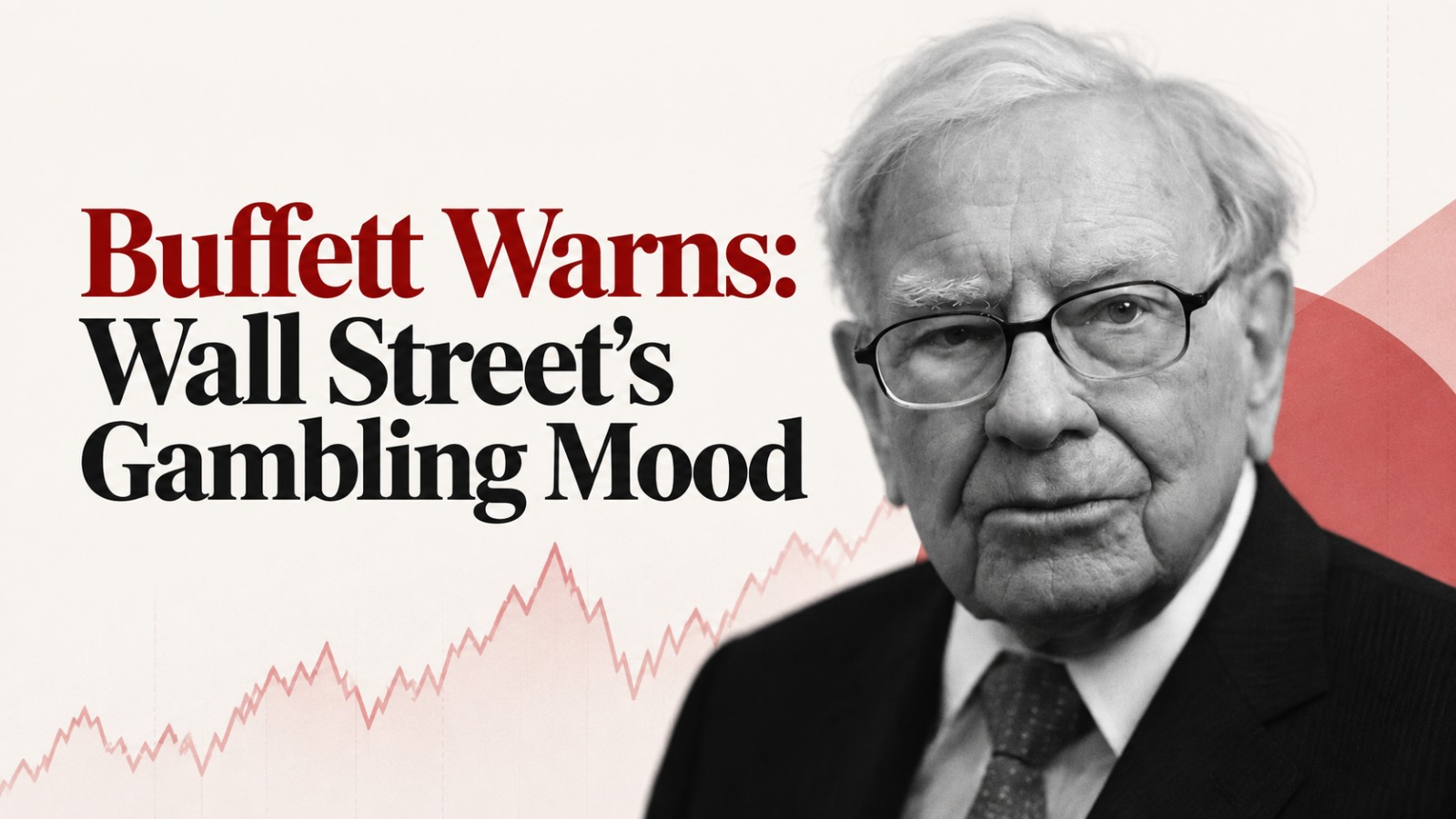
Warren Buffett has spent decades urging investors to think like business owners rather than traders chasing the next quick win. His latest assessment of Wall Street suggests he sees that distinction becoming increasingly blurred.
Buffett, the former chief executive of Berkshire Hathaway, recently warned that “we’ve never had people in a more gambling mood than now,” describing Wall Street as being like “a church with a casino attached.” The remarks, made in an interview with Fortune, reflect his concern that speculative behaviour has become a more visible part of the investing landscape.
What makes the warning particularly striking is not simply the level of enthusiasm surrounding financial markets. It is how closely traditional investing and outright wagering can now sit alongside one another.
Prediction markets, for example, allow users to take positions on the outcomes of time-limited events. In some cases, those activities can take place through the same brokerage environment investors use to buy shares in publicly traded companies. The material notes that this has become common among a number of discount brokers.
That convergence helps explain why Buffett’s casino analogy has resonance beyond the usual debate over whether stocks are expensive.
Warren Buffett sees risk in the mood, not just the market
Buffett’s comments do not amount to a prediction that stocks are about to collapse. Instead, they focus attention on investor behaviour.
Periods of rising markets can make speculation appear easier than it really is. When rapid trading, cryptocurrencies, event contracts and conventional stock investing increasingly occupy the same financial ecosystem, the boundary between investing for long-term business growth and betting on short-term outcomes can become less obvious.
Buffett’s warning suggests that the psychology surrounding markets matters. A strong willingness to gamble can encourage investors to take risks they may not fully appreciate, particularly when recent gains create confidence that favourable conditions will continue.
The warning takes on added significance considering that the reputation of Buffett is founded on a very different philosophy. In particular, he has been known to be someone who is more interested in holding onto his investments for a long period of time as opposed to continuously buying and selling stocks.
Still, an uncomfortable market environment does not automatically mean long-term investors should head for the exits.
Market history complicates the case for pulling back
The historical record cited in the analysis offers an important counterweight to Buffett’s warning.
The S&P 500 has recovered from every bear market in its history so far and subsequently reached new highs after previous downturns. That does not eliminate the possibility of another decline, nor does it tell investors when one might occur. It does show why abandoning a long-term strategy purely because market sentiment appears speculative can carry its own risk.
A long-term S&P 500 chart reproduced in the material makes that point visually. Despite repeated periods of severe market stress over several decades, the broader trajectory eventually resumed upward after those setbacks. The chart is credited to YCharts.
That creates an apparent contradiction, but only on the surface.
Buffett can be concerned about excessive risk-taking while investors can simultaneously have good reason to avoid making dramatic changes to diversified, long-term plans. One argument is about present behaviour and valuation risk. The other is about what history has shown can happen when investors remain invested through difficult periods.
The bigger danger may be abandoning a workable strategy
For ordinary investors, the more useful takeaway may have less to do with predicting the next market correction and more to do with knowing what kind of investor they are.
The analysis argues that someone who had continuously bought the S&P 500 and remained invested through market cycles would historically have done reasonably well, even without attempting to follow every warning from Wall Street or prominent investors. Its broader conclusion is that investors need an approach they can maintain through both strong and difficult markets.
That does not make Buffett’s concern irrelevant. Quite the opposite.
A speculative environment can make disciplined investing harder. When brokerage accounts increasingly provide access to activities designed around short-term outcomes, investors may face more opportunities to confuse activity with strategy.
The unusual feature of the current debate is therefore not simply that Buffett thinks risk is elevated. It is that the financial environment he is describing increasingly places long-term investing and short-duration speculation within reach of the same user, sometimes through the same platform.
For investors wondering whether Buffett’s warning means they should pull money out of stocks, the historical evidence presented offers no simple signal to do so.
Instead, the tension is clearer: speculative enthusiasm may be high, yet market history has repeatedly punished investors who assume every period of elevated risk must be followed by a permanent loss of value.
Also Read: Warren Buffett Is Warning Investors Again, and This Time the Numbers Look Hard to Ignore