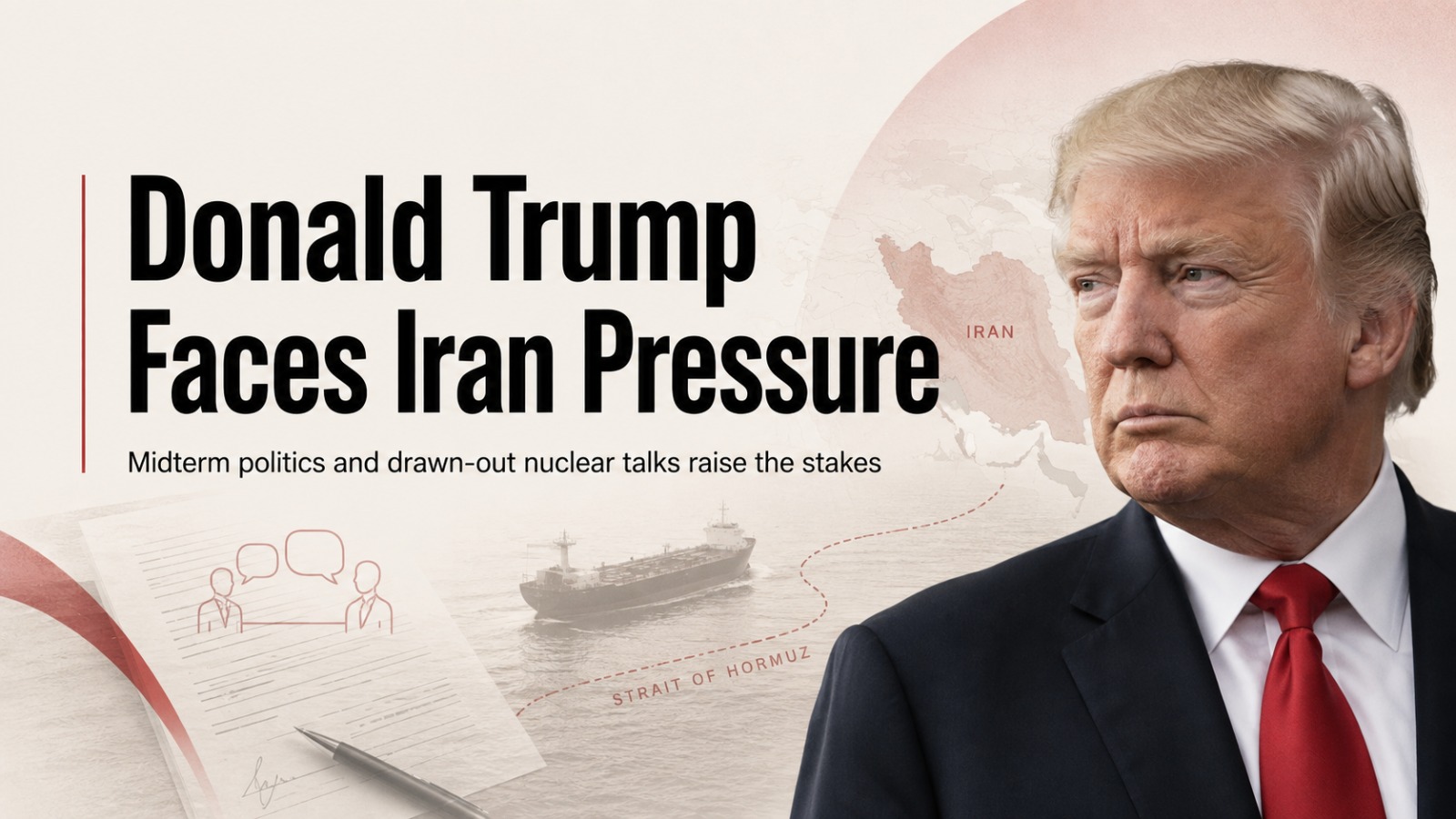
Iran’s negotiating strategy is increasingly being viewed through the lens of the approaching US midterm elections, with Tehran setting out a timetable that could keep President Donald Trump tied to the conflict for months. The assessment, reported by The Guardian’s diplomatic editor Patrick Wintour, points to a growing debate inside Iran over whether prolonging negotiations could weaken Trump politically or instead make a future settlement harder to reach.
The emerging approach places the November midterms alongside military, economic and diplomatic calculations surrounding the conflict. Iranian political discussion has increasingly focused on Trump’s domestic position, including his approval ratings, public attitudes towards the war and the economic pressure associated with higher oil prices.
What makes that political calculation more significant is the timeline Tehran has now outlined for negotiations.
Kazem Gharibabadi, Iran’s deputy foreign minister, told the state-run IRNA news agency that once an arrangement for commercial shipping through the Strait of Hormuz is agreed, it could take another two to four months before negotiations move to a second stage focused on Iran’s nuclear programme.
That would represent a much slower process than initially envisaged. Gharibabadi said an earlier plan to begin the nuclear phase within 30 days of a June memorandum of understanding with the United States had been abandoned by the Trump administration.
Tehran sets a difficult path to the next round
Before nuclear negotiations can advance, Iran has placed several issues on the table.
These include sanctions relief, an end to the US blockade of Iranian ports, the release of frozen Iranian assets and fresh commitments relating to non-belligerence. Taken together, those conditions could push negotiations beyond the US midterm elections.
That possibility has sharpened the political dimension of the talks.
If no broader agreement is reached before Americans vote, Trump could enter the elections without an Iranian commitment on nuclear weapons and with the financial and political costs of the conflict still hanging over his administration.
Jason Brodsky of United Against Nuclear Iran, which the Guardian described as an advocate of the war, argued that Tehran has little incentive to provide Trump with a period of calm before the elections. His assessment was that further episodes of tension between Washington and Tehran over the Strait of Hormuz remained likely.
Iran sees a political dilemma for Donald Trump
The debate is also playing out openly in Iranian media.
Mehr News, described in the report as close to the Islamic Revolutionary Guards Corps, argued that Trump faces an uncomfortable choice. Continuing the conflict could add to political and economic pressure at home, while reducing tensions could be viewed by part of his political base as a retreat from earlier positions.
That thinking helps explain why the US elections have become more than a distant political event for Tehran. They are being discussed as a factor that could influence the balance of the conflict itself.
The report says Iranian media have also closely followed comments from Marc Zell, chair of Republicans Overseas Israel, who linked the administration’s approach to the midterms and said the American public had grown tired of war.
Some Iranian voices believe Republican losses in Congress could constrain Trump, make additional war funding more difficult or force Washington to take negotiations more seriously.
Former Iranian diplomat Mostafa Zahrani is among those who see an electoral defeat as potentially limiting Trump’s ability to return to the conflict.
Not everyone in Tehran wants to wait
There is no consensus inside Iran, however.
Nasser Hadian, a professor of international relations at Tehran University, has argued against allowing the negotiations to drift towards the US elections. His view is that Iran should make use of its current position rather than assume a politically weakened Trump would be easier to deal with.
Hadian warned that an electoral setback could actually reduce Trump’s incentive to reach an agreement and leave him more vulnerable to pressure from Israel and other political forces.
That argument exposes the central risk in Tehran’s strategy.
Weakening an American president politically does not automatically produce a diplomatic advantage. A president with less political capital may have fewer reasons, rather than more, to spend that capital on an agreement with Iran.
The competing view among Iranian diplomats is that public opposition to further conflict, combined with pressure from Republicans thinking ahead to the next presidential election, could ultimately narrow Trump’s room for manoeuvre.
Iran is divided over what comes after the war
The midterm calculation is only one part of a much broader argument inside Iran about the country’s long-term relationship with the United States.
President Masoud Pezeshkian has repeatedly said he does not want an endless war. Working alongside chief negotiator Mohammad Ghalibaf, he continues to support the June memorandum of understanding and sees it as an important foundation for Iranian foreign policy.
Iranian hardliners take a different view.
The conservative newspaper Kayhan has dismissed the memorandum, arguing that Washington cannot be trusted to honour its commitments. It has also rejected the idea that access through the Strait of Hormuz should simply be treated as a bargaining tool in negotiations.
There is a wider strategic divide as well.
Both moderate and hardline camps envisage some form of new regional security order emerging from the conflict. Hardliners place greater emphasis on reducing or ending the US military presence in the region and view control over access to the Strait of Hormuz as a source of leverage.
Pezeshkian, meanwhile, has indicated that legitimate US investment could have a place in Iran.
Former foreign minister Javad Zarif has gone further in arguing for a more balanced foreign policy. In an essay cited in the report, Zarif said Iran would benefit from avoiding excessive dependence on Russia and China and warned that uncontrolled confrontation with Washington also makes cooperation with other countries more difficult.
The midterms may shape the timing, but not settle the bigger question
Iran’s immediate strategy may be to avoid giving Trump a quick diplomatic success before November. Yet the deeper issue remains unresolved: what does Tehran ultimately want from its confrontation with Washington?
For some in Iran, the coming elections present an opportunity to increase political pressure on Trump. For others, waiting for a weaker US president could waste a moment when an agreement is still achievable.
That division means the calendar may be clearer than the endgame.
The months leading to the midterms could determine when negotiations move forward, but Iran’s internal debate shows that the country has not reached a single view on how far it should push the confrontation, what compromises it should accept or what kind of relationship with the United States should follow.
Also Read: SpaceX Rocket Crash on the Moon Explained: Why Did the Falcon 9 Upper Stage Hit the Lunar Surface?