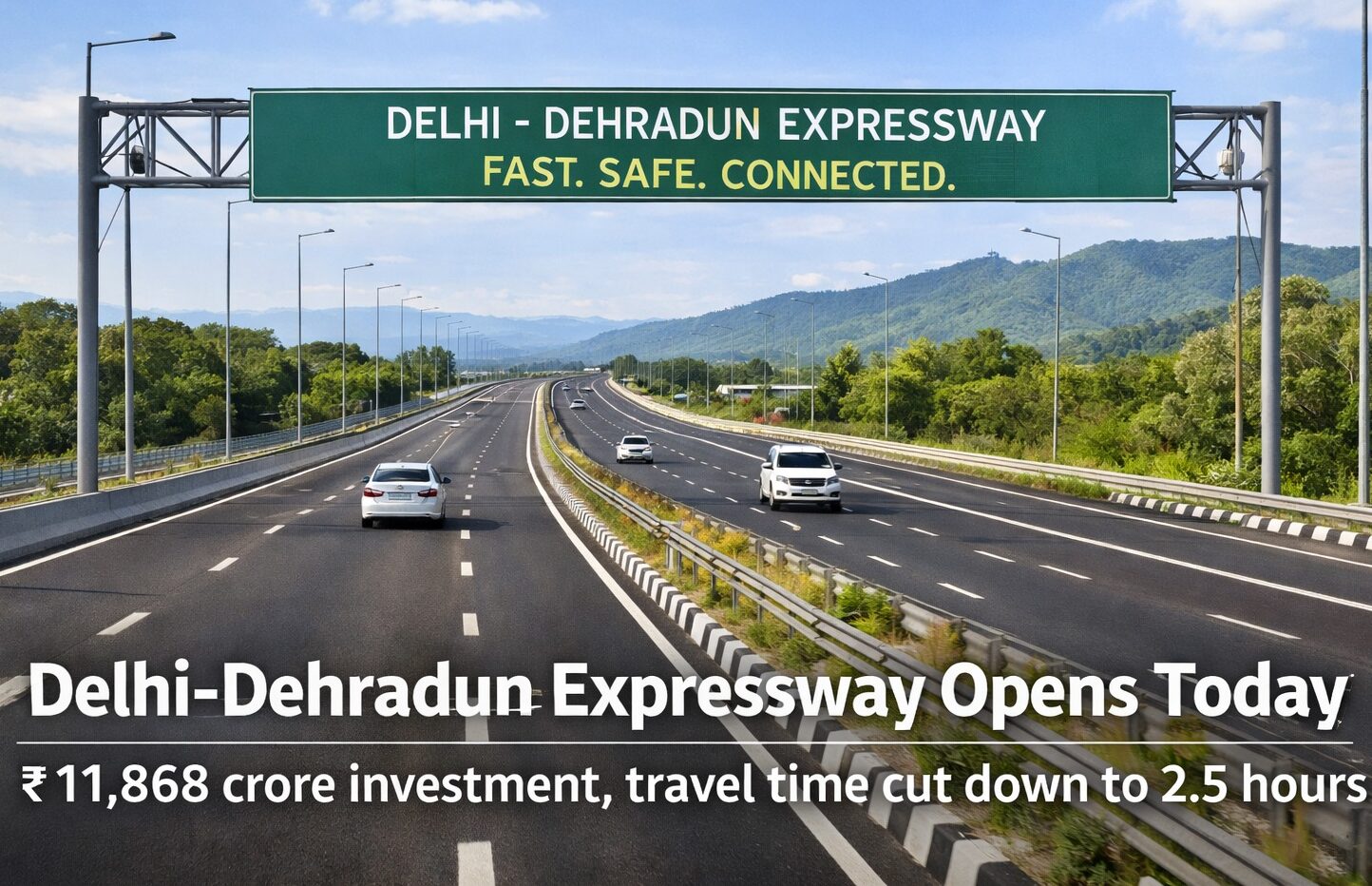
India’s road infrastructure network receives a major boost today with the opening of the Delhi-Dehradun Expressway, a high-speed corridor designed to transform travel between the national capital and Uttarakhand’s capital city. Built at an investment of ₹11,868.6 crore, the project is expected to reduce journey time from more than six hours to around two and a half hours.
The expressway, also known as the Delhi-Dehradun Economic Corridor, is set to be inaugurated by Prime Minister Narendra Modi on April 14. As part of the day’s schedule, he is expected to visit Saharanpur in Uttar Pradesh to review the wildlife corridor on the elevated section of the route before offering prayers at the Jai Maa Daat Kali Temple near Dehradun.
Faster Road Link Between Two Key Cities
The new expressway is expected to significantly improve road travel for commuters, tourists, and commercial traffic moving between Delhi and Dehradun. The route passes through Delhi, Uttar Pradesh, and Uttarakhand, creating a direct and faster connection between the regions.
For years, travelers on the Delhi-Dehradun route have faced long travel times due to congestion and bottlenecks on existing highways. With the new corridor now ready, travel is expected to become quicker, smoother, and more predictable.
Mega Project Built at ₹11,868.6 Crore
The project was launched in February 2021, when Union Road Transport and Highways Minister Nitin Gadkari laid the foundation stone. Later that year, in December 2021, Prime Minister Narendra Modi laid another foundation stone linked to the development.
Constructed at a total cost of ₹11,868.6 crore, the expressway was originally targeted for completion by December 2024. It now enters full operation as one of the major road projects connecting North India.
Also Read: History Created as Jos Buttler Breaks T20 Barrier and Joins Virat Kohli in Rare Club
First Section Already in Use
Part of the expressway had already been opened to the public earlier. A 32-kilometre stretch connecting Delhi through Akshardham, Geeta Colony, and Shastri Park to Mandola Vihar in Ghaziabad and onward to Khekra in Baghpat was completed by mid-2025.
This section became operational in December 2025 and provided an early glimpse of the corridor’s benefits, especially for local commuters and regional traffic.
Linked to Major Highway Networks
One of the strongest advantages of the Delhi-Dehradun Expressway is its integration with other major transport corridors. The project includes more than 100 underpasses and five railway overbridges, improving traffic flow and reducing interruptions.
The expressway also connects with important routes such as the Delhi-Mumbai Expressway, the Eastern Peripheral Expressway, and roads leading toward Haridwar and Roorkee. This wider connectivity is expected to strengthen movement of goods and passengers across multiple states.
Wildlife Protection at the Core
A standout feature of the project is its emphasis on ecological protection. The corridor includes a 12-kilometre elevated wildlife section through Rajaji National Park, designed to allow animals to move safely across their natural habitat.
The wildlife-friendly infrastructure includes six animal underpasses, eight animal passes, two elephant underpasses of 200 metres each, and a 370-metre tunnel near the Daat Kali Temple area. These measures aim to balance infrastructure growth with environmental responsibility.
Built in Four Strategic Phases
The expressway has been developed in four phases to manage construction efficiently across varied terrain.
Phase 1 includes a 32-kilometre, 12-lane stretch from Akshardham Temple in Delhi to the Eastern Peripheral Expressway near Baghpat.
Phase 2 extends 118 kilometres from the Eastern Peripheral Expressway to the Saharanpur Bypass. This segment includes six lanes, seven interchanges, and 60 underpasses.
Phase 3 covers 40 kilometres from the Saharanpur Bypass to Ganeshpur with a six-lane configuration.
Phase 4 connects Ganeshpur to Dehradun across 20 kilometres, featuring four to six lanes, twin tunnels, and elevated wildlife-sensitive sections.
Smart Systems for Safer Travel
The corridor is also equipped with an Advanced Traffic Management System, aimed at improving road safety and operational efficiency. These systems are expected to support real-time traffic monitoring, better incident response, and smoother vehicle movement.
With high-speed design, modern safety systems, and environmental safeguards, the Delhi-Dehradun Expressway marks a major milestone in India’s expanding highway network. It is expected to improve regional connectivity, support tourism, and make travel between Delhi and Dehradun faster than ever before.
Also Read: Priyanka Chopra Jonas Becomes Bentley’s Global Brand Ambassador