

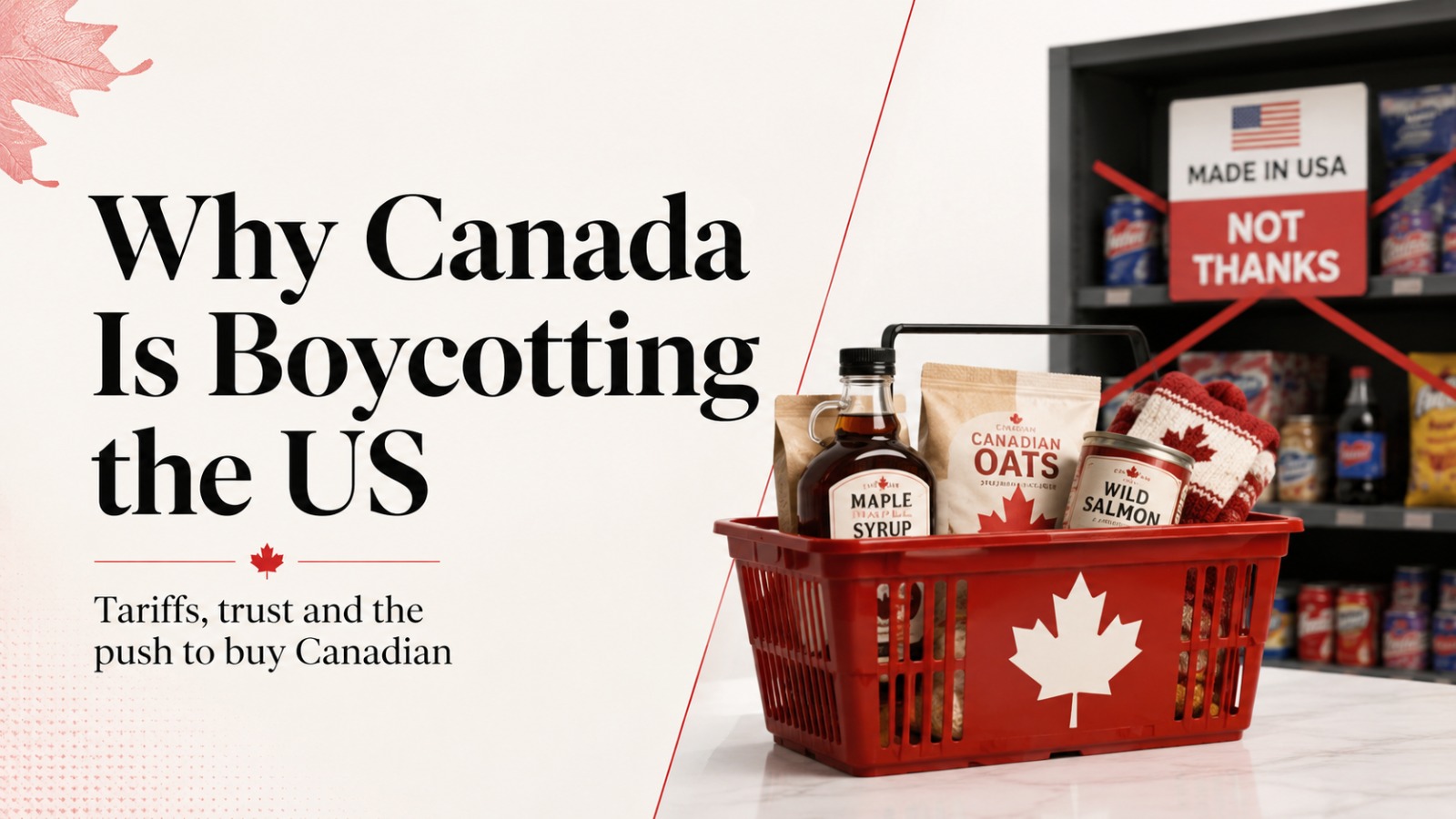
Canada’s consumer boycott of the United States has deepened amid another escalation in the trade dispute between the neighbouring countries. The US imposed 50% tariffs on US$20 billion worth of Canadian goods, while Canadian Prime Minister Mark Carney pledged to respond “dollar for dollar” after trade talks collapsed. The broader boycott had already been developing since early 2025, driven by opposition to Donald Trump’s trade policies and threats involving Canada’s sovereignty.
The striking part is not simply that Canadians are angry. It is how far some are prepared to rearrange their everyday lives to keep American money out of their spending.
William McDonald, a diesel mechanic from Thunder Bay, Ontario, began avoiding American goods after tariffs were introduced last year. His decision has not been cheap. He estimated that switching from US beer to Canadian beer costs him roughly C$1,000 more annually, while his groceries are about C$50 more expensive each week. Yet he said he remains willing to absorb the additional cost.
That willingness to accept inconvenience and higher prices helps explain why the boycott has become more than a symbolic response.
US Tariffs are only part of the anger
The immediate economic dispute matters, but the resentment described by Canadians goes beyond customs duties.
The boycott grew in response to both the trade confrontation and Trump’s repeated threats involving Canada, creating a sense among some Canadians that the relationship with their closest neighbour can no longer be treated as dependable. More than 3,500 people from across Canada responded to an online Guardian callout describing changes they had made because of the US administration’s economic and political stance. Many expressed anger and sadness, while also suggesting the changes had become part of their normal routine.
That sentiment is reflected in slogans that have emerged around the movement. “Anything but US”, shortened to ABUS, and “Anywhere but USA”, or ABUSA, have circulated alongside “Elbows Up!”, a hockey-inspired phrase associated with defending Canada.
For many participants, the boycott is therefore about economic pressure, national identity and political sovereignty at the same time.
Canadians are checking the label before the price
One of the clearest signs of the shift can be found in supermarkets.
An Angus Reid survey conducted in July found that 40% of grocery shoppers were actively checking where products originated, with most of those shoppers avoiding US goods when alternatives were available.
Canadian shoppers described replacing American groceries, alcohol and household goods, while retailers have increasingly made country-of-origin information easier to identify.
The search for alternatives sometimes requires much more than choosing another brand.
Elizabeth Lorenz, a retired teacher in Nanaimo, British Columbia, said she reads packaged-food labels and refuses products made in the US. When ingredients are unavailable from another country, she adjusts recipes. She even began growing yams and sweet potatoes because the versions available to her were American-grown.
Her experience captures the unusually personal nature of the boycott. This is not just a decision made at the checkout counter. For some people, it has changed what they cook and what they grow.
American holidays are being replaced too
Travel is another major target.
Some Canadians who previously crossed the border for entertainment, shopping or holidays now say they are choosing destinations within Canada, Mexico, the Caribbean or Europe instead.
Jane, a teacher from Camlachie, Ontario, stopped travelling to the US and has been taking a four-hour trip to Toronto for sporting events she once attended after a much shorter drive across the border. She has also switched her vacations to destinations including Mexico, the Dominican Republic and Europe.
Others are going further. One respondent from Winnipeg said her family avoids US airlines and will not even use an American airport for a connecting flight.
The choices suggest that the boycott is spreading into parts of the economy where replacing an American product is considerably more complicated than choosing another bottle of ketchup.
The boycott has reached Apple, Amazon and social media
Technology has become another front.
Respondents said they had stopped paying for or using American technology companies, streaming platforms and social-media services. The products and services mentioned included Netflix, Amazon Prime, Apple TV, Disney+, Tesla, X, Facebook and Instagram.
James Buchan, an IT worker in Halifax, went considerably further. He sold a MacBook, iPhone, AirTags and AirPods and replaced them with alternatives. He also moved to European-based email providers and changed mapping, calendar and language-learning services, while leaving Facebook, Reddit, Instagram and WhatsApp.
The example proves that the protest is now far more than products that have been considered to be typical for countries of their origin. Consumers who wish to conduct a complete boycott should consider digital services and software as well.
Whisky drinkers are discovering Canadian alternatives
Alcohol has also become a highly visible part of the movement.
Kurt, a retired engineer in Calgary, said his whisky-tasting group previously spent about US$10,000 a year on American whisky. After the tariff dispute intensified, the group stopped buying it entirely and began discovering Canadian alternatives. He said they now have no intention of returning to American whisky.
His family has also stopped drinking California wine and has not visited the United States since January 2025, despite having travelled there frequently for more than three decades.
Such decisions illustrate an important consequence of prolonged boycotts. Once consumers spend enough time searching for substitutes, they may discover alternatives they continue buying even after the original political dispute changes.
The deeper issue is trust
That may ultimately be the most important reason Canada’s boycott of the US could prove difficult to unwind.
Several Canadians described the damage not simply in terms of tariffs, but as a breakdown of trust.
Sarika, an academic in Vancouver, said she would not return to American products even under a different US administration because she now considers the country unreliable. A Toronto finance worker named Vikram similarly said Canada could no longer treat its relationship with the United States as it had previously and argued that Canadians needed greater economic control and protection of their sovereignty.
That is what makes the current boycott different from a short-lived burst of consumer anger.
For the Canadians participating, the argument is increasingly about independence. Every Canadian beer replacing an American one, every holiday redirected away from the US, every product label inspected and every technology service abandoned becomes a small expression of the same idea: economic choices can also be political choices.
The biggest question may no longer be whether the boycott lasts through the latest round of tariffs. It is whether Canadians who have spent more than a year rebuilding their shopping and travel habits will ever feel a reason to go back.
Also Read: Two Gen Z Founders Quit Their Jobs to Build Good Girl Snacks

















