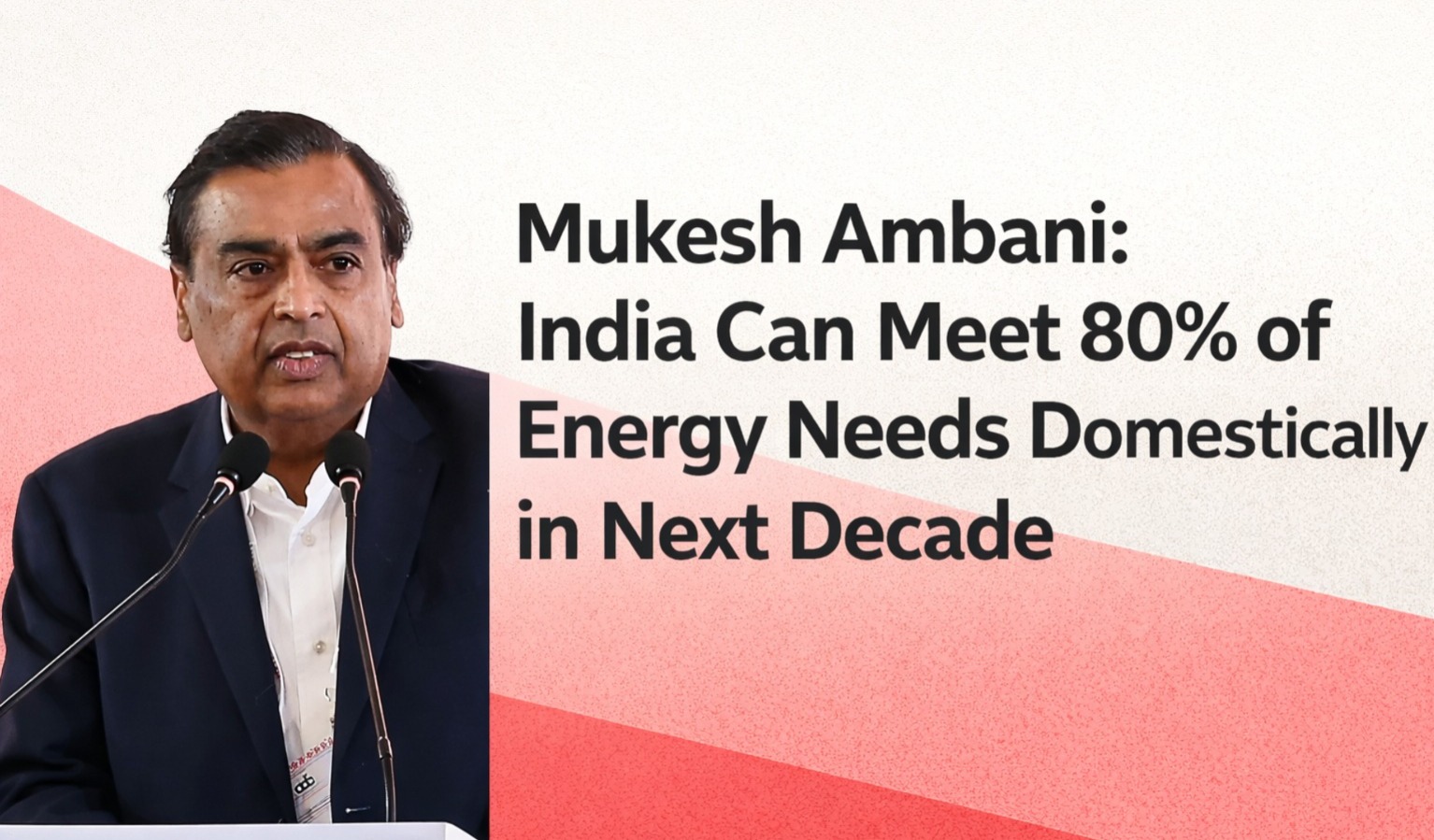
Mukesh Ambani at JioBlackRock Event: India has a “clear path” to sharply cut its dependence on imported energy over the next ten years, if it keeps investing heavily in the energy system and physical infrastructure, and rides the next wave of technology breakthroughs.
That was the core message from Reliance Industries Chairman and MD Mukesh Ambani during a conversation at a JioBlackRock event in Mumbai on February 4, where he spoke in a fireside chat alongside BlackRock Chairman and CEO Larry Fink.
Why this matters right now?
India currently meets over 80% of its energy needs through imports, a vulnerability that becomes painfully obvious whenever global markets turn volatile . Ambani’s claim flips that picture: he argued that India can move from being an import-heavy energy consumer to becoming “reasonably self sufficient”, driven by investment, infrastructure buildout, and innovation.
What Mukesh Ambani actually said?
In the chat, Ambani framed the next decade as a window where India can build at scale using “today’s technology”, not just in energy, but in the systems that support a 1.4-billion population.
“In the next decade, India will not import 80 per cent of its energy… with technological breakthroughs, we will be reasonably self sufficient in energy.” said Ambani
He also pointed to the sheer unfinished nature of India’s buildout:
“The physical infrastructure for 1.4 billion… we’ve done a lot, but there’s a lot more to do.”
The backdrop: renewables push and the 2030 clean power target
The remarks land in the middle of India’s push to scale renewable energy. The report notes the government’s target of reaching 500 gigawatt of clean power by 2030, aimed at reducing the import bill, cutting emissions, and strengthening self-reliance.
Ambani also said India has “already emerged as one of the world’s leading renewable power producers,” while stressing that further investment in physical infrastructure will be critical.
Beyond energy: “country scale intelligence infrastructure”
Interestingly, Ambani didn’t keep the conversation limited to energy. He tied energy security to a bigger ambition: scaling India’s technological backbone.
His pitch: India should build what he described as “country scale intelligence infrastructure,” so that “every village has intelligence available to them”.
In the same breath, he pushed for faster adoption of emerging technologies, including AI across education, healthcare, and digital infrastructure to support long-term growth.
A broader economic argument: growth, startups, and household savings
Ambani said India’s economy is entering a phase of “visible, sustainable growth,” attributing it to policy continuity and fiscal conservatism . He also pointed to India’s startup ecosystem and suggested it could throw up “100 new Reliances” in the coming years.
He added a sharper point on household savings: the report states he flagged that India imported $60 billion worth of gold and $10-15 billion of silver in the past year, largely as stores of savings and argued for channeling household savings more productively .
If Ambani’s argument holds, India’s energy story over the next decade won’t just be about adding more capacity, it’ll be about building the physical and digital infrastructure to make that capacity dependable, distributed, and domestically anchored.
And in his framing, that shift isn’t only an energy-security move. It’s also an economic strategy, one that links cleaner power, new infrastructure, wider AI adoption, and a more productive savings culture into a single national growth narrative.
Also Read: Silver’s Big Fall Shocks Markets, Even Long-Time Critics See a Short Bounce