This Millionaire Plumber Debate started with a bold claim: “In the age of AI, the next millionaires won’t be coders or consultants. They’ll be plumbers and electricians.”
This bold statement was made by renowned tech investor and NVIDIA’s CEO, Jensen Huang. He explained this prediction in the context of the artificial intelligence boom and the current US workforce landscape.
However, this statement has sparked conversations across industries and continents. And hence the question arises- are we really entering an era where blue-collar workers outpace white-collar professionals in wealth creation? Or is this just another oversimplified prediction in the storm of AI hype?
Let’s understand this more through three distinct lenses from a debate on LinkedIn:
- Jensen Huang: A Tech Optimist
- Mani Maran Ramalingam: Marketing Strategist
- Prof. Procyon Mukherjee: Author & Business Visionary
Jensen’s Take: AI Will Redefine Value, Not Just Replace Jobs
For Jensen, the logic is straightforward: as AI automates repetitive digital work, the demand for hands-on, non-automatable trades will surge. You can train a machine to code, but you can’t yet send an algorithm to fix a burst pipe or rewire your apartment.
In his view, this coming imbalance will shift income dynamics. Society has long undervalued skilled trades like plumbers, electricians, mechanics, but as digital work becomes commoditized, the pendulum may swing.
“AI will make coding cheaper, not plumbing,” Jensen argues. “And when something becomes scarce, it becomes valuable,” he added.
Mani Maran Ramalingam: The Reality Is Already Unfolding
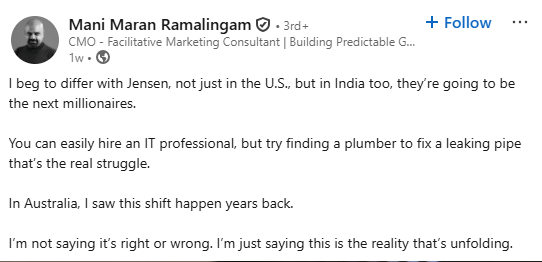
In a LinkedIn post, Marketing Strategist and CMO Mani Maran Ramalingam stated his opinion, “I beg to differ with Jensen- not just in the U.S., but in India too, this shift is already visible.” This echoes an observation rooted in lived experience rather than theory.
His argument is simple: Finding a software engineer might be easy, but finding a reliable plumber remains a struggle.
Giving an example of a similar situation, he stated that in Australia, he observed a shift years back due to the shortage of skilled tradespeople, and hence, already driven demand and wages upward.
“You can easily hire an IT professional, but try finding a plumber to fix a leaking pipe; that’s the real struggle,” he writes in his LinkedIn post.
For many industry leaders, his take is pragmatic, not predictive. According to them, he is not glamorising the rise of trade jobs, nor dismissing white-collar work. Instead, he is highlighting a reality in motion that societies dependent on service industries are beginning to feel the cost of neglecting manual skills.
Prof. Procyon Mukherjee’s Counterpoint: Business Models Still Rule Value
But not everyone agrees with the idea that plumbers will be tomorrow’s millionaires.
Professor Procyon Mukherjee, an author, faculty advisor at SBUP, and Ex-President Hindalco said, “Jensen’s naivety is striking.” His critique cuts to the heart of economics: business models, not scarcity alone, determine wealth.
He points out that platforms like Urban Company in India have already organized the informal service economy, turning individual trades into scalable, standardized businesses.
In a comment on Ramalingam’s post, he stated, “A plumber is minutes away- Urban Company! Their salaries are never a windfall. The reason is simple – business models get the better of commodity skills; Jensen’s naivety is striking to think that private equity will leave such opportunities to the dust!”
Mukherjee also warns of a broader labor ripple effect. If AI renders millions of conventional jobs redundant, displaced workers will inevitably move into trades like plumbing or hairdressing. “That influx will push supply up, and incomes down,” he explains.
His argument, rooted in labor economics, suggests that AI won’t make everyone richer; it will just rearrange where value accumulates.

Three Perspectives, One Reality: The Workforce Is Changing
The truth probably lies somewhere between optimism and realism.
Jensen is right that AI will transform which skills are valuable. Ramalingam is somehow correct from an Indian perspective that the shift is already visible, especially in developing markets. And Prof. Mukherjee is also right that the ultimate winners will be those who control the business model, not just the skill.
Whether it’s a coder training models or a plumber fixing leaks, the future of work will depend on how humans and machines collaborate, and who owns the systems that organize that collaboration.
AI may not make every plumber a millionaire. But it’s already making every worker, white or blue collar, rethink what it really means to be irreplaceable.
Read More: From Gaming to Generative AI: How Nvidia Rewired the Future of Chips?