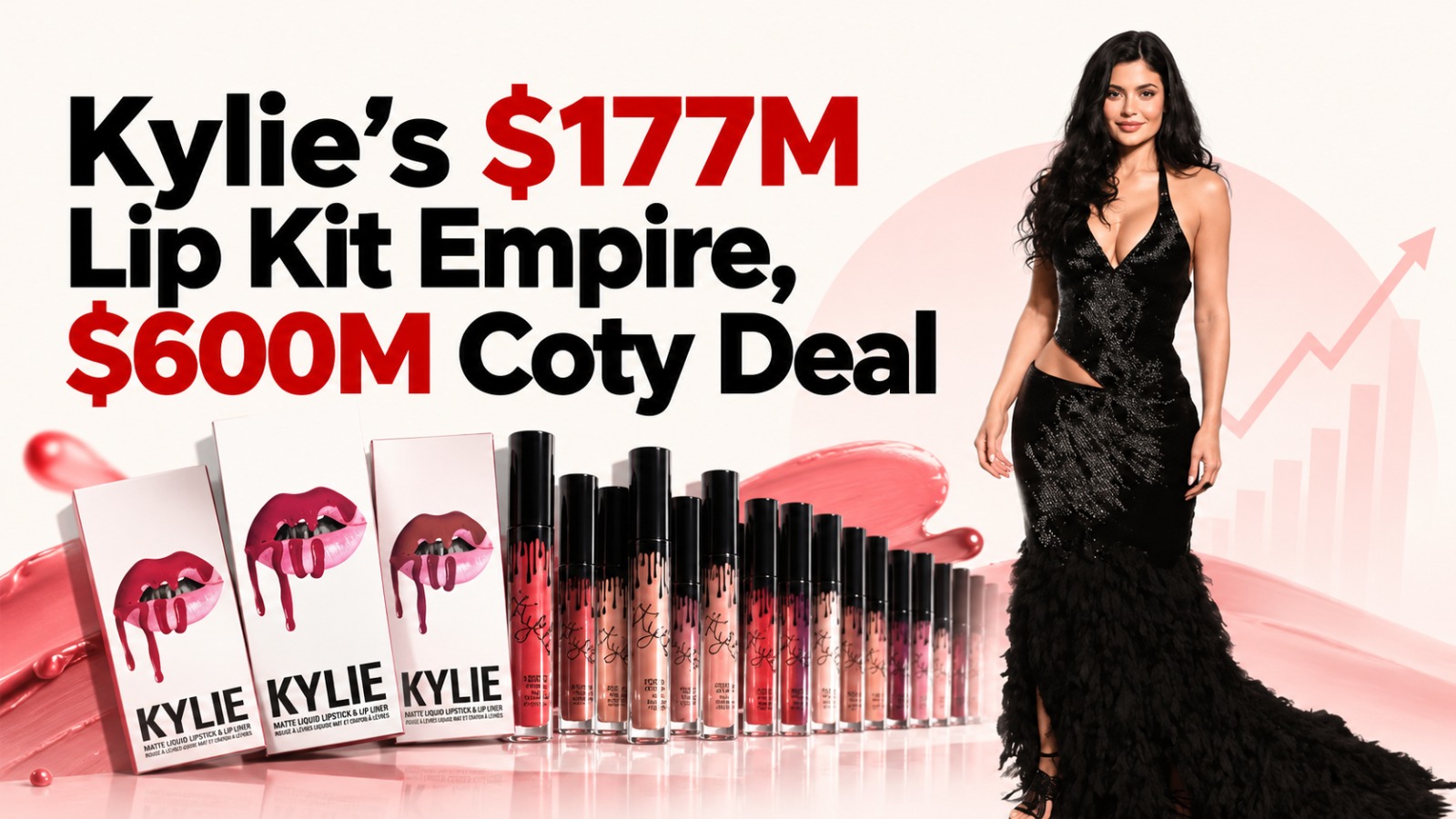
Kylie Jenner’s beauty business began with a lip kit launch in November 2015. Four years later, the cosmetics brand had attracted a $600 million investment from Coty, one of the world’s largest beauty companies, in exchange for a 51% ownership stake. The deal marked a major step in the growth of Kylie Cosmetics, turning a social media-driven makeup venture into a business backed by a global beauty group.
Announced on November 18, 2019, the partnership brought together Jenner’s influence over product development and online audiences with Coty’s expertise in manufacturing, distribution and international expansion. At the time of the agreement, Kylie Cosmetics had generated an estimated $177 million in net revenue over the preceding 12 months.
The transaction reflected the commercial potential of a beauty brand built around a prominent public figure and a strong digital presence.
From a Lip Kit Launch to a Broader Beauty Business
Jenner launched Kylie Cosmetics in November 2015, beginning with the Kylie Lip Kit. The debut product sold out, helping establish the brand among beauty consumers.
The business subsequently expanded beyond lip products into eyeliners, eyeshadows, blushes, highlighters and concealers. Its portfolio also included brushes, makeup bags and limited-edition sets released throughout the year.
In May 2019, Jenner extended the business into skincare with the launch of Kylie Skin, giving the brand a presence in another major beauty category.
Social media played a central role in the company’s growth. Coty highlighted Jenner’s combined personal and brand following of more than 270 million across social media channels when announcing the agreement. It also described Kylie Cosmetics and Kylie Skin as fast-growing brands with highly engaged online audiences.
This digital reach was an important part of the business proposition. Jenner’s connection with consumers gave the brands an established audience, while their online sales channels provided a direct route to customers.
Why Coty Paid $600 Million for a 51% Stake
Coty and Jenner announced their long-term strategic partnership on November 18, 2019. Under the agreement, Coty would acquire a 51% ownership stake for $600 million. The acquisition was expected to close in the third quarter of Coty’s fiscal 2020.
The deal valued majority ownership of the business at a substantial price, reflecting the brand’s existing revenue, consumer following and potential for international growth.
Coty presented the transaction as part of its broader effort to reshape its business and place greater emphasis on beauty. The company’s chairman, Peter Harf, described Jenner as a modern-day icon with a strong understanding of beauty consumers.
Pierre Laubies, then Coty’s chief executive officer, also welcomed the partnership, highlighting the company’s plans to work with Jenner and her team.
The arrangement gave Coty a majority stake while allowing Jenner to remain closely involved in the creative direction of the brands.
The $177 Million Revenue Figure Behind the Deal
The financial details provided a clearer picture of why the partnership mattered to Coty.
Kylie Cosmetics had generated an estimated $177 million in net revenue during the 12 months preceding the announcement. Coty expected the acquisition to contribute more than one percentage point annually to the net revenue growth of its core fragrance, cosmetics and skincare portfolio over the following three years.
The company also expected the transaction to be neutral to earnings per share in its first year, with a positive contribution thereafter. Coty further projected that the return on invested capital would exceed its cost of capital by fiscal 2023.
These figures represented Coty’s expectations at the time of the announcement, rather than guaranteed outcomes.
For Coty, the transaction offered a way to expand its exposure to a digitally driven beauty brand while using its existing business capabilities to support further growth.
How Jenner and Coty Divided Responsibilities
The partnership was designed to combine Jenner’s creative involvement with Coty’s operational capabilities.
Jenner and her team would continue to lead creative work across product development and communications. Their role included building on the brands’ existing identity and Jenner’s connection with consumers.
Coty, meanwhile, would take overall responsibility for portfolio development, drawing on its research and development, manufacturing, distribution and commercial strategy capabilities. The agreement also designated Coty as the licensee for skincare, fragrance and nail products.
Both sides would help determine the brands’ strategic direction, with a focus on entering new beauty categories and expanding internationally.
Products would continue to be sold through leading luxury beauty retailers and the brands’ own digital channels.
Jenner said the partnership would allow her team to concentrate on creating and developing products while working towards building an international beauty business.
The arrangement therefore went beyond a financial investment. It established a division of responsibilities intended to connect a creator-led brand with the infrastructure of an established beauty company.
Coty’s Global Reach Offered a Route to Expansion
Founded in Paris in 1904, Coty operates across fragrance, colour cosmetics, skincare and body care. Its business spans more than 60 brands and licences, with approximately 11,300 employees, seven manufacturing sites and sales in more than 120 countries, according to its corporate information.
The company has described itself as a global leader in fragrance and mass-market colour cosmetics.
Its scale offered Kylie Cosmetics and Kylie Skin access to established manufacturing capabilities, distribution networks and commercial expertise that could support expansion beyond their existing markets.
Coty’s fiscal 2026 figures provide a more recent picture of the company’s scale. It reported net revenue of $5.8 billion, adjusted earnings before interest, taxes, depreciation and amortisation of $847 million, and free cash flow of $348 million.
These later financial figures reflect Coty’s broader business and should not be confused with the financial performance of Kylie Cosmetics alone.
A Beauty Brand Built on Digital Influence
The Kylie Cosmetics deal illustrated how an online audience could become a significant commercial asset in the beauty industry. Jenner’s brand had grown from a lip kit launch into a broader makeup and skincare business before Coty agreed to acquire majority ownership.
The partnership combined Jenner’s creative control and social media reach with Coty’s global operating capabilities. Its stated ambition was to develop a high-growth beauty brand that could enter new categories and reach consumers across international markets.
The $600 million agreement was a defining moment in the brand’s development, linking a business built around Jenner’s public profile with the resources of an established global beauty company.
Also Read: GTA 6 India Guide: ₹7,499 Edition and the Disc-Free Box Claim