Elon Musk’s Starlink is making another run at India, but the proposal now in front of the country’s space regulator is much bigger than the constellation already cleared for the market.
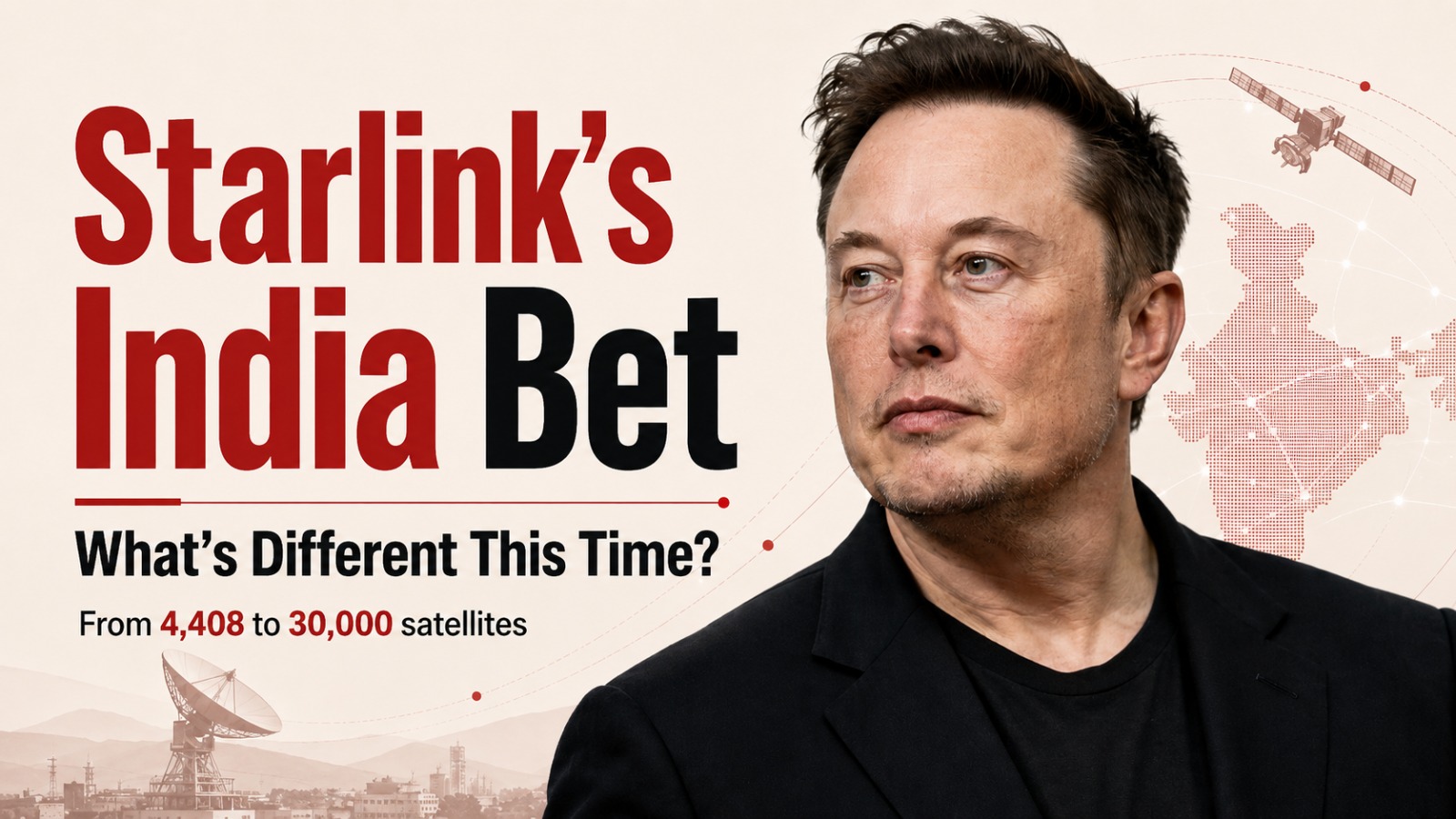
Starlink has reapplied for approval to deploy its second-generation satellite constellation in India, a network that could include as many as 30,000 low Earth orbit satellites. The application has been submitted to the Indian National Space Promotion and Authorisation Centre, or IN-SPACe.
The number itself makes the scale of the new push clear. But the more interesting part of Starlink’s latest India bet is what those satellites could eventually be asked to do.
The proposed Gen 2 constellation includes capabilities such as direct-to-device, or D2D, connectivity, allowing compatible smartphones and other communication devices to connect directly with satellites rather than depending entirely on specialised satellite equipment.
That gives the new application a different complexion from Starlink’s already-approved first-generation network in India.
Starlink already has one constellation cleared in India
IN-SPACe approved Starlink’s Gen 1 constellation in July 2025. That network comprises 4,408 low Earth orbit satellites and is intended to provide conventional broadband services.
The fresh Gen 2 proposal goes considerably further on scale, with approval being sought for a constellation of up to 30,000 satellites.
It also brings D2D capability into focus.
Instead of requiring a conventional satellite dish or other specialised equipment for every connection, direct-to-device technology can allow supported phones and communication devices to establish a link with satellites themselves.
For India, the potential use case is straightforward. Such connectivity could be useful in places where conventional mobile coverage is unavailable and where installing towers or laying fibre may be expensive or impractical. The technology could also offer another communication route during natural calamities when terrestrial infrastructure has been disrupted.
Those remain potential applications, however. The filing is an application for regulatory approval, not an indication that these services have already been authorised or launched in India.
Why this application matters more than a routine re-filing
Starlink has been here before.
Its earlier application for the Gen 2 constellation was rejected because certain proposed features and spectrum bands did not conform to Indian requirements.
That makes the latest filing significant for a reason beyond the size of the constellation.
Starlink is not starting from scratch in India. It already has approval for Gen 1. What it is now trying to secure is permission for a much larger second-generation system with a broader set of capabilities.
There is, however, an important distinction that should not be blurred.
The available information does not specify exactly what Starlink has changed in the new Gen 2 application compared with the version that was rejected. It would therefore be premature to say that the earlier spectrum or technical concerns have been resolved, or that direct-to-device connectivity itself is a newly introduced feature intended to address those objections.
What can be established is simpler: an earlier Gen 2 proposal was rejected over compatibility with Indian requirements, and Starlink has now returned to IN-SPACe seeking authorisation for the second-generation constellation again.
The real difference is clearest when Gen 2 is compared with Gen 1
For anyone trying to understand Musk’s latest India bet, the cleanest comparison is not between two versions of the Gen 2 paperwork, because the changes between those filings have not been detailed.
It is between the Gen 1 network India has already approved and the Gen 2 network Starlink now wants approved.
Gen 1 covers 4,408 LEO satellites and conventional broadband.
Gen 2 could extend to 30,000 LEO satellites and includes capabilities such as direct-to-device connectivity.
That is the heart of the new push.
Starlink is effectively seeking room in India for a substantially larger satellite architecture with the possibility of connecting supported devices directly from orbit. If authorised, the technology could expand the ways satellite connectivity is used, particularly where conventional communications infrastructure is difficult to build or temporarily unavailable.
For now, though, the decisive question sits with IN-SPACe.
Starlink has returned with its second-generation ambition. Whether the latest proposal meets the Indian requirements that stopped the previous attempt remains to be determined.
Also Read: Starlink’s India Entry Sparks Spectrum Battle: Jio and Airtel Demand Fair Play