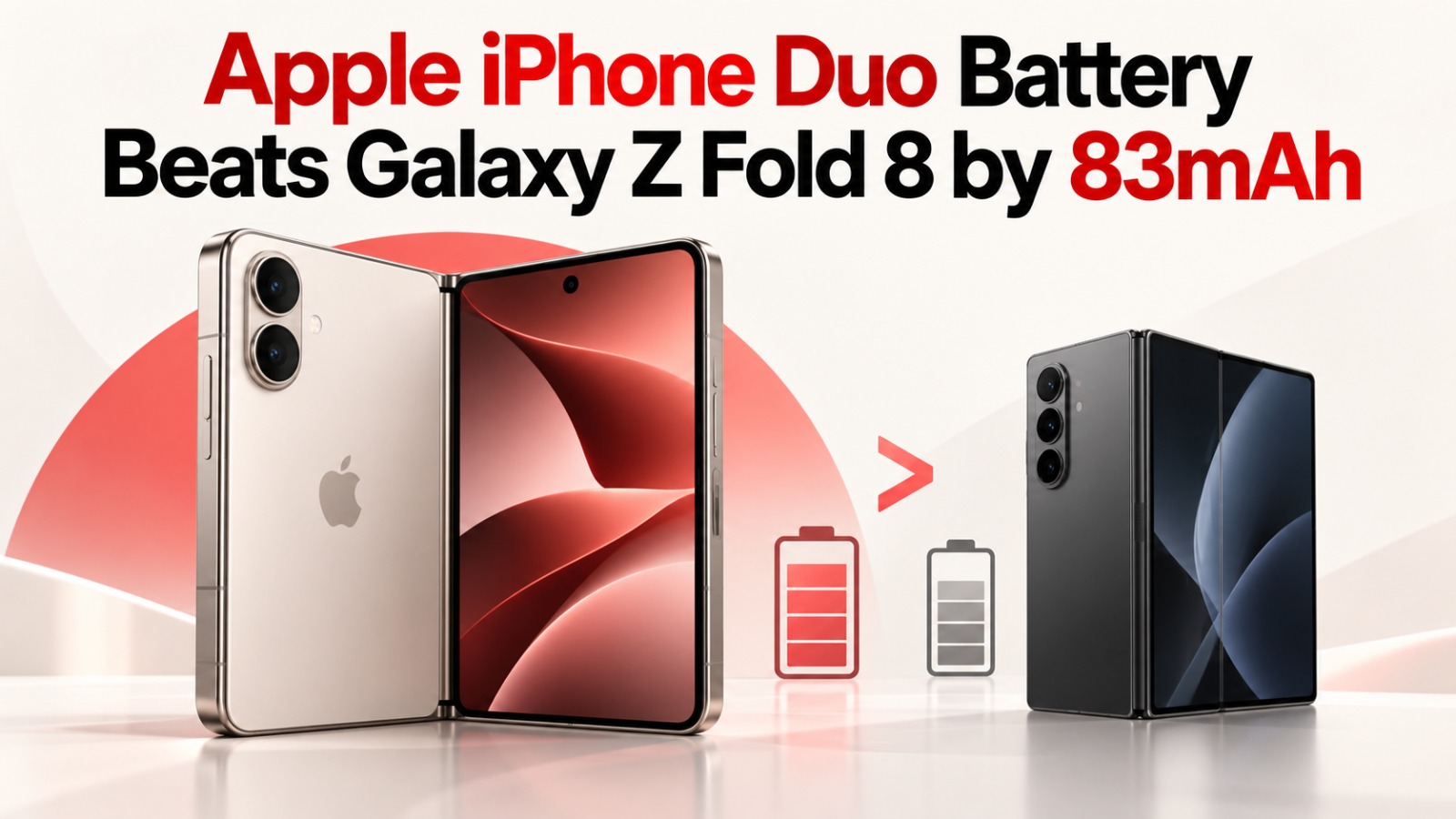
Apple’s first foldable iPhone has received an official battery capacity confirmation through European Union energy labelling, revealing a 4,883mAh battery that puts it slightly ahead of Samsung’s Galaxy Z Fold 8. However, the capacity figure tells only part of the story, with differences in display usage and battery longevity shaping how the devices compare.
The certification lists the iPhone Duo’s battery as a dual-cell unit, comprising a 2,962mAh cell and a 1,921mAh cell. Together, they deliver a rated capacity of 4,883mAh. The device also carries a rated endurance of 51 hours and 30 minutes per cycle under the applicable labelling assessment.
The disclosure offers a clearer picture of Apple’s battery strategy as it enters the foldable smartphone market, where manufacturers must balance battery capacity, device dimensions and the power demands of multiple displays.
iPhone Duo Edges Galaxy Z Fold 8 in Battery Capacity
The iPhone Duo’s 4,883mAh battery exceeds the Galaxy Z Fold 8’s capacity by 83mAh, giving Apple a narrow advantage in this particular specification.
However, battery size alone does not determine how long a phone lasts between charges. Display technology, software optimisation, usage patterns and power management all influence real-world endurance.
Samsung’s foldable also has an advantage in rated battery longevity, with support for 1,200 charge cycles. This makes battery durability an important consideration alongside capacity for buyers comparing the two devices.
The iPhone Duo also sits between the iPhone 18 Pro and iPhone 18 Pro Max in battery capacity within Apple’s own smartphone range. Its foldable design, however, introduces another variable: which screen a user relies on throughout the day.
Two Displays, Two Different Battery Demands
The iPhone Duo features a 7.6-inch inner display and a 5.4-inch cover screen. This allows users to switch between a larger folding display and a more compact outer screen, depending on the task.
The supplied endurance figures highlight a notable difference between the two configurations. Battery life is rated at 44 hours when using the outer screen, compared with 31 hours when using the inner foldable display.
That gap illustrates why a single battery capacity figure cannot fully describe the experience of using a foldable phone. The amount of time spent on the larger screen can influence how frequently the device needs charging.
Apple is also promoting fast charging for the iPhone Duo. The company says the battery can reach 50% charge in approximately 20 minutes with a wired connection or 30 minutes using MagSafe.
Motorola and Honor Offer Larger Batteries
Although Apple’s first foldable moves ahead of Samsung in battery capacity, some Chinese smartphone makers have gone further with larger batteries.
The Motorola Razr Fold and Honor Magic V6 are cited as examples of competing foldables with higher-capacity batteries. Both highlight the growing role of silicon-carbon battery technology in the segment.
These comparisons show that Apple has not taken the lead across the entire foldable market. Instead, the iPhone Duo’s battery capacity places it ahead of one major rival while leaving room for competition from devices designed around larger battery packs.
The practical difference will depend on more than capacity alone, particularly for users who spend extended periods working, streaming video or multitasking on an inner display.
January 2027 Delivery Estimates Follow Strong Pre-Order Demand
Battery details are emerging as the iPhone Duo moves from its launch announcement towards wider availability. Apple unveiled the device alongside the iPhone 18 Pro series on September 9, while pre-orders opened on October 16. Sales are scheduled to begin on October 23.
However, delivery estimates for new orders have already moved into January 2027, indicating that buyers placing orders now may face a considerable wait.
Industry analysts Navkendar Singh and Tarun Pathak have pointed to tight supply and the device’s appeal to a relatively specialised group of early adopters. Faisal Kawoosa has noted that longer waiting periods could frustrate prospective buyers without necessarily reducing the product’s overall sales potential.
For customers in India, availability could also influence purchasing decisions, with some buyers potentially considering local orders while others explore grey-market sourcing. The final choice will depend on access to the device and individual purchasing preferences.
Apple’s First Foldable Enters the Market at $1,999
The iPhone Duo starts at $1,999 and marks Apple’s entry into the foldable smartphone category. Alongside its dual-cell battery, the device carries an IP68 protection rating, according to the reported European certification details.
The eSIM-only design also means the phone does not include a physical SIM tray. That removes one internal component and may provide additional flexibility when arranging the device’s internal hardware, although the battery capacity itself remains the key specification confirmed by the certification.
For Apple, the challenge is not simply to match the battery size of established foldable phones. It is to deliver dependable endurance across two displays while maintaining the charging convenience and overall experience expected from a premium iPhone.
The confirmed 4,883mAh figure gives prospective buyers a more concrete basis for evaluating the device. Its 83mAh advantage over the Galaxy Z Fold 8 makes for a useful headline comparison, but actual battery performance, charging frequency and long-term durability will matter more to users deciding whether Apple’s first foldable is worth the wait.
Also Read: Samsung Galaxy S27 Ultra Launch May Come Early in 2027