The Bihar government has awarded the long-delayed 2,400 MW Bhagalpur (Pirpainti) power project to Adani Power Ltd after the company offered the lowest tariff in a competitive tender that drew three other major bidders, including Torrent Power and JSW Energy, according to people directly familiar with the process.
The project is central to Bihar’s plan to secure reliable baseload power as the state’s electricity requirement is projected to nearly double to more than 17,000 MW by 2034–35.
How Adani won: the tariff math
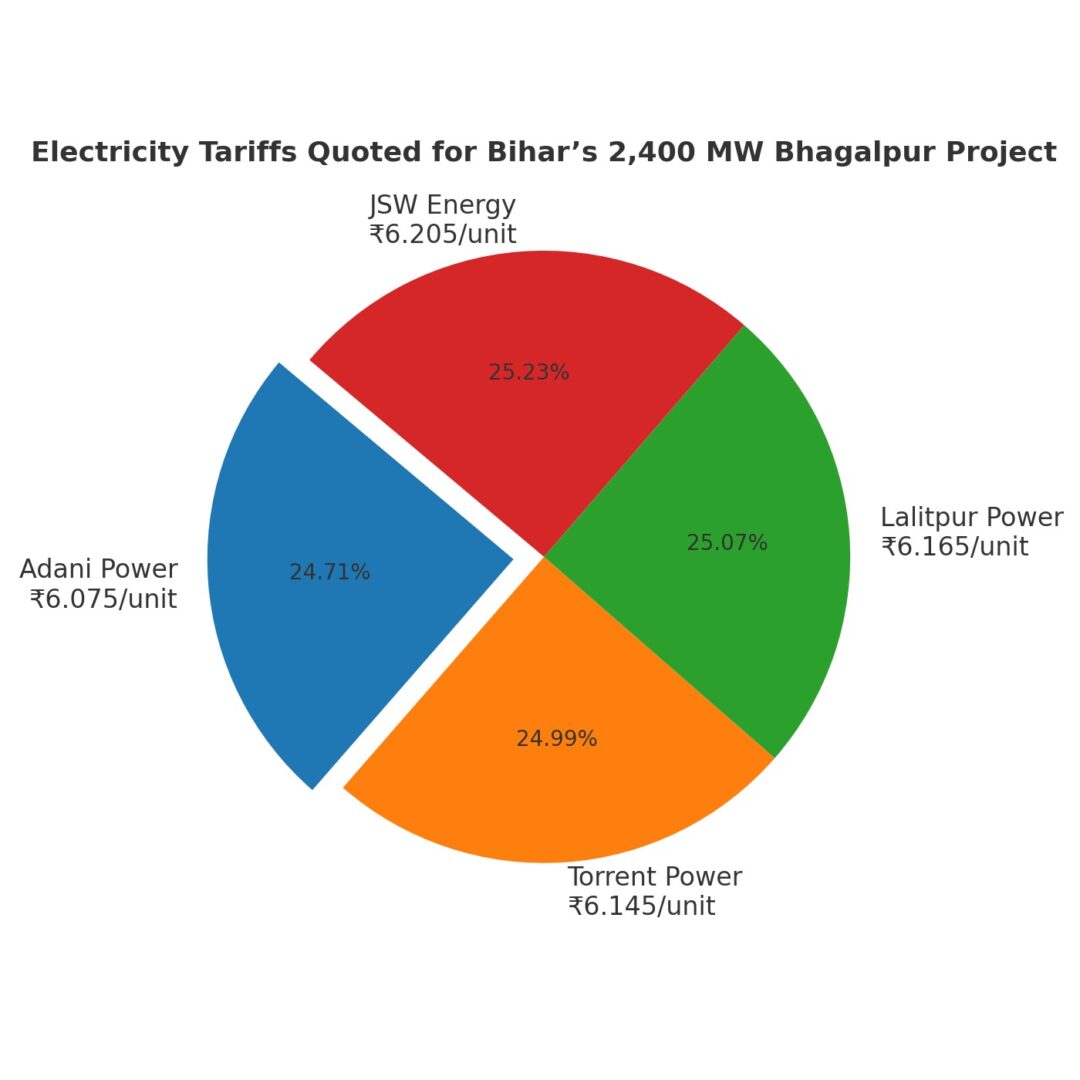
Officials said four qualified bidders were in the fray, with Adani Power emerging as the lowest (L1) bidder at a levelised tariff of ₹6.075 per kWh.
That quoted tariff breaks down into:
- Fixed charge: ₹4.165 per unit
- Fuel charge: ₹1.91 per unit
Torrent Power was the second-lowest bidder at ₹6.145 per kWh, followed by Lalitpur Power Generation Co. Ltd at ₹6.165 and JSW Energy at ₹6.205, people aware of the bid evaluation said.
The entire process was conducted through an electronic bidding platform under standard government procedures, they added, stressing that all offers were evaluated through the same e-bidding framework “to ensure full transparency and equal opportunity”.
State government officials have described the discovered tariff as “highly competitive”, especially when compared with a recent 3,200 MW bid in Madhya Pradesh, where the fixed charge alone was in the higher range of ₹4.222 to ₹4.298 per kWh, against ₹4.165 for the Bhagalpur project.
A ₹30,000 crore bet on Bihar’s power and industry
Adani Power plans to invest around ₹30,000 crore in the Bhagalpur (Pirpainti) plant, positioning it as one of the largest single-project investments in Bihar in decades.
For a state that has struggled to attract large-scale private industrial projects, with officials acknowledging that there has been virtually no major new industrial unit in the last five years, the scale of the project is significant.
Experts have long argued that reliable, affordable power is a precondition for industrialisation. Data cited by infrastructure specialists point to a strong correlation between per capita electricity use and per capita GDP, suggesting that Bihar’s long-term growth prospects are tightly tied to how quickly it can expand and stabilise its power supply.
Housing and infrastructure expert V. Suresh has estimated that every ₹1 crore invested in infrastructure generates roughly 200–250 man-years of employment across more than 70 trades, ranging from unskilled to highly skilled roles. Using that rule of thumb, investments of the kind Bihar is now courting are expected to support substantial employment across construction, engineering, logistics and ancillary industries.
Budget 2023’s ₹10 lakh crore allocation for capital expenditure was projected by such experts to create massive employment nationwide; Bihar officials are now hoping that projects like Bhagalpur will ensure the state captures a larger share of those indirect benefits instead of merely exporting workers.
Land, concessions and the project structure
The Bhagalpur project is not a fresh idea. It was first conceived in 2012 by the Bihar State Power Generation Company Ltd (BSPGCL), but the project saw multiple failed attempts to attract a developer before being relaunched in 2024.
One advantage the state had this time: the land.
Officials said the land for the plant, acquired more than a decade ago, remains fully owned by the Bihar government. Under the awarded structure:
- The land has been leased to the developer at a nominal rent under the Bihar Industrial Investment Promotion Policy 2025.
- This, they said, is a standard incentive extended to all investors under the policy, not a project-specific concession.
- The land will revert to the state government after the end of the project term.
- Adani Power will be fully responsible for developing, financing, operating and maintaining the plant and supplying power to Bihar.
Officials involved in the negotiations stressed that no special concessions have been given to Adani Power beyond what the state’s investment policy already provides.
Congress attacks ‘inflated’ tariff, BJP defends bid
Even before the ink has dried on the award, the project has become a political flashpoint in Bihar, which is in the middle of an election campaign.
The Opposition has seized on remarks by former Union minister R.K. Singh, who has alleged irregularities and described the power purchase arrangement as a “scam”. The Congress has amplified those claims to target the ruling BJP.
Congress general secretary K.C. Venugopal, in a post on X on Friday, alleged that the Adani Group was being given “red carpet treatment” in Bihar. He termed the proposal for the state to buy electricity at around ₹6 per unit “yet another example of a complete drain of wealth from the poor and middle classes into the coffers of Modi’s cronies”.
Government officials and people associated with the bidding process reject that charge. They argue that the ₹6.075 per kWh tariff discovered through the competitive bidding is “highly competitive” in the current environment, citing recent cost escalations in key inputs for power generation and pointing again to higher fixed charges discovered in comparable bids in other states.
According to them, the Bhagalpur power tariff is among the lowest for similar large-scale projects in the current cycle, once fixed and fuel charges are taken together and benchmarked against other recent tenders.
Power, migration and Bihar’s development deficit
Behind the numbers lies a deeper story about Bihar’s development model.
Despite accounting for roughly 10% of India’s population about 13.5 crore people, Bihar has seen limited industrialisation and persistent out-migration. Data shared by analysts and officials highlight:
- Only 5.7% of the state’s workforce is employed in manufacturing.
- Nearly 49.6% of workers depend on farming, forestry and fishing for their livelihood.
- Together with Uttar Pradesh, Bihar is one of India’s largest labour-supplying states, contributing an estimated 34 million workers to the national workforce, many of whom migrate for low-paid jobs elsewhere.
Economists often point to inadequate electrification and weak infrastructure as key reasons why large private investors have stayed away, forcing generations of workers to seek employment outside the state.
The Bhagalpur power project, coupled with Adani Group’s existing presence in power transmission, cement (with a committed ₹1,600 crore investment), logistics and airport operations, is being viewed by some analysts as a potential catalyst for clustered industrial growth, provided the power is made available reliably and distribution bottlenecks are addressed.
A test case for Bihar’s industrial reset
For Bihar, the 2,400 MW Bhagalpur (Pirpainti) plant is more than just a power purchase contract. It is being positioned as a cornerstone infrastructure project that could:
- Strengthen the state’s base load power supply as demand rises towards the projected 17,000 MW mark.
- Support industrial and services investment that has largely bypassed the state for decades.
- Generate multi-year employment across construction and allied sectors during the build-out.
- Signal that large private players are finally willing to make long-term bets in Bihar.
Whether that promise is realised will depend on more than one tariff number. Project execution, fuel security, environmental clearances, grid evacuation infrastructure and the state’s broader industrial policies will all play a role.
For now, Adani Power’s ₹6.075 per unit bid has secured it one of the most closely watched power projects in eastern India and thrust Bihar’s struggle to balance competitive tariffs, investment needs and political scrutiny into the national spotlight.
Also Read: The Policy Exchange raises $1.5 million in Pre-Series B