A cap table rarely feels important when a startup is young. Two founders may split the company, issue shares and move on to building the product. But the moment outside capital, employee options or an acquisition enters the picture, that simple ownership record can become one of the most important documents in the company.
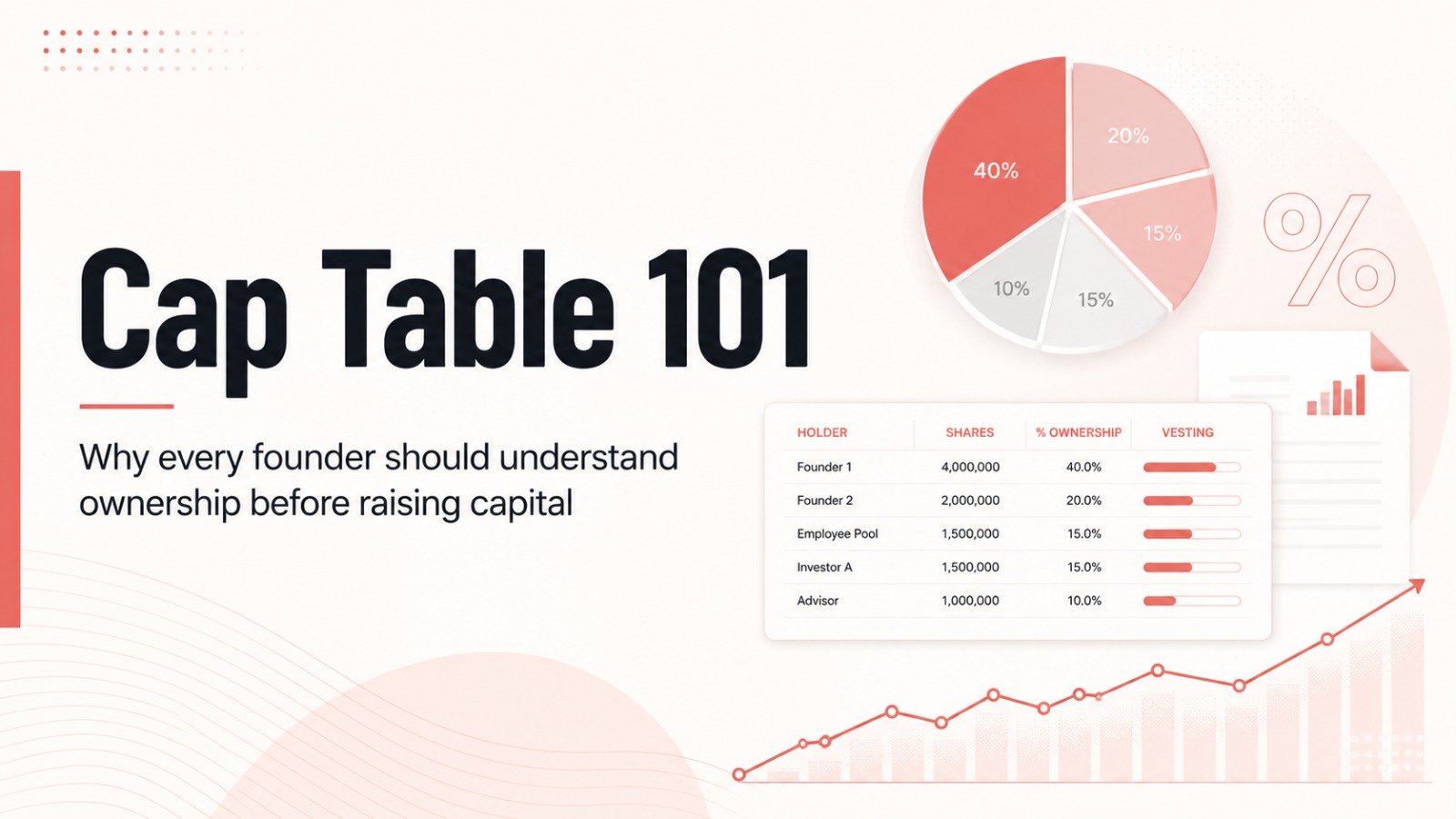
A capitalization table, or cap table, shows who owns the company, what type of securities they hold and how much of the business each stakeholder represents. More importantly, it shows how that ownership changes when new shares are issued. For founders, understanding it early can prevent expensive surprises later.
What Does a Cap Table Show?
At its simplest, a cap table lists shareholders, the number and class of shares they hold, options or other securities, and their ownership percentage. Suppose two founders each own 500,000 shares in a company with 1,000,000 shares outstanding. Each owns 50 percent.
Now the company raises money and issues 250,000 new shares to an investor. The founders still hold 500,000 shares each, but total shares rise to 1,250,000. Their ownership falls from 50 percent to 40 percent each.
That is dilution. Nobody took shares away from the founders; the company simply created more shares. This is why founders should look beyond the number of shares they own and understand the denominator used to calculate ownership.
Outstanding vs Fully Diluted Ownership
The cap table may provide varying ownership percentages depending on the information used. The term outstanding shares is often used to refer to the shares that have been issued. The fully diluted ownership position may take into account other securities as well.
This distinction matters during fundraising. If an investor says they will own 20 percent of the company, founders should ask whether that is calculated before or after the option pool, convertible securities and new investment are included.
A percentage without a clearly defined denominator can be misleading.
Why Investors Study the Cap Table
For the investor, the cap table provides information about the history of ownership and dilution of ownership in the company. The investor wants to know whether the founders still have substantial ownership in the company, whether sufficient shares have been set aside for the employees, and if there are any existing securities that could make the next funding difficult.
A dirty cap table may indicate issues in corporate governance. Unregistered promises of equity, lost share information, or convertible securities not recorded can slow down the due diligence process.
A complicated cap table is not necessarily a problem. An inaccurate one is.
The Option Pool Can Dilute Founders More Than Expected
Startups often reserve shares for employees through an option pool. During a funding round, investors may ask the company to increase this pool so future hires can receive equity.
Timing is important here. In case the pool gets increased before the entry of the investor, the dilution normally comes into effect for the current shareholders first. A founder who assumes that the investor is getting a stake of 20 percent will realize that his own stake is much lower.
That is why founders should review a pro forma cap table before signing a financing agreement. It shows what ownership will look like after the entire transaction is completed.
SAFEs and Convertible Notes Add Another Layer
SAFEs and convertible notes are two of the most common methods by which startups can access capital without having to go through an equity round of funding. SAFE is an acronym that stands for Simple Agreement for Future Equity.
Problems arise when a company has several instruments with different terms. Individually, each investment may appear small, but their combined conversion can create meaningful dilution.
Founders should therefore model convertible instruments before negotiating the next round rather than waiting until the financing documents are being finalized.
Why Equity Promises Must Be Documented
Perhaps the most easily preventable issue with a cap table starts with verbal agreements. The founders promise a consultant 1 percent of stock, or they promise one of their first employees “some equity.”
Years later, that promise can become a dispute. Was the percentage before or after fundraising? Was it supposed to vest? Was it an option grant or actual shares?
These questions become far more serious when investors are conducting due diligence or an acquirer is trying to establish who legally owns the company. Equity commitments should be documented when they are made, not reconstructed from old emails and conversations later.
Why the Cap Table Matters in an Acquisition
During a sale, a buyer needs to know exactly who owns the company and how the purchase price should be distributed. This can become complicated if investors hold preferred shares with liquidation preferences, employees hold options or convertible securities remain outstanding.
A shareholder owning 10 percent does not always receive exactly 10 percent of the sale proceeds. The rights attached to different classes of securities can affect who gets paid first and how much each stakeholder receives.
For that reason, founders should understand not only their ownership percentage but also the economic rights attached to the securities on the cap table.
A cap table is more than a spreadsheet. It is the financial history of a startup’s ownership and a model of how future decisions will affect founders, employees and investors.
Founders should keep it updated from the beginning, document every equity issuance, track convertible instruments and model dilution before agreeing to a funding round. Most importantly, they should always ask one question before raising the next rupee or dollar:
After this deal closes, who owns what? That answer often matters more than the headline valuation.
Also Read: Mahindra Scorpio Lifestyler Targets Toyota Hilux With Sub-₹19.79 Lakh Price