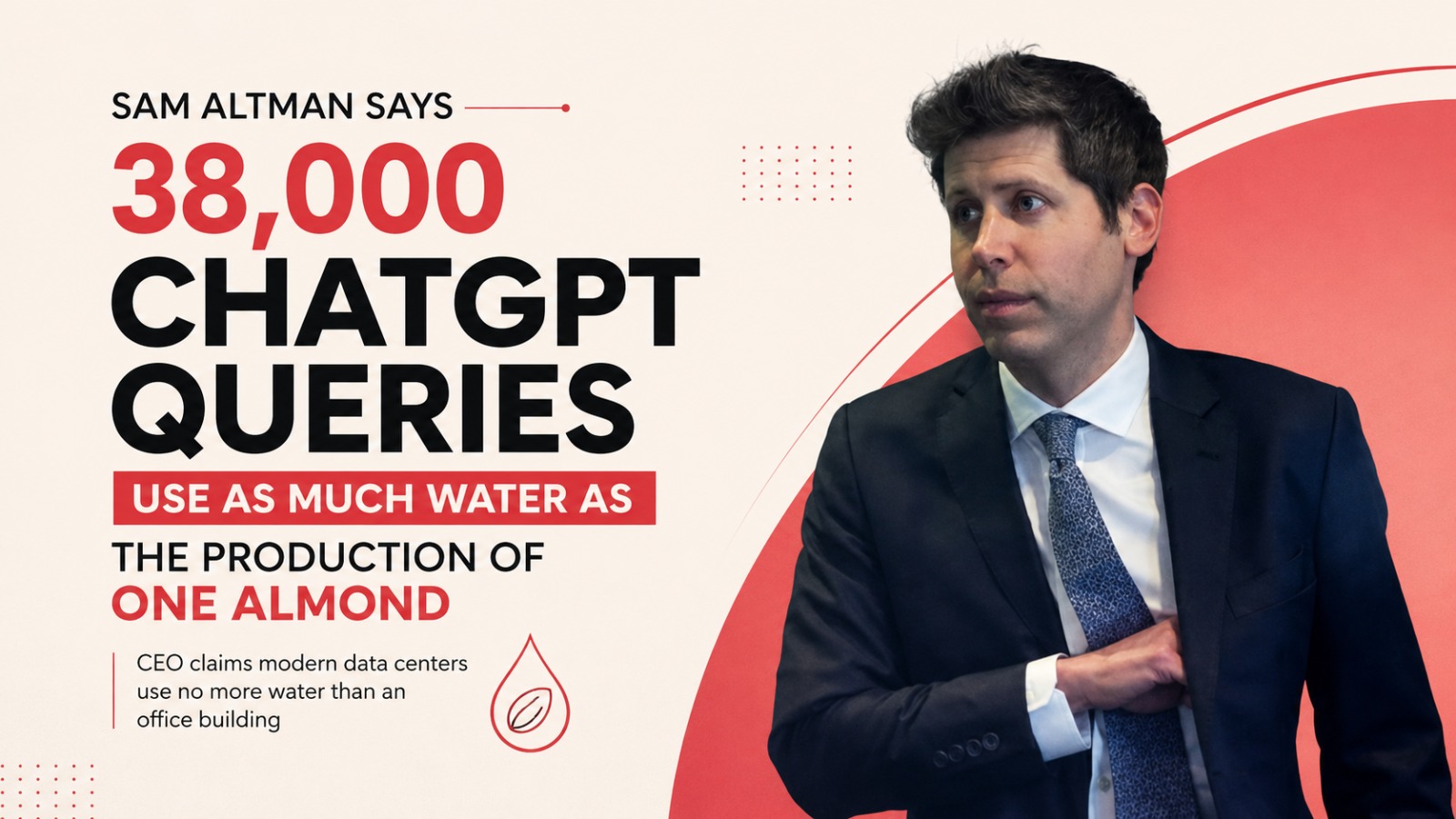
Sam Altman has pushed back against growing concerns over the amount of water consumed by artificial intelligence infrastructure, offering an unusually specific comparison to make his case: roughly 38,000 ChatGPT queries, he said, account for about the same amount of water used to produce a single almond in California.
The OpenAI chief executive made the remarks during an episode of the Sources podcast with Alex Heath, where the discussion turned to the backlash surrounding AI development and the environmental demands of data centers.
What makes Altman’s figure notable is the caveat that accompanied it.
He said he did not have the exact calculation in front of him and was working from memory. His estimate, which he described as “close,” was intended to represent what he called the “full-on” water accounting associated with ChatGPT, rather than simply the water flowing through an individual data center.
That distinction sits at the heart of his argument.
Sam Altman says the data-center water debate is outdated
Altman challenged the idea that modern AI facilities necessarily consume vast amounts of water through their cooling systems.
While he accepted the fact that data centers utilized evaporative cooling in the past, a technique which uses substantial amounts of water, he contended that modern data centers operate using completely different technology.
According to Altman, a modern large data center can now use an amount of water comparable with an office building, with much of that consumption associated with ordinary human needs such as sinks and toilets.
He described the belief that data centers remain exceptionally water-intensive as a persistent idea that, in his view, no longer stands up to scrutiny.
His comments come as the expansion of AI infrastructure continues to draw attention not only for electricity demand, but also for its potential effect on local water supplies.
The almond comparison highlights a much wider debate
The comparison with almonds is particularly striking because almond farming itself has long been associated with high water use.
The report cites researchers estimating that producing one almond requires about 1.1 gallons of water.
At the same time, earlier statements attributed to Altman have suggested that an individual ChatGPT response may require somewhere between 1 and 50 millilitres of water. Using those figures, the report calculates a considerably different range of roughly 85 to 5,500 ChatGPT queries for the amount of water associated with producing one almond.
That is well below the 38,000-query figure Altman recalled during the podcast.
The difference matters because there is no single water-consumption figure that applies neatly to every AI query.
Water use can vary depending on the facility, cooling system and infrastructure involved. Training large AI models can also have a very different environmental footprint from serving individual chatbot requests.
GPT-3 training using older systems consumed close to 185,000 gallons of water. It also points out that increasingly complex AI workloads, including agents that process far more tokens than conventional chatbot exchanges, could continue adding pressure to data-center resources.
Older facilities remain part of the concern
Altman’s argument focuses heavily on newer cooling technology, but the wider data-center industry still includes facilities operating under different conditions.
Georgia where water consumption and local supply concerns have become contentious. One facility in Fayette County was reported to have used 29 million gallons over 15 months, while a development in Morgan County was linked to allegations from neighbours that their water had turned muddy.
At the same time, technology companies are introducing cooling designs intended to reduce or eliminate routine water consumption.
Examples cited include an Nvidia liquid-cooling system described as eliminating water use for cooling, Microsoft closed-loop systems, and Amazon’s claim that its data centers consume only 0.075% of the water Americans use on lawns and gardens.
That leaves the AI water debate in a more complicated place than a single comparison can capture.
Altman’s 38,000-query estimate offers a simple way to communicate what he believes is a misunderstood environmental cost. But his own qualification that the number was recalled from memory, together with the wide range of figures associated with different generations of infrastructure, shows why the question of how much water AI actually uses remains difficult to reduce to one universal number.
OpenAI’s CEO wants the conversation to move away from assumptions based on older cooling systems and toward the technology being deployed in newer data centers.
Whether that argument settles concerns around AI infrastructure is another matter. Water consumption can depend heavily on where a facility is built, how it is cooled and what kind of computing work it performs. For communities hosting rapidly expanding data-center developments, those differences are likely to remain just as important as any global per-query estimate.
Also Read: iPhone 18 Pro Price Estimates Surface Ahead of Apple Event