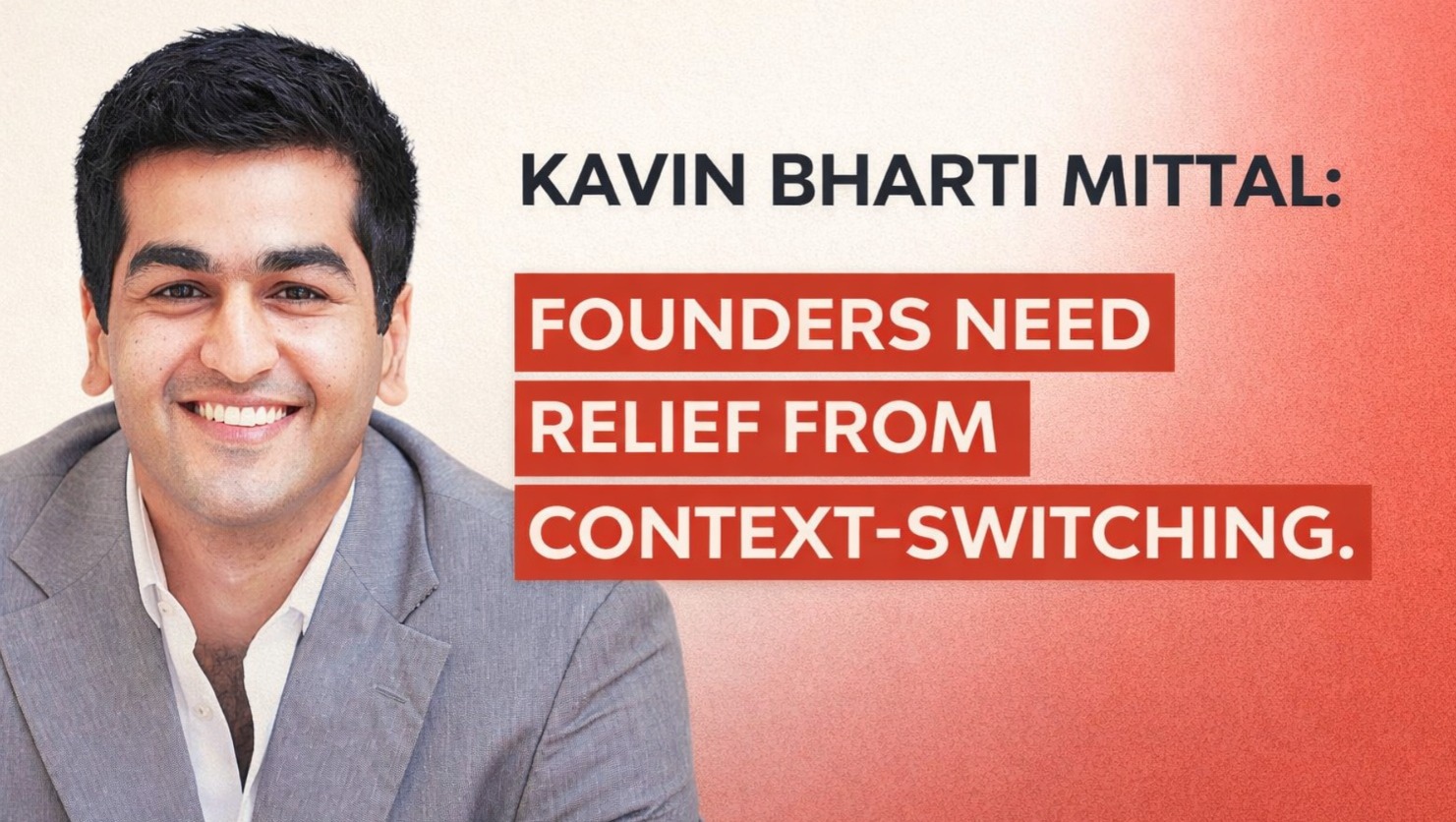
In a candid LinkedIn post that reads less like a product launch and more like a founder’s confession, Hike founder Kavin Bharti Mittal has put words to a problem many startup leaders quietly live with every day: the exhaustion of constant context-switching.
Kavin Bharti Mittal on Founder Burnout
Mittal frames the issue not as a personal weakness, but as a structural reality of building companies at scale. In his telling, the founder’s day is rarely defined by deep, uninterrupted work. Instead, it is shaped by a relentless series of competing demandsm an investor waiting on a response, a team member escalating a decision, a customer asking to speak directly to the CEO, a co-founder seeking clarity, a lawyer needing a signature. Each thread feels urgent. Each arrives at once.
That experience, he suggests, has defined much of his own operating life.
Drawing from his time building two companies, Mittal says he spent both journeys dealing with the same core challenge: not a lack of discipline, and not weak hiring, but the sheer burden of switching between high-stakes conversations all day long.
In the post, he points to the scale of those ventures to establish the weight of that experience, saying Rush hit $650 million in gross revenue in a year, while Hike peaked at 40 million monthly users. Those numbers are presented by Mittal in the post as markers of the environments in which he learned this lesson.
According to Mittal, the tools he turned to over the years did not solve the real problem. Better calendars, better notes, and better project management systems may have improved speed, but they did not reduce the mental load. In his words, they made him faster at context-switching, not freer from it. The result was not clarity, but scale: handling 30 threads instead of 20.
That is the tension at the heart of his post, and it is also the foundation of his new product pitch.
Mittal says what he truly needed was not another dashboard or workflow layer, but “someone who could hold the context” for him, someone who could understand which thread mattered first, separate issues that genuinely required founder attention from those that merely felt urgent, and sit close enough to the flow of work to act as a filter rather than just a recorder.
He says that is what he built Lia for.
The positioning is deliberate. Lia is not described as another productivity app or another software layer in an already crowded stack. Instead, Mittal introduces it in human terms: “someone who sits in your inbox and knows what deserves you.”
That line is likely to resonate because it taps into a deeper shift in the way founders and executives are beginning to talk about work. For years, workplace software has promised optimization, more efficiency, more automation, more visibility. Mittal’s post argues that efficiency alone is not enough when the real bottleneck is cognitive burden. The issue is not simply managing information. It is managing attention.
That distinction matters.
Founders are often told that the answer to overload lies in sharper prioritisation, stronger systems, or better delegation. Mittal is effectively arguing that even with those in place, the volume and simultaneity of founder-level decisions create a different kind of pressure. It is not just about too much work. It is about too many contexts competing for the same mental bandwidth.
Seen that way, his post is as much a commentary on leadership as it is a product introduction. It reflects a founder’s attempt to define a category around a lived pain point rather than a trend. The storytelling works because it stays rooted in operational reality: inboxes, escalations, signatures, customer pulls, investor timelines. There is nothing abstract about it.
And that may be why the message feels fresh. Instead of selling aspiration, Mittal is selling relief.
Instead of promising that founders can become superhuman, he is acknowledging that even experienced operators reach a point where the number of live threads becomes the real drag on performance.
There is also a subtle but important shift in how authority is framed. In many startups, the founder’s value is treated as the ability to stay on top of everything. Mittal’s post suggests the opposite: the real value of a founder’s time lies in not being pulled into everything equally. The hardest problem is not access to information, but judgment over what deserves direct attention.
That is the space where Lia is being positioned.
Whether that message lands widely will depend on how many founders see their own daily reality in it. But the post itself is notable for one reason already: it captures a familiar leadership burden in unusually plain language. No jargon. No inflated promise. Just a simple argument, that modern work has become very good at helping people process more, but not necessarily at helping them think with less fragmentation.
For startup founders, that may be an uncomfortably accurate observation.
And for Mittal, it is clearly the opening case for why Lia exists.
Also Read: Pronto: Instant Home Cleaning Services in Just 10 Minutes!