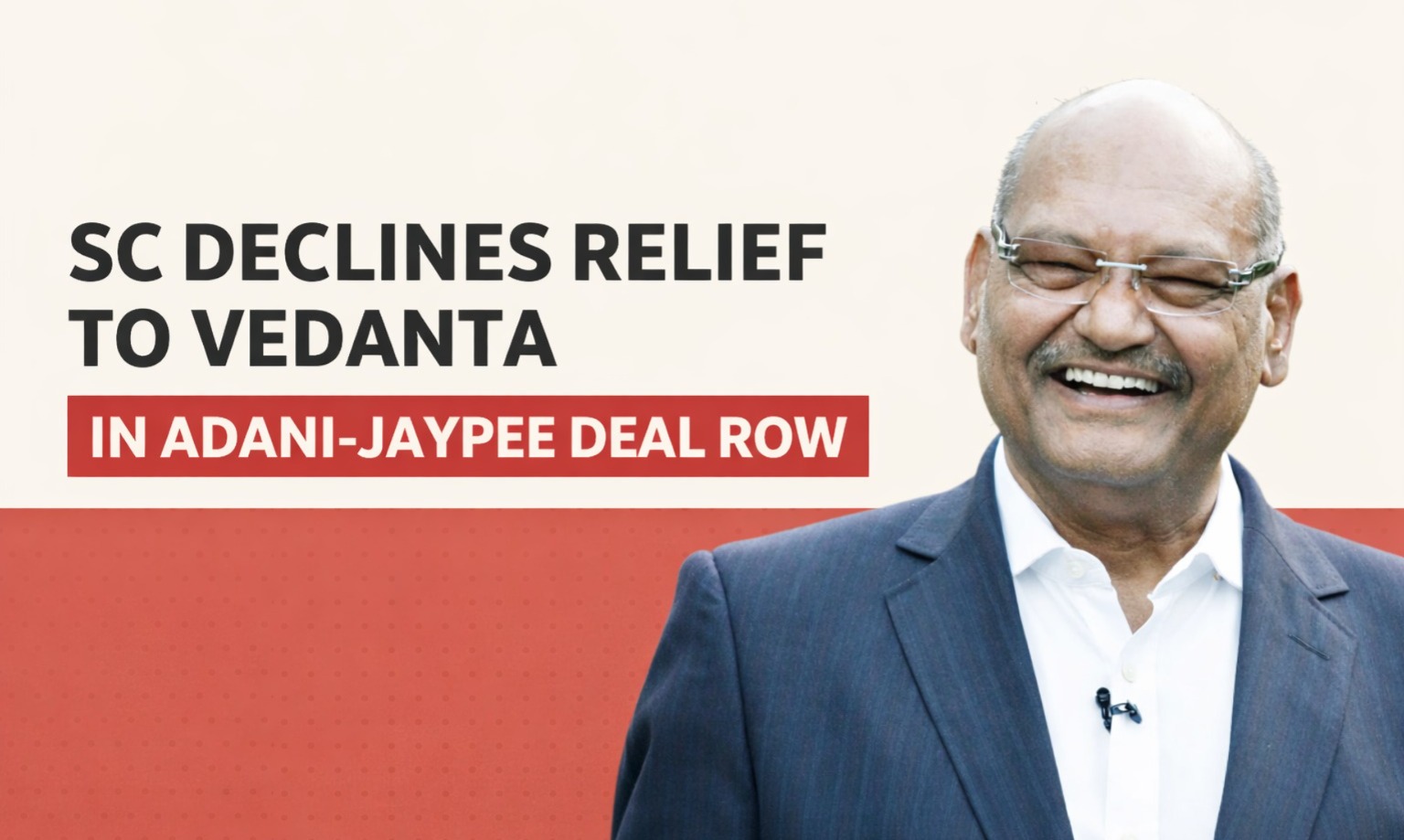
In a significant development in the insolvency battle over Jaiprakash Associates Ltd (JAL), the Supreme Court on Monday declined to interfere with the National Company Law Appellate Tribunal’s interim order that allowed Adani Enterprises’ resolution plan to move ahead. At the same time, the court asked the appellate tribunal to take up Vedanta’s challenge on priority, with the matter already listed for April 10.
A bench led by Chief Justice of India Surya Kant and Justice Joymalya Bagchi made it clear that it was not inclined to step in at this stage, noting that the dispute is already before the NCLAT for final hearing. The court said there was no reason to interfere with the appellate tribunal’s order and requested that the appeal be heard out of turn on the scheduled date or on the next working day if arguments remain incomplete.
That means Adani Enterprises’ approved resolution plan for JAL, valued at Rs 14,535 crore in the material before the court, will not be stalled for now. But the Supreme Court also added an important safeguard: if the monitoring committee overseeing the company’s affairs needs to take any major policy decision in the interim, it must first obtain the NCLAT’s sanction.
The case has become one of the most closely watched insolvency contests in recent months because it pits two major corporate groups against each other in the race for a debt-laden company with a wide asset base. Jaiprakash Associates entered insolvency in June 2024 after defaults exceeding Rs 57,000 crore, according to the uploaded reports. Its holdings span real estate, infrastructure and cement assets, including projects in Noida and Greater Noida.
Vedanta has challenged both the outcome and the process. In the reports placed on record here, the company argued that its offer was higher than Adani’s and alleged that the insolvency process did not maximise value for creditors.
One account says Vedanta called the Committee of Creditors’ approval of Adani’s plan “unfair, opaque, and inequitable.” Another says Vedanta claimed it had earlier been told in writing that it was the highest bidder before that outcome was later reversed.
Yet the lenders’ position, as reflected in the uploaded coverage, is equally clear. They have argued that a resolution plan is not judged only by headline value. Upfront cash, feasibility of execution and repayment timelines also matter under the insolvency process. Adani’s proposal was preferred because it offered around Rs 6,000 crore upfront and a faster repayment schedule of about two years, while Vedanta’s revised offer was said to involve a longer payout period and was also disputed on the ground that it came after the bidding window had closed.
The journey through the legal process that brought us to this hearing on Monday is equally crucial. Adani Enterprises’ resolution plan had already been approved by the National Company Law Tribunal. However, Vedanta went to NCLAT seeking interim relief from execution of this plan, which was turned down on March 24 despite the larger matter remaining pending. This decision to deny interim protection led to the case being referred to the Supreme Court, which did not overturn this interim order on Monday.
So, for now, the Supreme Court has not settled the commercial dispute itself. What it has done instead is set the immediate legal direction: no stay, no derailment of the approved plan at this stage, but a faster hearing before the NCLAT and a restriction on any major policy moves by the monitoring committee without tribunal approval. In practical terms, that keeps Adani’s resolution plan alive while preserving Vedanta’s chance to press its objections before the appellate forum.
However, the broader issue is now left for resolution before the NCLAT. There, the arguments of Vedanta regarding maximizing the value, transparency, and equal bidding will most likely be tested against the arguments made by the lenders that under the law of insolvency, there was room to take into account certainty and speed of realization. For now, the insolvency case involving Jaypee is not yet closed but just about.
Also Read: What Was Harshad Mehta Worth at the Height of His Rise?