

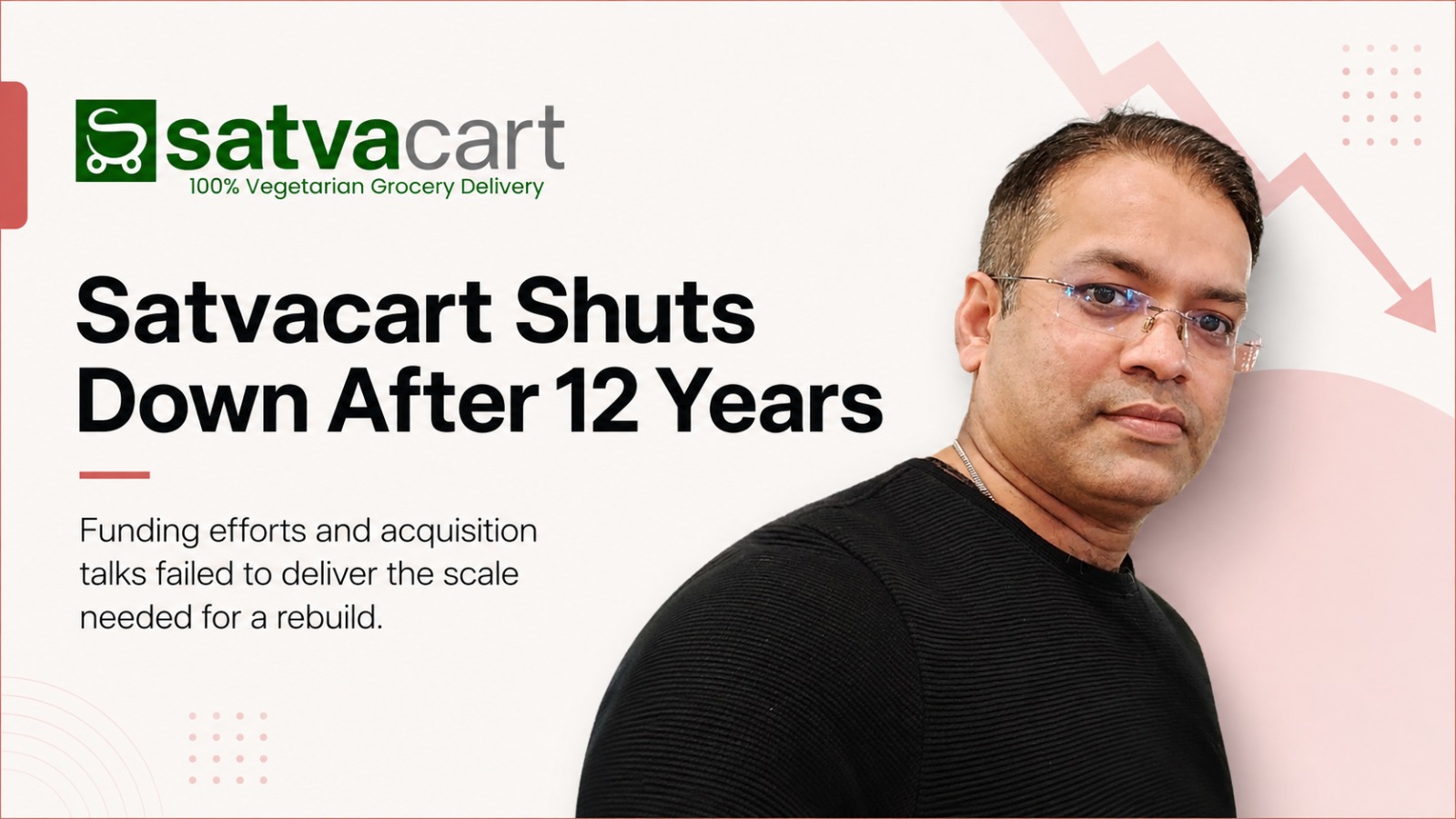
E-grocery startup Satvacart has closed after 12 years of operations, bringing an end to a business that chose measured growth and profitability at a time when much of India’s online grocery market was moving towards scale and, eventually, quick commerce.
August 28 was Satvacart’s final day of operations, after which its team was disbanded, founder Rahul H. Saxena said. The shutdown followed several difficult years in which the company explored fresh funding, strategic investments and possible acquisitions in an effort to keep the business going.
One detail stands out in Satvacart’s final stretch. The company did receive capital, but Saxena said much of it came in smaller tranches that were not sufficient to rebuild and scale the business. At the same time, Satvacart was in discussions with two larger investors for a more substantial investment, but neither transaction was completed.
Acquisition was another possible route. Satvacart held discussions with multiple potential buyers, but those conversations also ended without a deal.
The result left the company in an increasingly difficult position. Saxena said Satvacart continued exploring realistic funding, strategic investment and acquisition possibilities until the end, but its profitability-focused approach had not produced the scale that prospective investors were seeking.
That contrast became central to Satvacart’s story.
From milk subscriptions to an inventory-led grocery business
Satvacart was among the earlier companies to enter India’s online grocery space. It began with milk subscriptions in Gurugram before developing into an inventory-led grocery delivery business that operated through clusters and independent warehouses.
The startup raised seed capital from Palaash Ventures and angel investors, using the funding to expand operations, acquire customers and strengthen its technology team.
But instead of following competitors into aggressive customer acquisition and rapid expansion, Satvacart pursued what it described as a more measured approach built around growth and profitability.
Saxena said the company became one of the early online grocery businesses in the category to demonstrate profitability in 2019.
That discipline, however, did not translate into the kind of scale that became increasingly important when Satvacart later sought institutional capital or strategic interest.
A grocery market that moved towards speed and scale
The environment around Satvacart changed considerably during its 12-year journey.
India’s online grocery market increasingly shifted towards quick commerce, where delivery speed, dense fulfilment networks and scale became important competitive factors. Companies including Zepto and Swiggy Instamart emerged as prominent participants in this model, while large technology and e-commerce companies also moved deeper into faster grocery delivery.
For a smaller business such as Satvacart, that shift created a difficult funding equation.
The company had prioritised profitability rather than pursuing expansion at the same pace as heavily scaled competitors. But when it later looked for larger institutional investors or strategic buyers, its smaller size became a disadvantage in a market increasingly centred on scale-driven business models.
The case of Satvacart illustrates that there is a delicate balance in starting up a venture; while being financially responsible helps build the internal strength of a company, it doesn’t always impress investors who desire market expansion.
Final months became difficult to sustain for Satvacart
The situation grew particularly challenging in Satvacart’s final months.
Saxena said continuing the business had reached a point where keeping operations running was coming at a cost to people who had supported the company. With a sizeable funding round not materialising and acquisition discussions failing to reach completion, the company ultimately decided to stop.
There was no suggestion from Saxena that the closure erased the work that went into building the company.
Reflecting on the journey, he said he had no regrets about shutting down Satvacart and believed he had given the company the best effort he was capable of.
Over those 12 years, the business had been built across technology, operations, fundraising, marketing, supply and customer experience. The company’s closure now ends that chapter, with Saxena indicating that he is looking ahead to what comes next.
Satvacart may not have matched the scale that eventually came to define India’s online grocery and quick-commerce race, but its final years reveal something more specific about the economics of that transition. The company was able to secure some capital and reach discussions with larger investors and potential acquirers, yet none of those paths produced the level of backing needed for a meaningful rebuild.
Eventually, it was not just the difference between being funded or not. It was the difference between having sufficient funds to survive and having sufficient funds to compete on a scale that the market demanded.
Also Read: Inside Breedr: Ian Wheal’s $27M Push to Digitize Cattle
















