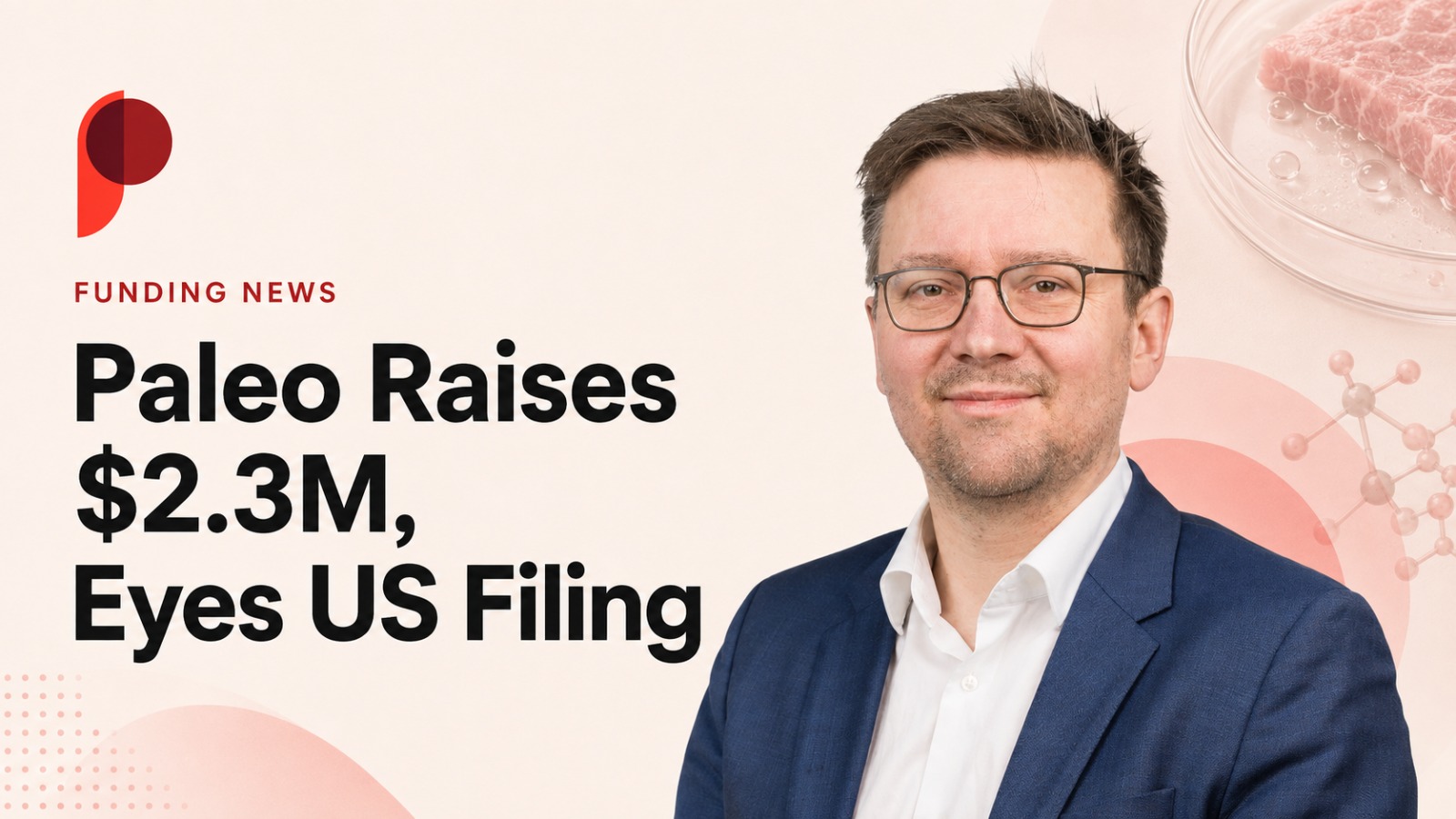
Belgian food-tech startup Paleo has raised €2 million, or about $2.3 million, in fresh funding as it moves its animal-free myoglobin technology closer to regulatory approval and commercial use.
The round was led by Beyond Impact and comes at a point when Paleo says much of the technical development behind its ingredient is already in place. Rather than directing the new capital primarily toward research or large-scale infrastructure, the company plans to focus on regulatory submissions in North America, customer trials and formulation work.
That shift makes this funding round less about proving that precision fermentation can produce myoglobin and more about getting the ingredient into a position where food manufacturers can actually use it.
For Paleo, one number captures how far the technology has moved: the company says it has reduced the production cost of its myoglobin by a factor of 613 over the past two years.
What Paleo is making, and why it matters
Myoglobin is an iron-rich heme protein naturally associated with muscle tissue. It plays an important role in the colour and characteristic flavour experience of meat, including the changes that occur when meat is cooked.
Paleo is attempting to recreate that functionality without relying on animals.
The company uses precision fermentation to produce bioidentical versions of myoglobin. Its process involves inserting a myoglobin-encoding DNA sequence into the yeast strain Komagataella phaffii. Fermentation is then used to grow the yeast and trigger myoglobin production. The protein is secreted outside the yeast cells, separated through centrifugation and filtration, and prepared for use as a food ingredient.
According to Paleo, the resulting ingredient itself is free of genetically modified organisms. CEO and co-founder Hermes Sanctorum said the company has spent years optimising the production strain to achieve high productivity and a competitive cost of goods.
Paleo was founded in 2020 by Sanctorum and board director Andy de Jong.
A 613-fold cost reduction changes the commercial equation
One of the more significant developments behind Paleo’s latest funding round is not simply that the ingredient can be produced, but that the economics appear to have improved substantially.
The startup works with several contract manufacturers instead of building its own large production facilities. Paleo says it has demonstrated its technology at scales well above 10 cubic metres, allowing it to make use of existing fermentation capacity as demand grows.
That approach could become important as the company moves from technical validation toward commercial supply. Paleo says its priority is no longer centred mainly on R&D or proving whether the underlying process works.
The new capital will instead support the steps that come immediately before market entry, particularly regulation and customer adoption.
Plant-based meat is the first target
Paleo produces versions of myoglobin associated with beef, chicken, pork, lamb and tuna for human food applications. It has also developed mouse, rat and rabbit versions intended for potential pet-food use.
Its most advanced application, however, remains meat alternatives such as burgers, sausages, minced products and whole cuts.
Sanctorum argues that one of the problems facing alternative meat is not simply consumer interest, but the gap between price and eating experience. Paleo is positioning myoglobin as an ingredient capable of improving colour, aroma and the overall meat-like experience at relatively low inclusion levels.
The company operates primarily as a B2B ingredient business and is already in strategic and commercial discussions with potential customers that could incorporate its myoglobin into their products. Paleo is also exploring opportunities in pet food and nutraceuticals.
US regulatory filing is now the near-term milestone
Regulatory clearance is the next major test.
Paleo is preparing a Generally Recognized as Safe, or GRAS, dossier in the United States, covering the safety, production and characterisation data for its myoglobin. Sanctorum has described the submission as a near-term priority and a key milestone for the company.
The company also intends to pursue a regulatory filing with the European Food Safety Authority, although that submission is expected later. Sanctorum said the European pathway is more extensive and is likely to take longer.
The latest investment takes Paleo’s total funding to nearly €18 million, or around $20.8 million.
That funding arrives after a period of adjustment for the company. Paleo previously announced a strategic refocusing of its operations amid long regulatory timelines and weaker funding conditions in alternative proteins, a move that included a significant workforce reduction at its Leuven R&D centre.
The new round suggests the company has entered a different phase. Instead of putting most of its attention on whether precision-fermented myoglobin can be made at useful scale, Paleo is now concentrating on the harder commercial questions: securing approvals, working directly with customers and building a path to market.
For an alternative-protein industry still looking for products that can compete more convincingly on taste and cost, Paleo’s next test will be whether years of fermentation work can translate into an ingredient that food companies are willing, and legally able, to put on shelves.
Also Read: Equentis Leads $2 Million Pre-Series A Funding Round in DocPharma