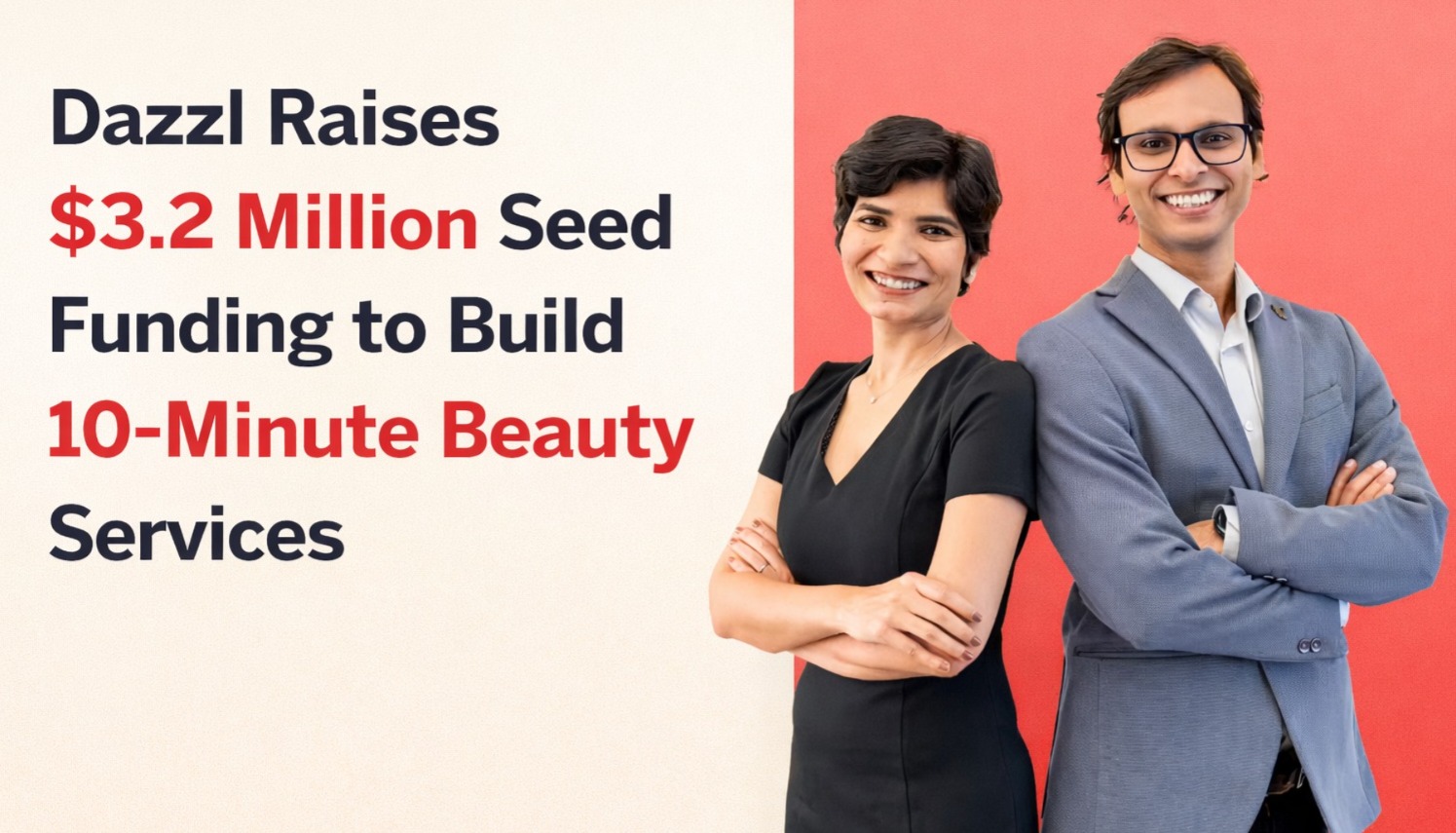
Bengaluru-based beauty and wellness services startup Dazzl has raised $3.2 million in a seed round led by Stellaris Venture Partners, betting that India’s “quick commerce” habit is now spilling beyond products and into services.
The round also brought in a cluster of founders and operators as angel investors, including Ritesh Agarwal (Founder & Group CEO, PRISM; formerly OYO), along with Maninder Gulati, Abhinav Sinha, Sameer Brij Verma, and Abhishek Bansal . Storyboard18 described this as Dazzl’s first institutional fundraise.
The pitch: beauty appointments, but on “today’s timeline”
What Dazzl is banking on is that the pain it’s trying to solve is straightforward: there’s planning, slot times, and rescheduling required in the beauty and wellness services that city life has to offer. This, according to co-founder Komal Solanki, has caused what’s supposed to be a pleasantly fun task turn into a chore for the target market, and that’s what the company can solve.
Founded in 2025 by Komal Solanki and Ashish Bajpai, Dazzl offers at-home beauty and wellness services with professionals reaching customers in under 10 minutes of booking.
The company’s focus is on high-frequency, everyday use cases, the kind of services people might want between meetings or before stepping out, such as quick blow-dries, head massages, and quick manicure-type services.
Where the money goes: micro-markets first, playbooks next
Dazzl says the fresh capital will be used to validate and scale its model across select areas/micro-markets in Bengaluru, while building repeatable “hyperlocal operations” and go-to-market playbooks.
The startup also plans to invest in core technology and training systems, a signal that speed is only half the promise; consistency is the other half.
In the coming 12 months, the plans of co-founder Ashish Bajpai include scaling up in and around the Bengaluru city and showing repeat use in clusters, as it aims to develop a “repeatable technology and operations playbook.”
What this means is that Dazzl is attempting to prove a couple of things at the same time. It wants to prove the fact that people will avail themselves of beauty services as they do when ordering groceries. Additionally, the company wants to prove the fact that they have the capability of offering the same experience in different pockets of the city.
The operating model: speed, controlled supply, and trained pros
Unlike appointment-led beauty platforms that primarily match supply and demand, Dazzl says it runs a hyperlocal, vertically integrated setup, managing supply, training, and operations to keep quality consistent while meeting tight response times.
That design choice matters because “10-minute service” is an operational problem before it’s a marketing line: you need nearby professionals, predictable service standards, and a system that doesn’t break when demand spikes.
Stellaris partner Naman Lahoty framed the bet as part of a wider consumer shift: expectations for immediacy, once limited to product delivery, are now extending to services too.
Why investors are paying attention: a big market, and a new habit forming
One report pegs India’s beauty and wellness services market at $6-$7 billion, growing at an estimated 9-10% CAGR . But Dazzl’s narrative isn’t only about market size, it’s about frequency. If consumers begin ordering beauty services the way they order snacks or medicines, small, quick, repeatable, then the category’s economics and customer behaviour can start to look very different.
Dazzl’s strategy, as described in the reports, is to deepen its presence in Bengaluru first, testing repeat usage across clusters, before taking the model to other cities.
For Dazzl, the next phase is less about headlines and more about proof: whether “10-minute beauty” can remain reliable beyond early adopter pockets, and whether consumers actually return often enough to turn speed into a habit. The company says it is building the training and tech backbone to make that consistency repeatable, a quiet admission that in services, trust travels slower than delivery promises.
Also Read: India’s Computer Gap: Smartphone Boom Masks a Growing AI Skills Crisis