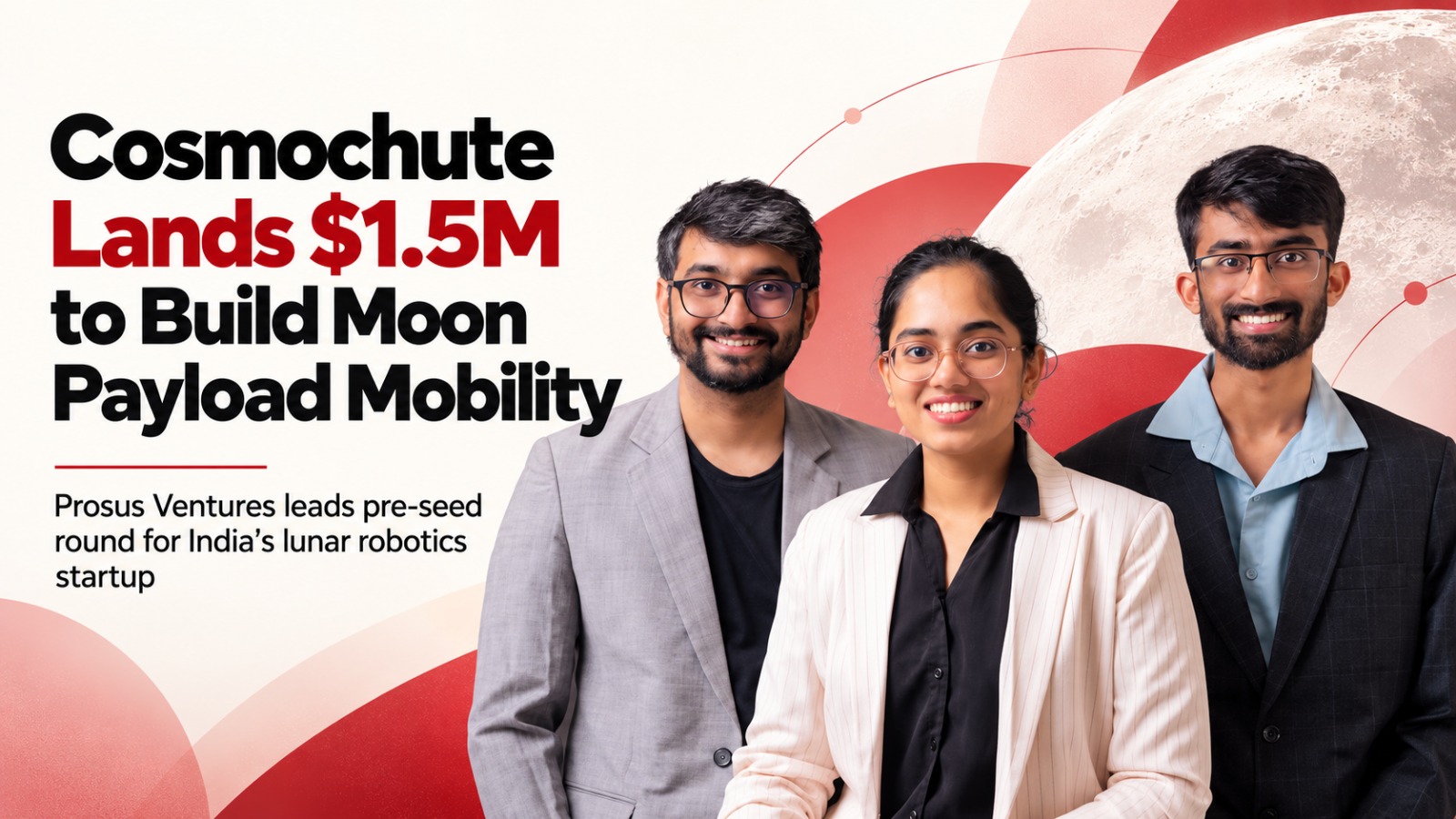
The Indian space robotics startup Cosmochute plans to use the pre-seed funding to develop its modular lunar mobility technology, expand its engineering team and advance research, with former Chandrayaan-1 programme director Mylswamy Annadurai providing guidance.
Indian space robotics startup Cosmochute has raised $1.5 million in a pre-seed funding round led by Prosus Ventures, securing fresh capital to develop technology designed to transport and deploy equipment on the Moon.
The investment will primarily support LEAP, Cosmochute’s flagship modular lunar mobility platform. The company is working on a system intended to address one of the practical challenges of lunar exploration: moving and deploying payloads after they reach the Moon.
Cosmochute is also joining six startups selected for the inaugural Atoms X cohort, an initiative launched earlier in 2026 through a partnership between Prosus Ventures and Accel.
Cosmochute’s LEAP Platform Targets a Challenge Beyond Reaching the Moon
However, getting the required hardware to the surface of the moon is just the first step. The transportation and deployment of this hardware require engineering that can further increase costs per mission.
This is the problem Cosmochute hopes to address through LEAP.
The platform is being developed as a modular lunar mobility system capable of supporting payload transportation and deployment. Rather than treating every mission’s equipment-handling requirements as an entirely separate engineering problem, the company wants to establish reusable infrastructure that could support multiple lunar missions.
Its longer-term ambition is to make lunar operations more standardised, scalable and commercially viable.
The approach remains a development goal. No operational deployment, completed lunar mission or commercial performance figures for LEAP have been disclosed in the available information.
Three UK-Returned Engineers Are Building Cosmochute in India
Cosmochute was founded by three UK-returned rocket engineers, Amit Chowdhary, Janhavi Gore and Dhruv Sangal, who have chosen India as the base for their space technology venture.
The startup also receives guidance from Mylswamy Annadurai, former programme director of Chandrayaan-1, bringing experience associated with India’s lunar exploration programme to its development efforts.
Cosmochute’s focus differs from the launch and satellite capabilities that have dominated much of the discussion around India’s private space sector. Its technology is aimed at what happens after equipment reaches its destination.
For the founders, this represents another stage in the development of space-related businesses.
Janhavi Gore, co-founder of Cosmochute, described the progression as a shift from demonstrating access to orbit, to commercialising that access, and eventually to building infrastructure for activities in space and on the Moon.
“We intend to utilise the funds to accelerate platform development, hiring and space research and innovation,” Gore said.
How Cosmochute Plans to Spend the $1.5 Million Funding
The newly raised capital is expected to support several areas of the startup’s development.
A central priority will be accelerating work on LEAP, while strengthening the engineering team needed to take the platform forward.
The funding will also support research and innovation, alongside progress on Cosmochute’s commercial roadmap.
Although lunar payload mobility is the immediate focus, the company sees potential for its technology beyond the Moon. Future applications could extend into other forms of in-space robotics and terrestrial robotics.
Why Prosus Ventures Is Backing Cosmochute
The investment places Cosmochute within Prosus Ventures’ broader interest in frontier technologies that combine specialised engineering with scientific research.
Through Atoms X, Prosus Ventures and Accel are supporting startups working across sectors including climate infrastructure, space communications, aerospace launch systems and next-generation healthcare.
Dhruv Gupta, an investor at Prosus, said the firm is exploring technologies that could contribute to future industries, including deep technology, specialised engineering and infrastructure.
“At Prosus Ventures, we actively explore frontier technologies spanning specialised engineering, deep technology and future-economy infrastructure, supporting founders as they build ambitious companies on their terms,” Gupta said.
Cosmochute’s selection reflects the programme’s interest in businesses attempting to solve technically demanding problems with potential long-term commercial applications.
India’s Space Startups Look Beyond Launch Vehicles and Satellites
The Cosmochute investment also draws attention to an emerging area of India’s private space industry: infrastructure intended to support operations beyond Earth orbit.
Launch vehicles and satellites are essential for accessing space, but sustained lunar activity would also require systems capable of handling equipment and supporting operations after arrival.
Cosmochute is positioning LEAP within that requirement.
Its proposed reusable platform could, if successfully developed, help reduce the need for mission-specific approaches to lunar payload transportation and deployment.
That ambition, however, comes with significant technical demands. The available details do not establish when LEAP will undergo testing, whether a lunar demonstration has been scheduled or when the company expects to begin commercial operations.
For now, the $1.5 million investment gives Cosmochute additional resources to pursue its engineering goals.
The more important milestone will be whether the startup can turn its modular lunar mobility concept into a working system capable of supporting future missions.
For an Indian company founded by three rocket engineers, that is the challenge at the centre of its next phase of development.
Also Read: Elon Musk’s Tesla Roadster Flying Car Arrives Before GTA 6! Here’s the Price and Launch Date