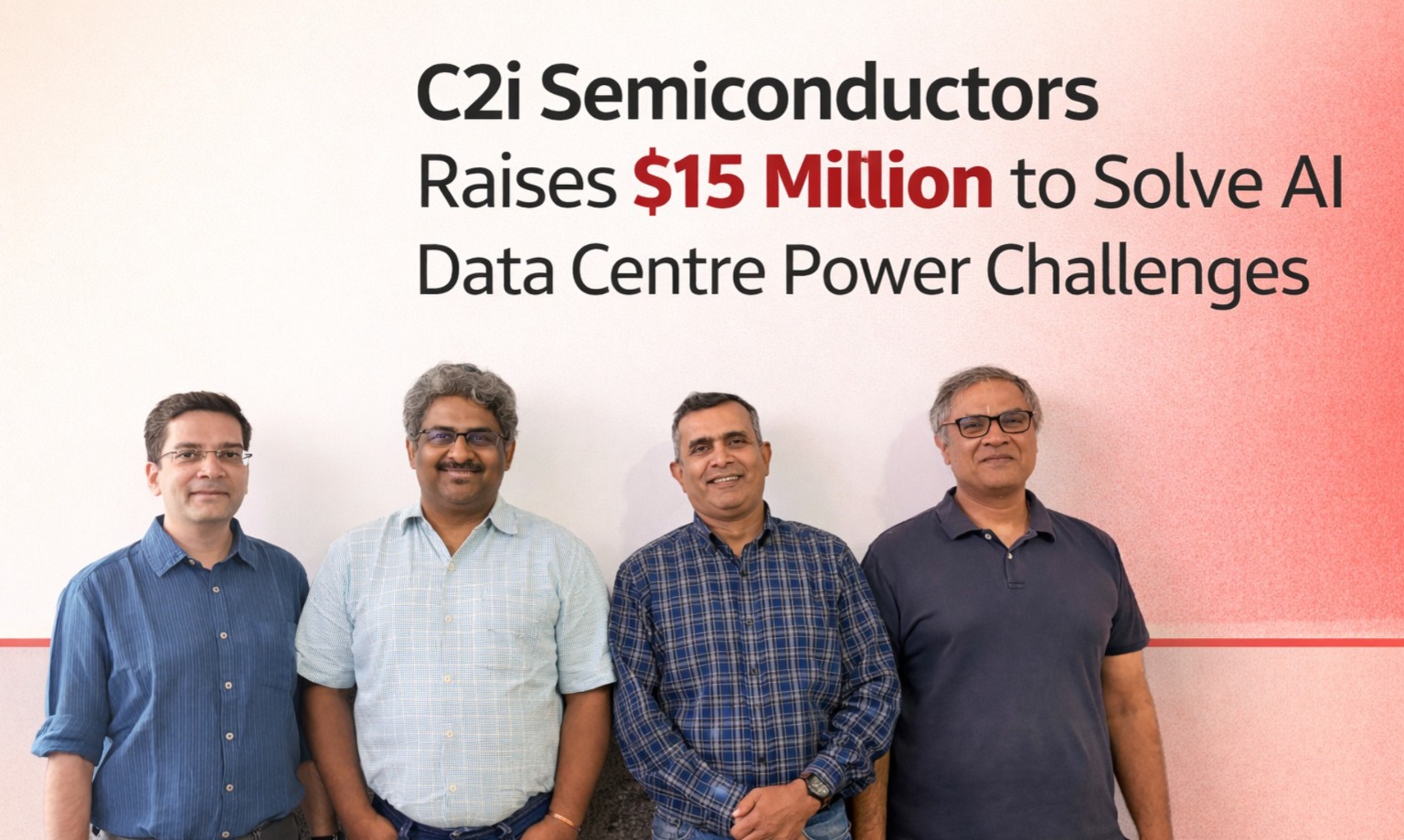
A Bengaluru startup C2i Semiconductors is placing its bet on a problem that’s becoming harder to ignore in the AI boom: power delivery.
C2i Semiconductors has raised $15 million in a Series A round led by Peak XV Partners, with participation from Yali Deeptech and TDK Ventures. The company says it is building power management solutions for AI data centres and cloud infrastructure, with a focus on system-level power delivery across computing platforms.
Why C2i is betting on power delivery
For AI infrastructure, the “headline” story is usually compute, GPUs, accelerators, faster interconnects. But C2i is going after the less glamorous constraint that can quietly cap scale: getting stable, efficient power to increasingly dense compute.
C2i argues that as AI workloads scale and compute density increases, power delivery is turning into a constraint. Its approach, the company says, is to develop configurable power architectures spanning from the grid to the core, aiming for higher power density, simpler system design, faster deployment, while still meeting the reliability requirements of large-scale AI infrastructure.
Ram Anant, C2i’s co-founder and CEO, framed the opportunity in the context of how AI is changing data-centre design, saying AI is “fundamentally reshaping how data centres are designed and built,” and that power delivery has emerged as one of the most critical constraints to scaling infrastructure.
Government support and the DLI link
C2i also pointed to government support as part of its journey so far. Anant acknowledged support from the Ministry of Electronics and Information Technology (MeitY) through the Design Linked Incentive (DLI) scheme, and said the financial assistance and access to advanced Electronic Design Automation (EDA) tools helped move product development forward.
In India’s semiconductor narrative, that detail matters. Funding is one piece; getting access to the right design tooling and support structures often determines whether a chip ambition becomes a shippable product.
What Peak XV and investors are saying
For Peak XV Partners, the pitch is straightforward: AI’s rapid build-out is pushing infrastructure toward new limits, and power is rising to the top of the bottleneck list.
“Power has become a major bottleneck in scaling AI. Addressing this challenge requires deep expertise across hardware and systems,” said Rajan Anandan, Managing Director at Peak XV Partners. He added that C2i’s approach to power management could extend the lifespan of graphics processing units and potentially generate billions of dollars in savings for the industry, positioning it as not just an efficiency play, but an economics play as well.
C2i’s co-founder and CTO Preetam Tadeparthy said the company aims to become a technology partner for computing infrastructure.
Who’s behind C2i Semiconductors?
C2i Semiconductors was founded in 2024 by Ram Anant, Vikram Gakhar, Preetam Tadeparthy, and Dattatreya Suryanarayana, with Harsha S B and Muthusubramanian N V listed as co-founders.
The round brings in a mix of venture and strategic participation, Peak XV Partners alongside Yali Deeptech and TDK Ventures, suggesting the company’s story is likely to be evaluated on real-world applicability in data centre and cloud deployments.
Why power is becoming a boardroom topic in AI
Even without getting into speculative numbers, the direction is clear: as AI compute stacks become denser, power delivery and reliability stop being “facility issues” and become core architecture decisions. C2i is building around that shift, treating power as a system-level design problem, not a last-mile component choice.
For data centre operators and cloud infrastructure builders, the appeal of solutions like this is simple: if power constraints can slow deployment or complicate system design, then improving the power architecture becomes a way to protect timelines, utilisation, and potentially hardware longevity, exactly the theme the investors are leaning on.
C2i hasn’t laid out a public roadmap in the material here, but its stated focus, configurable power architectures from grid to core, puts execution pressure on two fronts: proving reliability at scale and fitting into real procurement and deployment cycles in hyperscale-style environments.
If it can translate power innovation into simpler, faster deployments, it becomes easier to see why investors describe power as the next gating factor in AI infrastructure.
Also Read: Sam Altman Says India Can Become a Full-Stack AI Leader