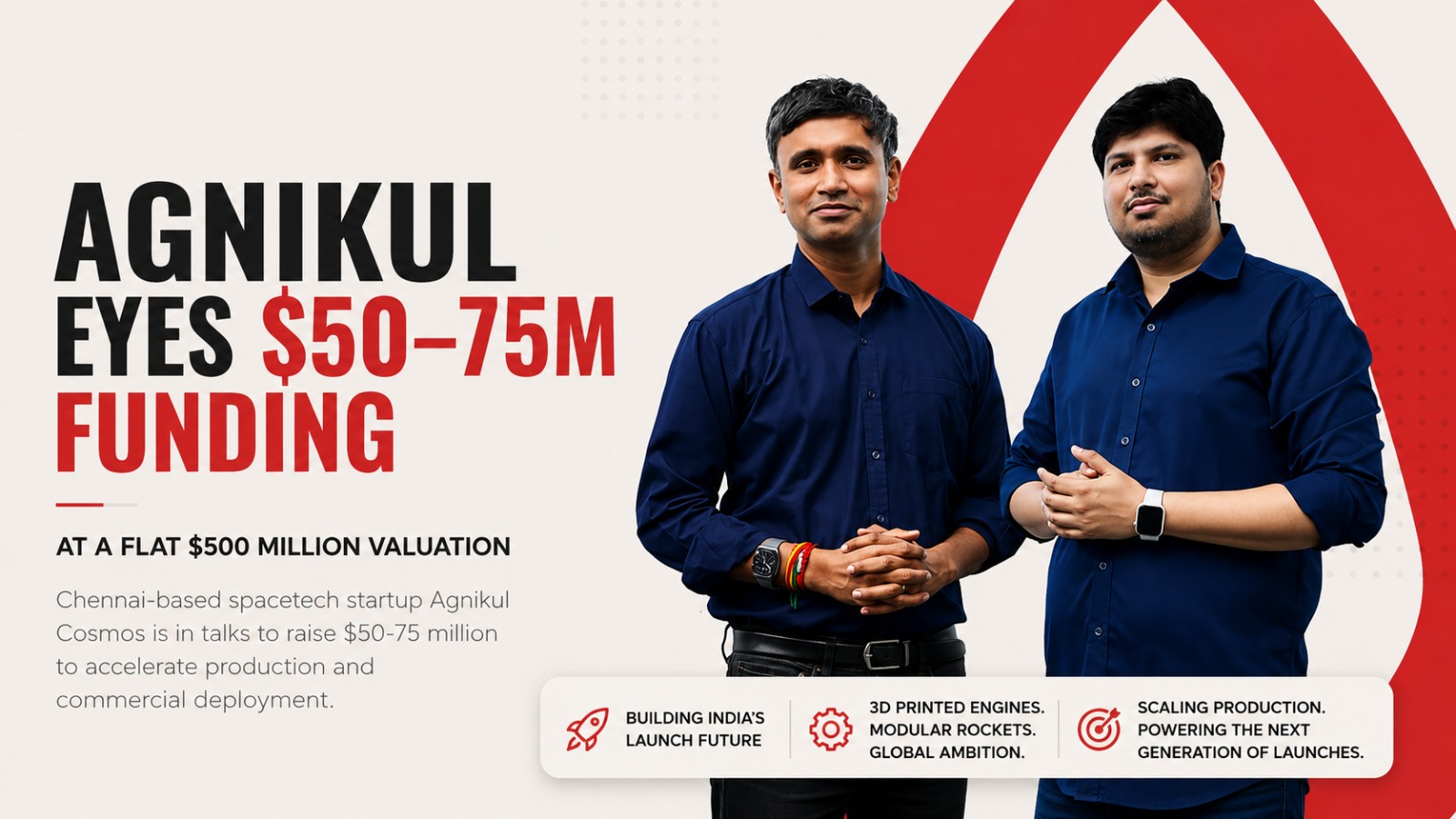
Chennai-based spacetech startup Agnikul Cosmos is in talks to raise $50 million to $75 million at a valuation of around $500 million, signalling continued investor interest in India’s private space sector as companies move from engineering milestones to commercial deployment.
The proposed raise is expected to happen at nearly the same valuation at which Agnikul raised $17 million in November from investors including HDFC Bank and 100X.VC. The discussions are still at an early stage, with the company reportedly exploring participation from growth-stage investor Avataar Ventures as well as existing shareholders.
Founded by Moin SPM and Srinath Ravichandran, Agnikul has become one of India’s closely watched launch vehicle startups. The company is working on modular rockets powered by fully 3D-printed engines and is targeting payloads of up to 300 kg. Its larger ambition is to serve the small satellite launch market with flexible launch systems, including mobile launchpads that can support launches from multiple locations.
The fresh capital, if closed, is expected to be used for expanding production capabilities. That is important because India’s private space companies are now entering a more demanding phase. The early story was about proving technology. The next phase will be about manufacturing readiness, reliability, customer commitments and repeated launches.
Investor appetite for Indian spacetech has grown sharply. Private funding into the sector more than doubled in 2025 to $196 million across 55 deals, according to Tracxn data cited in the report. In 2026, the sector has already crossed the $100 million mark, helped by Skyroot Aerospace becoming India’s first private spacetech unicorn.
Agnikul’s funding discussions come soon after Skyroot’s unicorn round, underlining how quickly the market is maturing. Both companies are building for satellite launches, but their technology paths are different. Skyroot’s Vikram-1 uses solid-fuel propulsion for its primary stages, while Agnikul is developing semi-cryogenic engines using liquid oxygen and kerosene. The latter is considered more efficient but also more complex to develop and operationalise.
That complexity is also why investors are looking closely at launch vehicle specifications, payload capacity and technology readiness before writing large cheques. For Agnikul, the opportunity is big, but the execution bar is equally high.
The broader signal is clear: India’s spacetech story is no longer only about policy liberalisation or engineering promise. It is now entering the capital-intensive phase where startups must prove they can convert technology into dependable launch businesses.
Also Read: Vaibhav Suryavanshi’s Rise Is Bigger Than a Net-Worth Number